Problem Statement
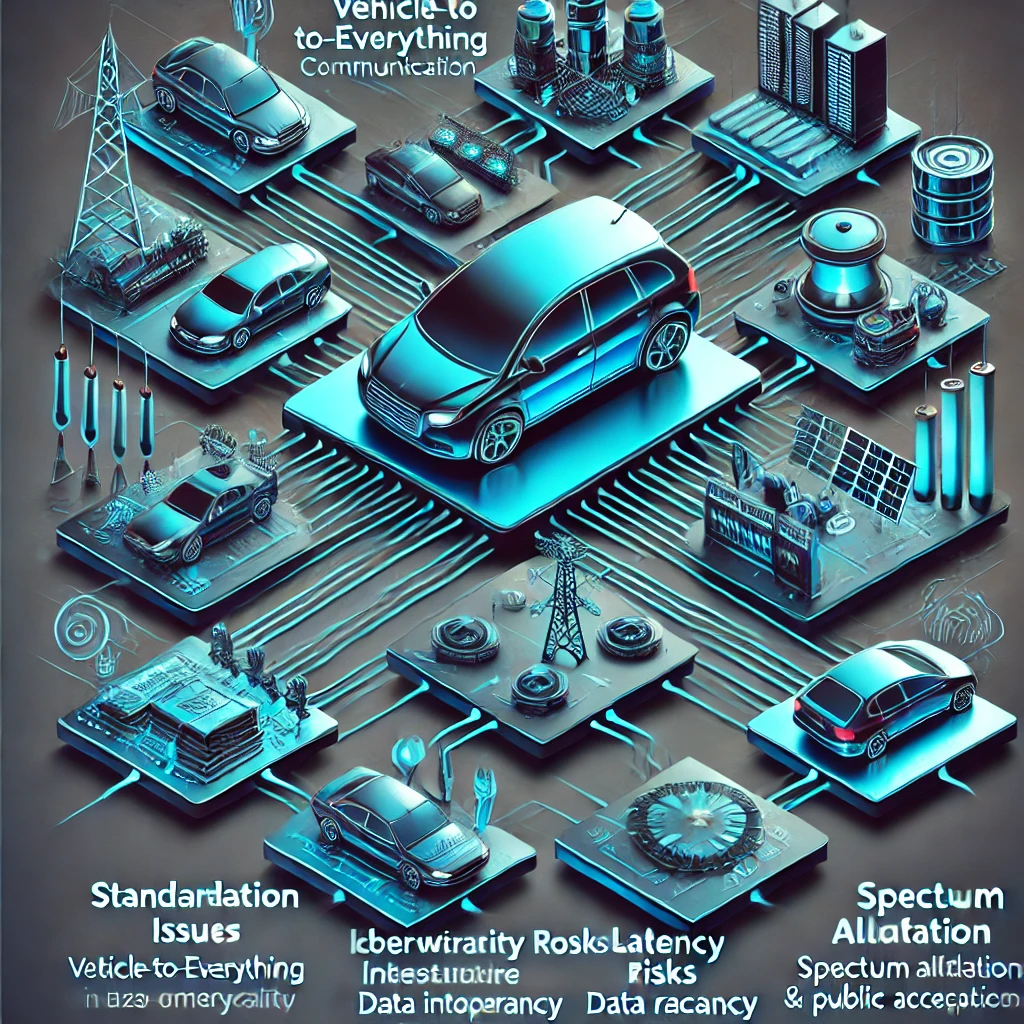
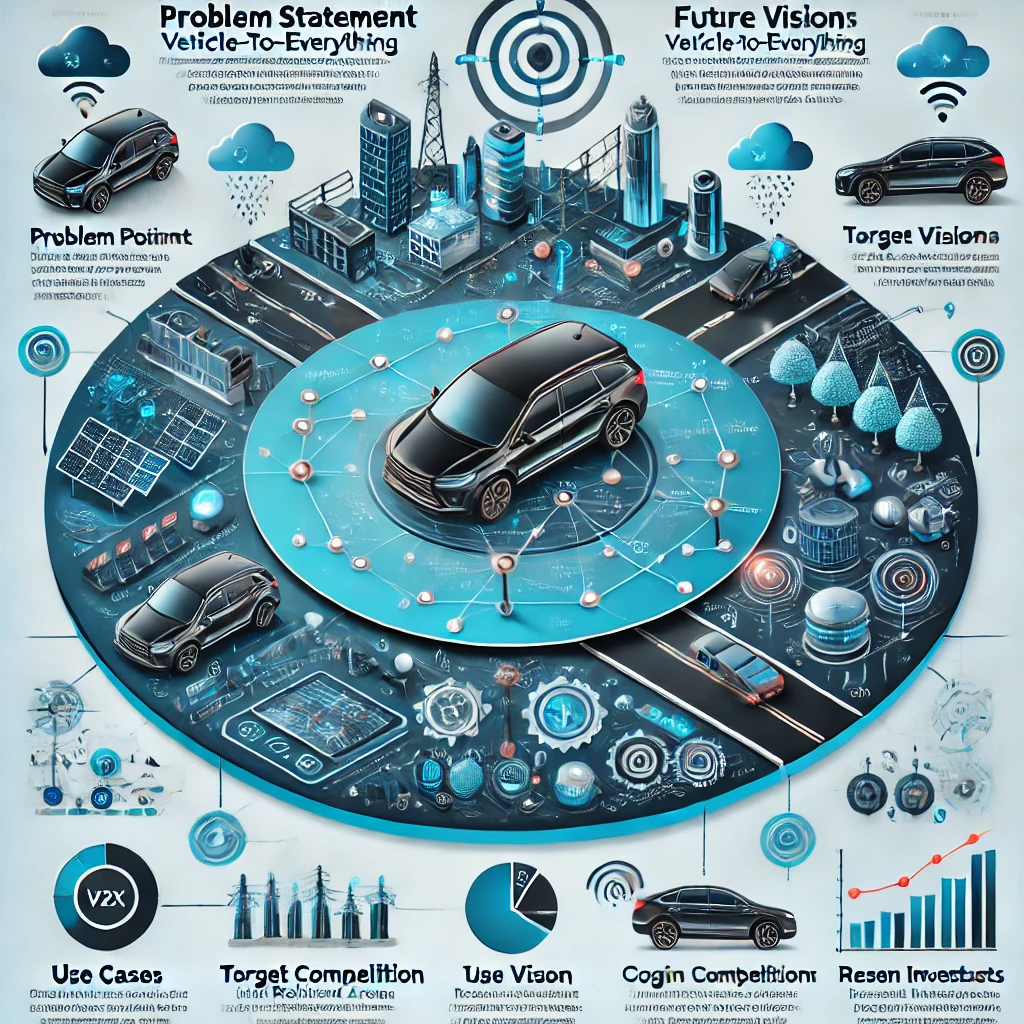
Vehicle-to-Everything (V2X) communication allows vehicles to interact with each other and infrastructure, significantly improving safety and traffic management. However, this technology faces several challenges, including standardization, cybersecurity risks, and high infrastructure costs. Ensuring seamless and secure V2X communication is vital for the future development and deployment of connected and autonomous vehicles.
Pain Points
- Standardization Issues: Lack of unified global standards for V2X communication.
- Cybersecurity Risks: Vulnerability to hacking and cyber-attacks.
- Infrastructure Costs: High costs associated with upgrading infrastructure.
- Interoperability: Ensuring different systems and devices work seamlessly together.
- Data Privacy: Concerns about the privacy of data transmitted between vehicles and infrastructure.
- Latency: Ensuring low latency for real-time communication.
- Reliability: Maintaining consistent and reliable communication in various environments.
- Spectrum Allocation: Limited availability of radio frequency spectrum for V2X communication.
- Scalability: Scaling V2X solutions to accommodate large numbers of vehicles.
- Public Acceptance: Gaining public trust and acceptance for V2X technology.
Future Vision
The future vision for V2X communication involves creating a robust, secure, and standardized ecosystem that supports the seamless interaction between vehicles and infrastructure. Advances in 5G technology and the development of global standards will be critical in achieving low-latency, high-reliability communication. Cybersecurity measures will be strengthened to protect against threats, and infrastructure investments will focus on scalability and interoperability. Collaboration between governments, industry players, and technology providers will be essential to ensure the successful deployment and adoption of V2X communication, ultimately enhancing road safety and traffic efficiency.
Use Cases
- Collision Avoidance: Vehicles communicating to prevent accidents.
- Traffic Management: Real-time data sharing to optimize traffic flow.
- Emergency Vehicle Priority: Enabling emergency vehicles to navigate traffic more efficiently.
- Autonomous Driving: Enhancing the capabilities of self-driving cars through real-time communication.
- Smart Intersections: Traffic lights and signals adapting to real-time traffic conditions.
- Platooning: Coordinated driving of vehicles in close proximity to reduce fuel consumption.
- Pedestrian Safety: Alerting vehicles of pedestrians in crosswalks.
- Road Hazard Warning: Vehicles communicating potential hazards to each other.
- Parking Assistance: Real-time updates on available parking spaces.
- Vehicle Diagnostics: Sharing vehicle health data for proactive maintenance.
Target Users and Stakeholders
User: Automotive Manufacturers, Technology Providers, and Urban Planners
Age Group: 30-60 years
Gender: All genders
Usage Pattern: Continuous use for development, deployment, and maintenance of V2X communication systems
Benefit: Enhances road safety, traffic management, and the capabilities of autonomous vehicles
Stakeholders
- Automotive Manufacturers: Integrating V2X technology into vehicles.
- Technology Providers: Developing V2X communication systems and infrastructure.
- Local Governments: Implementing and regulating V2X infrastructure.
- Consumers: Benefiting from improved road safety and traffic management.
- Cybersecurity Firms: Protecting V2X systems from cyber threats.
- Telecommunications Companies: Providing connectivity solutions for V2X communication.
- Urban Planners: Designing smart cities with integrated V2X infrastructure.
- Insurance Companies: Assessing risks and providing coverage for connected vehicles.
- Research Institutions: Conducting research on V2X technologies and their impact.
- Regulatory Bodies: Setting standards and regulations for V2X communication.
Key Competition
- Qualcomm: Leading provider of V2X communication solutions.
- Huawei: Developing advanced V2X technologies.
- NXP Semiconductors: Offering secure V2X communication solutions.
- Autotalks: Specializing in V2X chipset technology.
- Bosch: Integrating V2X communication into automotive systems.
Products/Services
- V2X Communication Modules: Hardware for enabling V2X communication in vehicles.
- Cybersecurity Solutions: Protecting V2X systems from cyber threats.
- 5G Connectivity: Providing the necessary bandwidth and low latency for V2X communication.
- Smart Infrastructure: Traffic lights, road signs, and other infrastructure equipped with V2X technology.
- Data Analytics Platforms: Analyzing data from V2X systems to improve traffic management.
Active Startups
- Savari: Developing V2X communication technologies.
- Cohda Wireless: Specializing in V2X software solutions.
- Commsignia: Providing V2X communication devices and software.
- Arada Systems: Focused on V2X communication technologies.
- Autotalks: Leading in V2X chipset technology.
- Neusoft Reach: Developing V2X solutions for smart transportation.
- DriveU.auto: Providing teleoperation systems for autonomous vehicles.
- Veniam: Creating V2X solutions for connected vehicles.
- Unex: Offering V2X communication modules and devices.
- Excelfore: Developing V2X and connected vehicle technologies.
Ongoing Work in Related Areas
- 5G Technology: Enhancing connectivity for V2X communication.
- Autonomous Vehicles: Integrating V2X to improve autonomous driving capabilities.
- Smart Cities: Implementing V2X infrastructure in urban areas.
- Cybersecurity: Developing robust security measures for V2X systems.
- Standardization: Creating global standards for V2X communication.
- Artificial Intelligence: Using AI for real-time data analysis and decision making.
- Internet of Things (IoT): Connecting vehicles and infrastructure through IoT.
- Sustainable Transportation: Using V2X to reduce emissions and improve efficiency.
- Traffic Management: Optimizing traffic flow with V2X communication.
- Vehicle-to-Pedestrian (V2P): Enhancing safety for pedestrians through V2X technology.
Recent Investment
- Qualcomm: Invested $500 million in developing 5G and V2X technologies in 2023.
- Huawei: Allocated $300 million for V2X research and development in 2022.
- NXP Semiconductors: Committed $200 million to enhance V2X security in 2023.
- Autotalks: Raised $150 million in funding for V2X chipset development in 2023.
- Bosch: Invested $400 million in integrating V2X into automotive systems in 2022.
Market Maturity
The V2X communication market is rapidly maturing, driven by advancements in 5G technology, increasing investments, and the need for enhanced road safety and traffic management. The development of global standards and robust cybersecurity measures is crucial for the widespread adoption of V2X technology. Collaboration between industry players, governments, and technology providers is essential to create a seamless and secure V2X ecosystem.
Summary
Vehicle-to-Everything (V2X) communication represents a critical advancement in the automotive industry, enabling vehicles to interact with each other and the surrounding infrastructure. This technology promises significant improvements in road safety and traffic management. However, the challenges of standardization, cybersecurity, and infrastructure costs must be addressed to ensure the successful deployment of V2X systems.
Key pain points include the lack of global standards, cybersecurity risks, high infrastructure costs, and the need for interoperability. Leading companies like Qualcomm, Huawei, and NXP Semiconductors are at the forefront of developing V2X solutions, while startups such as Savari and Cohda Wireless are driving innovation in this space.
The future vision for V2X communication involves the integration of advanced technologies, such as 5G and AI, to create a robust and secure ecosystem. Investments in infrastructure and cybersecurity are essential to support the scalability and reliability of V2X systems. Collaborative efforts between governments, industry players, and technology providers will ensure the successful adoption of V2X communication, ultimately enhancing road safety and traffic efficiency.
The market for V2X communication is maturing rapidly, with significant investments and ongoing research driving its growth. Companies are focusing on developing secure, scalable, and standardized solutions to meet the demands of connected and autonomous vehicles.