
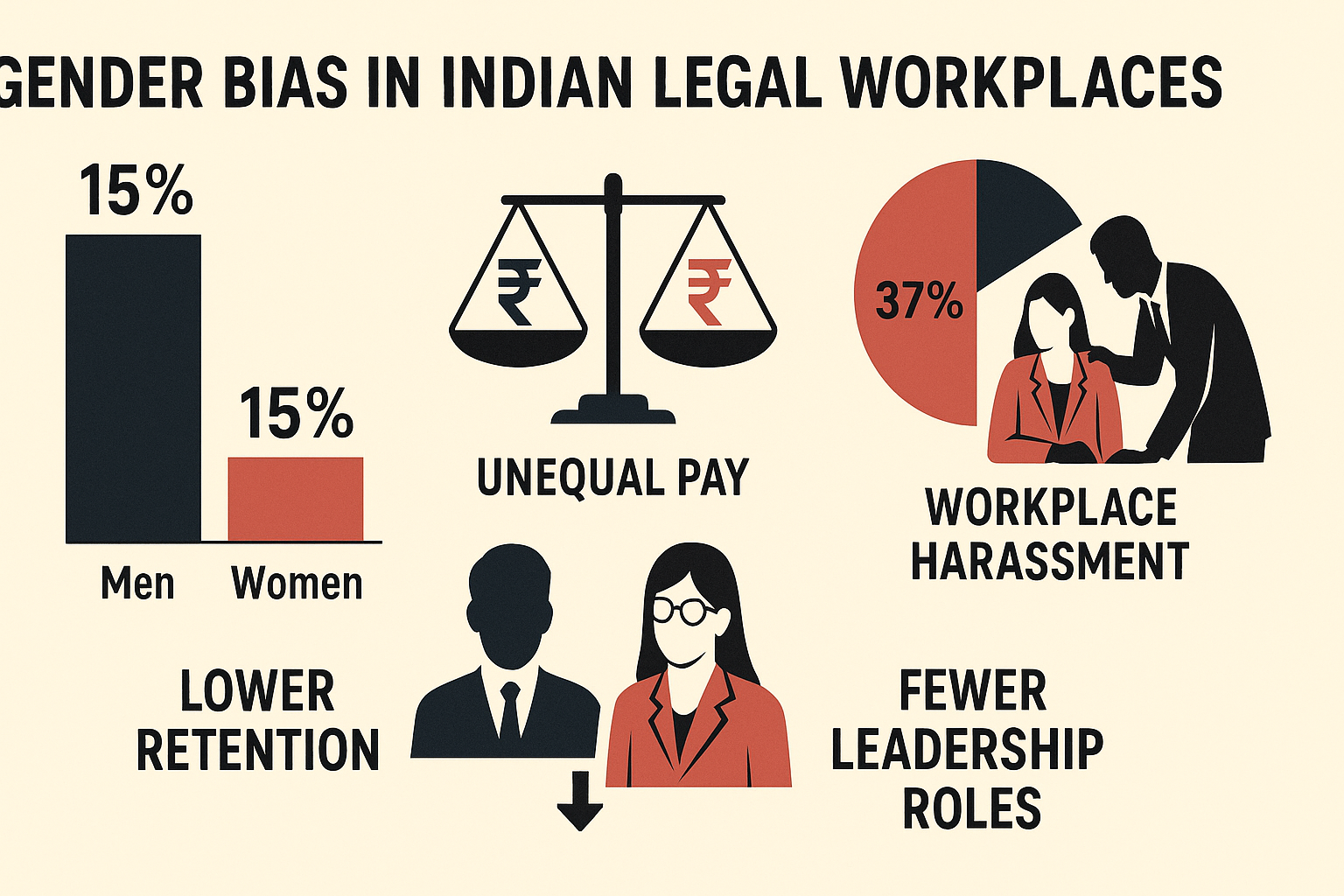
Despite significant progress in female enrollment in law schools and entry into the legal profession, Indian legal workplaces remain deeply gender-biased. The legal sector, long dominated by patriarchal norms, often sidelines women lawyers when it comes to leadership, recognition, and equal opportunity. Institutional sexism manifests in unequal pay for equal work, lack of promotions to senior positions such as partners or judges, and pervasive workplace harassment. These conditions create a hostile environment that leads to attrition, self-censorship, and career stagnation among talented women professionals.
This gender disparity is not just a matter of representation but speaks to systemic issues within law firms, courts, and legal departments. Despite existing policies, enforcement is lax, and there is limited transparency and accountability. With India’s growing emphasis on justice reform and gender equality, the legal industry lags behind other professional sectors in addressing inclusivity. Addressing this challenge requires a robust, data-driven, and technology-enabled approach to identify, mitigate, and eliminate gender bias.
LexEquity aims to become the central platform enabling legal organizations to audit gender practices, support women professionals with tools and mentorship, and foster inclusive, transparent workplace cultures.
10 Pain Points
- Underrepresentation in Senior Roles: Women constitute only 13.76% of High Court judges, indicating a significant gap in leadership positions.
- Unequal Pay: Female lawyers often receive lower compensation compared to male counterparts, even with equivalent experience and workload.
- Workplace Harassment: Incidents of sexual harassment and a lack of supportive infrastructure contribute to a hostile work environment.
- Limited Networking Opportunities: Predominantly male professional circles hinder women’s access to mentorship and career advancement.
- Stereotyping and Bias: Women lawyers face stereotypes questioning their competence and authority, affecting client trust and case assignments.
- Inadequate Maternity Support: Lack of maternity leave policies and childcare facilities forces many women to exit the profession post-childbirth.
- Disparity in Legal Education to Practice Transition: Despite high enrollment in law schools, only 15% of practicing lawyers are women, indicating dropout during the transition.
- Bias in Client Assignments: Prejudices lead to women being assigned less challenging cases, limiting their exposure and growth.
- Lack of Institutional Support: Absence of policies promoting work-life balance and addressing gender-specific challenges.
- Attrition Due to Marriage and Relocation: Societal expectations and familial responsibilities compel many women to leave or shift from litigation to corporate roles.
Key Competitors
In addressing gender bias in Indian legal workplaces, several organizations and startups have emerged as key players:
- Samāna Centre for Gender, Policy and Law: A consultancy focusing on equality, diversity, equity, and inclusion, providing capacity-building services to promote gender equality in legal and policy frameworks.
- Women in Law and Litigation (WILL): An organization formed by women legal professionals to combat gender discrimination in the legal field, offering support and advocacy for women lawyers.
- Sama: A Bengaluru-based legal-tech startup aiming to improve the justice system in India, co-founded by Akshetha Ashok.
- LegitQuest: A legal tech startup offering generative AI solutions to lawyers, which received an investment of INR 4 Cr ($474K) from Info Edge in November 2024.
- SpotDraft: A prominent LegalTech company in India, providing contract automation solutions, and recognized among the top LegalTech startups in the country.
Major Offerings by Competitors
Key features provided by competitors in this space include:
- DEI Consulting: Services focused on diversity, equity, and inclusion to promote gender equality in legal workplaces.
- Legal Support Networks: Platforms offering support and advocacy for women in law.
- AI-Powered Legal Research: Tools that utilize artificial intelligence to streamline legal research processes.
- Contract Automation: Solutions that automate contract creation and management.
- Mentorship Programs: Initiatives connecting junior women lawyers with experienced mentors.
- Policy Advocacy: Efforts to influence policies promoting gender equality in the legal sector.
- Training and Capacity Building: Workshops and training sessions aimed at empowering women legal professionals.
- Networking Events: Events designed to facilitate connections among women in the legal field.
- Awareness Campaigns: Campaigns to raise awareness about gender bias in legal workplaces.
- Research and Publications: Studies and reports highlighting challenges and progress in gender equality within the legal profession.
Product Vision for LexEquity
In a legal industry entrenched in hierarchy and legacy, LexEquity emerges as a transformative platform dedicated to dismantling gender biases and fostering inclusivity in Indian legal workplaces. Our vision is to build a comprehensive, AI-driven LegalTech ecosystem that empowers women lawyers, drives systemic reforms, and enables legal institutions to adopt transparent, equitable practices.
LexEquity will function as both a B2B solution for law firms and institutions and a B2C empowerment platform for women legal professionals. For law firms, it will provide a gender audit dashboard, compliance tools, and policy templates to assess and improve internal DEI metrics. For women professionals, it will offer a suite of features—mentorship matching, grievance reporting, career analytics, and mental health resources—to ensure sustained career growth.
What sets LexEquity apart is its data-driven approach. It will use anonymized employment data, court participation records, and user feedback to generate sector-wide insights and benchmarks, helping institutions proactively resolve gender-based challenges. Our product envisions shaping a future where gender equality is the norm, not an exception, and where every talented woman in law receives the opportunity, recognition, and support she deserves.
10 Use Cases
- Gender Bias Audit Tool: Assess firms’ internal gender metrics using AI.
- Mentorship Marketplace: Connect junior and senior women lawyers.
- Pay Parity Analyzer: Analyze salary discrepancies across roles and firms.
- Secure Harassment Reporting Portal: Confidential redressal system.
- Legal Career Analytics Dashboard: Track user progress and compare benchmarks.
- Work-Life Balance Planner: Personalized productivity and wellness recommendations.
- Inclusive Hiring Toolkit: Bias-free JD generators and screening tools.
- Diversity Certification Engine: Issue equity ratings to law firms.
- Policy Generator: Ready-to-use DEI policy templates for HR.
- Community Forums and Networking Events: Peer-to-peer support and growth.
Summary
Despite the increasing participation of women in India’s legal sector, systemic gender bias remains a significant barrier to equality. Women often encounter challenges such as underrepresentation in leadership roles, unequal pay, and workplace harassment. These issues contribute to lower retention rates and hinder career progression for women in law.
Key pain points identified include a lack of mentorship opportunities, bias in performance evaluations, inadequate support for work-life balance, and limited access to high-profile cases. Additionally, cultural and societal pressures, insufficient maternity support, and a general lack of awareness about legal rights exacerbate the problem.
To address these challenges, the proposed solution, LexEquity, aims to create a comprehensive platform that empowers women legal professionals and promotes equitable practices within legal institutions. Features include a gender bias audit tool, mentorship marketplace, pay parity analyzer, secure harassment reporting portal, and resources for work-life balance.
The platform also offers tools for inclusive hiring, diversity certification, and policy generation to assist organizations in implementing and maintaining equitable practices. By leveraging data-driven insights and fostering a supportive community, LexEquity seeks to dismantle systemic barriers and create a more inclusive legal industry in India.
Through these initiatives, the goal is to ensure that every woman in the legal profession has equal opportunities for growth, leadership, and success, thereby strengthening the overall integrity and effectiveness of the legal system.