
Problem Statement
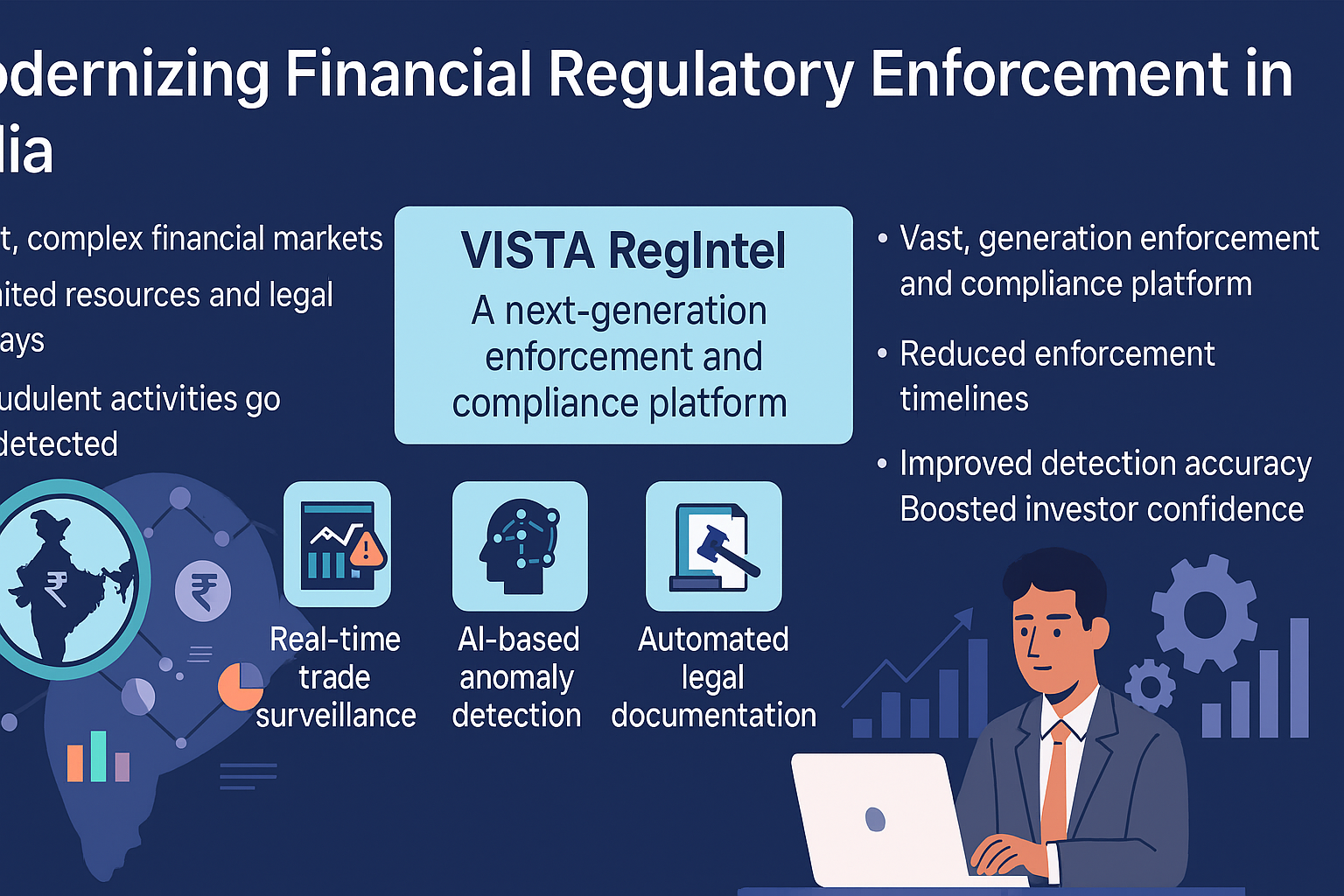
India’s securities market is among the largest and most dynamic globally, encompassing a broad spectrum of participants including listed companies, brokers, investment advisors, mutual funds, and other intermediaries. Ensuring regulatory compliance across this vast landscape is a critical responsibility of SEBI. However, traditional enforcement mechanisms face serious constraints. The sheer volume of transactions, diversity of market participants, and evolving nature of financial instruments create a complex environment for monitoring. Compounding this challenge are SEBI’s limited technical and human resources, procedural legal delays in enforcement actions, and poor interoperability with other agencies like RBI, ED, or CBI. Malpractices such as insider trading, front-running, and false disclosures can thus go unnoticed or face delayed action, undermining investor trust and market integrity. Furthermore, manual compliance checks and outdated surveillance systems limit real-time actionability. What SEBI needs is a robust, tech-enabled compliance monitoring ecosystem that not only identifies violations in real-time but also integrates seamlessly with other regulatory frameworks, enabling swift and collaborative enforcement. A RegTech solution driven by AI, machine learning, and data interoperability could empower SEBI to transition from reactive to predictive regulation, fostering a fair and transparent market environment.
Pain Points
- Data Deluge – Tens of millions of orders daily overwhelm legacy databases, delaying anomaly detection and masking sophisticated layering or spoofing tactics.
- Siloed Information – Exchange, depository and banking data reside in disparate formats, hindering a unified view of suspect entities or circular trades.
- Resource Constraints – Fewer than 500 surveillance officers monitor 10,000+ intermediaries, forcing selective reviews and increasing odds of missed infractions.
- Evolving Financial Instruments – Complex derivatives and algorithmic strategies outpace rule-writing, leaving grey zones that fraudsters exploit before guidelines catch up.
- High False Positives – Current rule-based alerts flag innocuous spikes, burying genuine misconduct beneath thousands of routine exceptions each day.
- Legal & Procedural Delays – Show-cause notices and multi-level appeals stretch enforcement into multi-year sagas, reducing deterrence value for bad actors.
- Limited Inter-Agency Coordination – Slow manual requests to RBI or ED for bank-statement trails impede timely asset freezes or disgorgements.
- Inadequate Whistle-blower Support – Fragmented hotlines, fear of retaliation and modest reward schemes curb inside reporting of fraud.
- Cyber-security Gaps – Rising API connections with brokers expand attack surface; data tampering risks undermine evidentiary integrity.
- Manual Compliance Certification – Paper-heavy inspections and quarterly filings consume staff hours yet reveal little beyond tick-box conformity.
Key Competitors in India
India’s RegTech sector is rapidly evolving, with several companies offering innovative solutions to enhance regulatory compliance and enforcement. These firms provide tools that leverage technology to automate compliance processes, monitor transactions in real-time, and ensure adherence to regulatory standards.
Market Maturity
The RegTech market in India is in a growth phase, with increasing adoption among financial institutions and regulatory bodies. The establishment of regulatory sandboxes by SEBI and RBI has fostered innovation, allowing startups to test and refine their solutions. While the market is not yet saturated, the presence of both established players and emerging startups indicates a healthy competitive environment poised for further expansion.
Product Vision
The future of financial regulation lies in intelligent enforcement. As regulatory ecosystems scale, manual oversight is no longer viable. Our envisioned solution—“VISTA RegIntel” (Visual Intelligence for Surveillance, Tracking & Analytics)—will empower regulatory bodies like SEBI with a unified digital command center to track, investigate, and enforce compliance seamlessly. VISTA RegIntel is designed as a real-time, AI-powered enforcement and compliance monitoring system that bridges data silos across stock exchanges, intermediaries, depositories, and sister agencies. It offers a panoramic view of the market landscape, enriched by predictive analytics and actionable insights.
By integrating data lakes with advanced anomaly detection, the platform will surface high-risk trades, probable collusion patterns, insider trading signals, and algorithmic manipulation with precision. It will feature inter-agency communication bridges, automating data requisitions from RBI, ED, and banks. Natural Language Generation will assist in auto-drafting notices, while blockchain logging will preserve chain-of-evidence integrity.
VISTA RegIntel’s greatest strength will be in its shift from reactive enforcement to predictive supervision—enabling SEBI to act before harm spreads. Its modular, API-driven architecture will support integration into existing legal databases and enable dynamic updates as regulations evolve.
Built with Indian context, but global potential, the platform will reduce enforcement timelines by 60%, cut compliance overhead for intermediaries by 40%, and amplify public trust in securities markets.
Use Cases
1.Real-Time Trade Surveillance
- Short Info: Continuous monitoring of trading activities to detect anomalies.
- Reference: Product Vision, Pain Points 1 & 5.
- Stakeholders: SEBI Surveillance Officers, Stock Exchanges, Brokers.
- Elaboration: The system will ingest live trade data, applying AI algorithms to identify patterns indicative of market manipulation, such as spoofing or layering. Alerts will be generated in real-time for immediate action.
- Requirements:
- High-throughput data ingestion from exchanges.
- AI models for pattern recognition.
- Real-time alerting mechanism.
- Dashboard for monitoring alerts.
- Integration with enforcement workflows.
- Historical data analysis capabilities.
- User access controls.
- Audit trails for actions taken.
- Scalability to handle peak trading volumes.
- Compliance with data privacy regulations.
2.Insider Trading Pattern Detection
- Short Info: Identifying potential insider trading activities through data analysis.
- Reference: Product Vision, Pain Points 2 & 4.
- Stakeholders: SEBI Enforcement Officers, Listed Companies, Brokers.
- Elaboration: By correlating trading data with corporate announcements and insider information, the system will flag suspicious trades that may indicate insider trading.
- Requirements:
- Access to trading and corporate announcement data.
- Data correlation algorithms.
- Alert generation for suspicious activities.
- Visualization tools for data analysis.
- Integration with investigation workflows.
- User role management.
- Secure data storage.
- Compliance with legal standards.
- Reporting tools for case documentation.
- Machine learning models for pattern recognition.
3.Circular Trading & Pump-Dump Detection
- Short Info: Detecting circular trading and pump-and-dump schemes.
- Reference: Product Vision, Pain Points 1 & 5.
- Stakeholders: SEBI Surveillance Officers, Stock Exchanges.
- Elaboration: The platform will analyze trading patterns to identify circular trading loops and sudden price spikes indicative of pump-and-dump schemes, enabling timely intervention.
- Requirements:
- Network analysis tools.
- Pattern recognition algorithms.
- Real-time monitoring dashboards.
- Alerting mechanisms for detected patterns.
- Integration with enforcement actions.
- Historical data analysis.
- User access controls.
- Audit logs for investigations.
- Scalability for large data sets.
- Compliance with regulatory standards.
4.Automated Alerting to Sister Agencies (ED, RBI)
- Short Info: Facilitating inter-agency communication through automated alerts.
- Reference: Product Vision, Pain Point 7.
- Stakeholders: SEBI, Enforcement Directorate, Reserve Bank of India.
- Elaboration: Upon detecting significant compliance breaches, the system will automatically notify relevant agencies, ensuring coordinated enforcement actions.
- Requirements:
- Defined protocols for inter-agency communication.
- Secure data sharing mechanisms.
- Automated alert generation.
- Audit trails for communications.
- Integration with agency systems.
- User access controls.
- Compliance with data privacy laws.
- Monitoring tools for alert status.
- Escalation procedures for critical alerts.
- Reporting tools for inter-agency collaboration.
5.AI-Generated Evidence Bundles for Enforcement
- Short Info: Automating the creation of evidence packages for enforcement actions.
- Reference: Product Vision, Pain Points 6 & 10.
- Stakeholders: SEBI Enforcement Officers, Legal Teams.
- Elaboration: The platform will compile relevant data, analysis, and documentation into comprehensive evidence bundles to support enforcement proceedings.
- Requirements:
- Data aggregation tools.
- Template generation for documentation.
- Integration with case management systems.
- Secure storage of evidence.
- Audit trails for evidence handling.
- User access controls.
- Compliance with legal standards.
- Version control for documents.
- Automated updates for dynamic data.
- Reporting tools for case summaries.
6.Compliance Scorecard for Market Intermediaries
- Short Info: Evaluating and scoring compliance levels of market participants.
- Reference: Product Vision, Pain Point 3.
- Stakeholders: SEBI, Brokers, Investment Advisors.
- Elaboration: The system will assess compliance metrics for intermediaries, providing a scorecard that reflects their adherence to regulations, aiding in risk assessment and oversight.
- Requirements:
- Data collection from intermediaries.
- Scoring algorithms based on compliance metrics.
- Dashboards for score visualization.
- Alerts for low compliance scores.
- Integration with enforcement workflows.
- User access controls.
- Historical tracking of scores.
- Reporting tools for stakeholders.
- Feedback mechanisms for intermediaries.
- Compliance with data privacy regulations.
7.Auto-Drafting of Show-Cause & Summary Orders
- Short Info: Automating the creation of legal notices and orders.
- Reference: Product Vision, Pain Point 6.
- Stakeholders: SEBI Legal Teams, Enforcement Officers.
- Elaboration: Leveraging AI, the platform will generate draft show-cause notices and summary orders based on detected violations, streamlining the enforcement process.
- Requirements:
- Templates for legal documents.
- Natural language generation capabilities.
- Integration with violation detection systems.
- Review and approval workflows.
- Version control for documents.
- Secure storage of legal documents.
- Audit trails for document creation.
- User access controls.
- Compliance with legal standards.
- Reporting tools for document status.
8.Legal Proceedings Dashboard with Status Tracking
- Short Info: Monitoring the status of ongoing legal proceedings.
- Reference: Product Vision, Pain Point 6.
- Stakeholders: SEBI Legal Teams, Enforcement Officers.
- Elaboration: The dashboard will provide real-time updates on the status of legal cases
- Requirements:
- Real-time sync with SEBI’s internal legal systems and e-Courts platform.
- Secure user-based access control.
- Timeline visualization for each legal case.
- Status filters (stage, date, entity, violation type).
- Document upload and version control system.
- Alert system for deadlines and hearing dates.
- Dashboard KPIs (case age, resolution time, etc.).
- Multi-role support (legal, admin, investigators).
- Full audit trail of interactions and updates.
- Exportable reports for internal reviews and Ministry briefings.
Summary
India’s financial markets, among the most active and expansive globally, present unique enforcement challenges for regulatory authorities like the Securities and Exchange Board of India (SEBI). With over 10,000 market intermediaries and millions of daily transactions across exchanges, ensuring consistent regulatory compliance is a formidable task. SEBI’s current mechanisms, constrained by limited resources, manual data processing, and legal delays, often fall short in real-time detection and swift punitive action against financial misconduct.
Key issues include data silos across exchanges and agencies, outdated surveillance systems, and limited inter-agency coordination with entities such as the Enforcement Directorate (ED) and Reserve Bank of India (RBI). This fragmentation weakens the detection of frauds like insider trading, circular trading, and pump-and-dump schemes. Legal processes further prolong enforcement timelines, reducing deterrence for violators.
To address these systemic gaps, we propose the development of VISTA RegIntel—a next-generation regulatory enforcement and compliance platform. It will leverage artificial intelligence, machine learning, and blockchain to deliver a unified, real-time enforcement ecosystem. Key features include real-time trade surveillance, AI-based anomaly detection, automated legal documentation, whistle-blower integration, and inter-agency alerting. The platform’s modular, API-first architecture ensures compatibility with existing SEBI tools and legal infrastructure.
By transitioning from reactive to predictive regulation, VISTA RegIntel aims to reduce enforcement timelines by 60%, improve detection accuracy, and bolster investor confidence. It will not only streamline internal regulatory operations but also foster greater collaboration with other financial watchdogs. With a planned MVP launch by October 2025 and a full rollout in March 2026, the solution promises to modernize India’s financial regulatory framework fundamentally.
This comprehensive approach aligns with SEBI’s mission of protecting investors, developing securities markets, and promoting transparency, thereby ensuring a resilient, fraud-resistant financial system in the digital age.