
Problem Statement
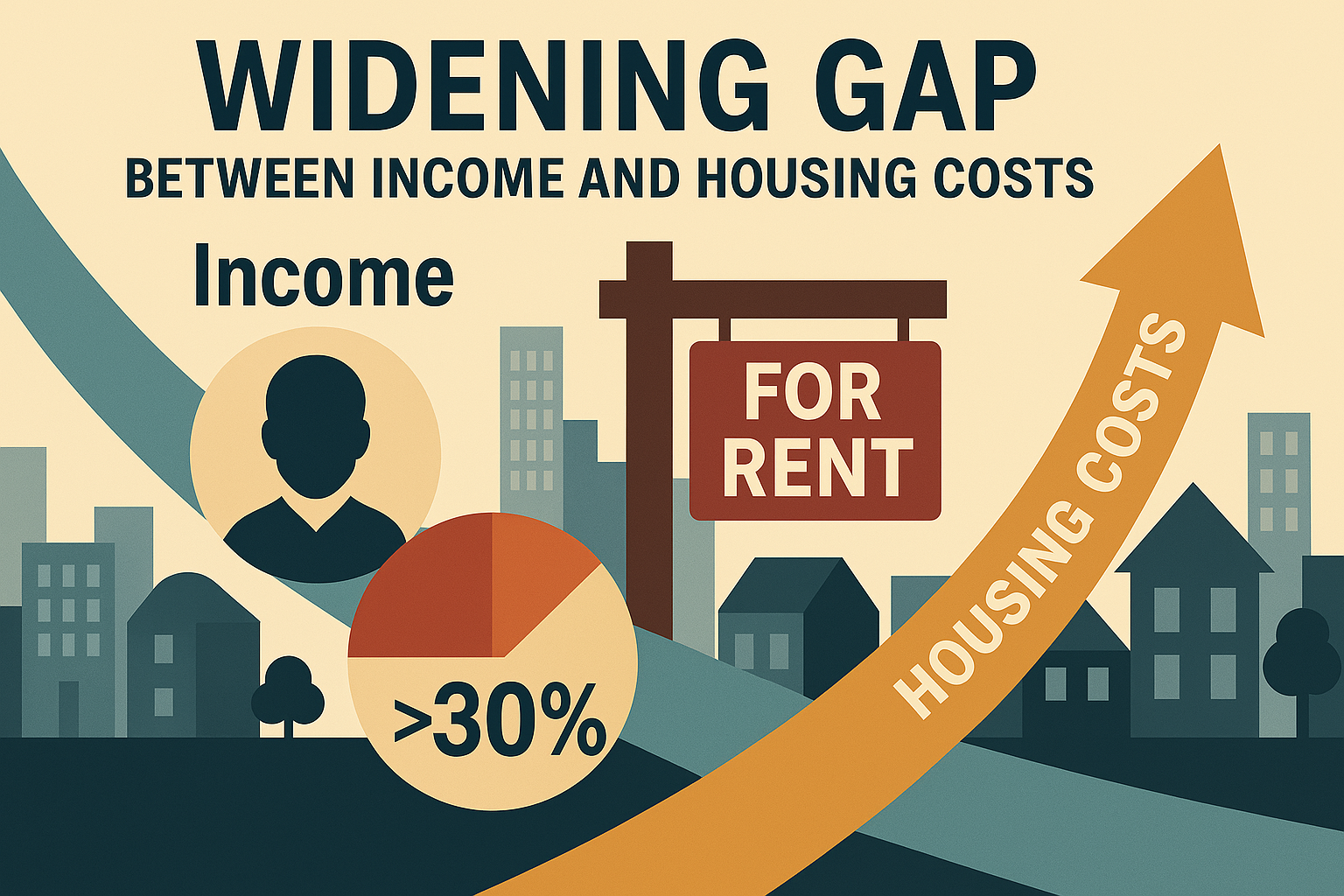
Over the past decade, the disparity between income levels and housing costs has grown significantly across urban and suburban areas. While wages have stagnated or grown only marginally, housing costs—particularly rental prices—have surged due to increased demand, speculative investments, and insufficient housing supply. As a result, millions of individuals and families, particularly in low-to-middle income brackets, now allocate a disproportionate share of their income to rent. This often exceeds the recommended threshold of 30% of household income, pushing them into financial instability.
This growing gap fosters widespread housing insecurity, where renters live paycheck-to-paycheck, unable to save for emergencies or future investments. Families face frequent relocations due to rent hikes, negatively impacting children’s education, mental health, and community ties. The problem is most acute in cities with rapid urbanization and limited rent control measures, but it increasingly affects even second-tier cities.
Current affordable housing programs are often limited, have long waitlists, or do not reflect real-time needs. There’s a pressing need for innovative, data-driven, and scalable solutions that empower renters with transparency, affordability, and financial predictability in housing.
Pain Points
- Rent-to-Income Imbalance
Many renters spend over 40% of income on rent, exceeding affordable housing guidelines, leading to budgeting stress and no financial buffer. - Lack of Affordable Housing Supply
Cities face a shortage of homes priced within low/mid-income ranges, forcing families to compromise on safety, size, or location. - Rent Volatility
Unpredictable, steep rent hikes with little notice create instability, sometimes forcing families into sudden, disruptive moves. - Credit-Based Discrimination
Renters with average credit scores struggle to secure decent housing despite regular incomes, widening the accessibility gap. - Insufficient Rental Support Tools
There’s a lack of tools that help renters plan, budget, or negotiate for rent affordability or provide financial aid navigation. - Ineffective Government Subsidy Access
Housing vouchers and rent subsidies are hard to apply for, have long wait times, and often fail to match the market rates. - No Transparency in Pricing or Value
Renters often lack clarity on why prices are set a certain way, or how rent compares across similar properties in an area. - Weak Tenant Rights Awareness
Renters often don’t know their rights around eviction, lease negotiation, or legal support—especially in non-rent-controlled areas. - Frequent Displacement & Moving Costs
Rising rents force frequent relocation, burdening renters with emotional and financial stress, especially those with families. - Stigma & Lack of Support for Shared Housing
Shared housing could help affordability but lacks structure, trust, and platforms that make co-living secure and desirable.
Key Competition
There are several companies and startups attempting to tackle the housing affordability crisis, but most focus on fragmented parts of the problem—none offer a complete, renter-first solution that ties affordability, education, support tools, and community living under one roof.
Key competitors
- Zillow – Offers rent price listings and affordability calculators but doesn’t address financial stress or provide proactive affordability support.
- Redfin – Similar to Zillow with better analytics but lacks tools specifically for low-income renters.
- PadSplit – Focused on affordable shared housing with verified listings and background checks.
- Roost – Helps renters save and earn financial incentives like rewards and credit building.
- Esusu – Provides rent reporting to credit bureaus and connects renters with financial aid resources.
Investment Summary
- Esusu raised $130 million in Series B funding in January 2022, led by SoftBank, highlighting growing interest in fintech-driven housing support.
- PadSplit secured $20.5 million Series B in September 2023 to expand affordable shared housing options.
- Zillow continues to invest in tech integrations and AI-driven affordability estimators with budgets exceeding $100 million yearly for R&D (2023 Annual Report).
- Redfin acquired RentPath for $608 million in 2021 to expand rental market data coverage.
Industry Innovations
- AI-based rent prediction models (Zillow, Redfin)
- Rent-to-income calculators with dynamic thresholds (Roost)
- Real-time rent payment assistance matching (Esusu)
- Automated housing voucher application bots (Non-profit pilot programs)
- Community-driven shared housing platforms (PadSplit)
- Gamified savings for housing (Fintech startups)
- Tenant credit-building tools via rent reporting (Esusu, RentTrack)
- Hyper-local affordability heatmaps (Zillow Labs)
- Rent insurance and eviction protection plans (Startup pilot models)
- Co-living verification and roommate matching platforms (Startup space)
Market Gaps
Despite these efforts, none of the current solutions integrate:
- Affordability insights + personalized financial tools + subsidy guidance + co-living options in a unified platform.
- Proactive, predictive rent stress alerts based on income/rent ratios.
- Localized legal rights education and rent negotiation support.
This leaves room for a renter-first, holistic affordability platform that bridges data, support, and shared living models in a modern and inclusive way.
Major Offerings by Competitors
followings are
- Rent listing aggregation
- Credit score impact tracking
- Rental history verification
- Affordability calculators
- Rent payment automation
- Financial literacy content
- Shared housing availability
- Rent reporting to credit bureaus
- Income verification tools
- AI-based neighborhood scoring
Product Vision
“HomeBase” is a smart, renter-first platform that makes housing affordability transparent, predictable, and achievable for everyone—especially the underserved. With rent prices rising and incomes lagging behind, renters today need more than listings—they need empowerment.
HomeBase does what no other tool does: it brings together AI-driven budgeting, dynamic affordability scoring, real-time financial insights, subsidy navigation, shared housing options, and personalized tenant support into one unified experience.
At its core is the Rent Affordability Engine, which monitors user income, spending, and rent contracts in real-time. It alerts renters when they’re approaching unhealthy housing cost burdens and recommends options—from alternative listings to local subsidies and co-living opportunities.
We also integrate tenant rights education, automated rent negotiation support, and verified roommate matching—all designed to reduce cost per person without sacrificing safety or dignity.
For financial institutions and housing providers, HomeBase offers secure, opt-in access to aggregated renter data—enabling better lending decisions, product design, and social impact reporting.
Our vision is simple but powerful: make housing affordability intelligent, transparent, and shared—because no one should have to choose between rent and everything else.
Use Cases
- Calculate personalized Rent Affordability Score
- Receive alerts before financial stress hits
- Access verified, affordable co-living options
- Match with compatible roommates based on lifestyle
- Apply for government housing assistance in one click
- Learn renter rights based on zip code
- Negotiate rent using AI-suggested messages
- Build credit by reporting rent payments
- Connect with local renters in community spaces
- Receive monthly financial health snapshots + budgeting tips
Summary
The widening gap between income and housing costs has placed immense pressure on renters across the globe, leading to widespread housing insecurity and financial instability. Existing housing solutions fail to address this crisis in a comprehensive, renter-first way. In response, we’ve developed the concept of HomeBase—a unified platform aimed at transforming how renters experience affordability.
Through deep user research and market analysis, we’ve identified key pain points: unpredictable rent hikes, limited co-living infrastructure, financial planning gaps, and poor access to rent support or tenant rights education. Competitors like Zillow, Esusu, and PadSplit tackle individual fragments of the problem, but none provide a holistic solution that unifies budgeting, housing navigation, credit-building, and shared living into a single platform.
HomeBase addresses this gap with a Rent Affordability Engine, dynamic co-living solutions, rights education, and AI-powered financial planning. It’s designed to help users make proactive decisions before reaching crisis points. Projected to launch in March 2026, the platform expects to generate up to $18M in revenue by year five through freemium tools, shared housing services, and institutional partnerships.
With empathy, innovation, and community at its core, HomeBase doesn’t just help renters survive—it empowers them to thrive.
Researched By Shubham Thange MSc CA Modern college Pune