
Problem Statement
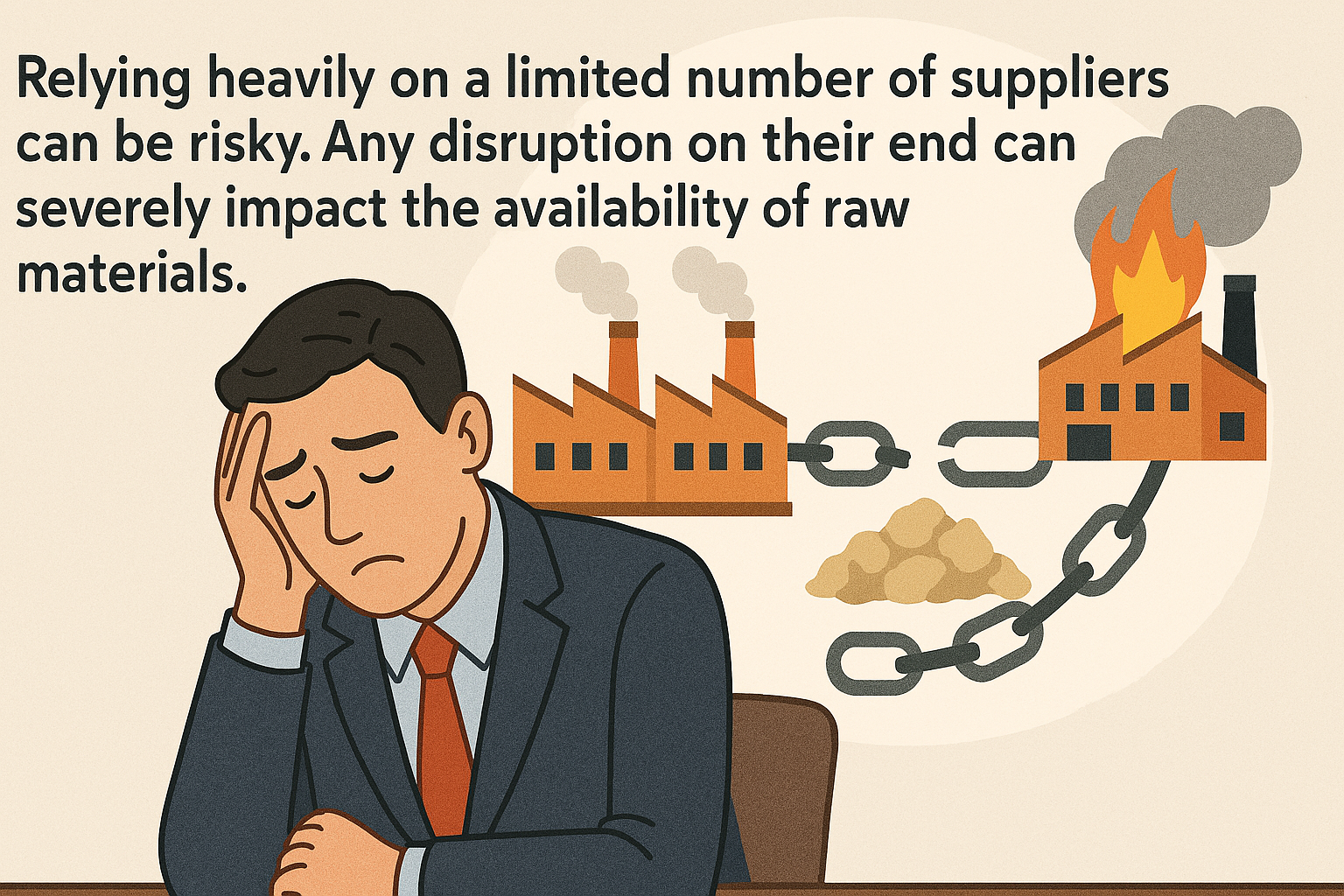
In today’s interconnected global supply chains, businesses often rely on a limited number of suppliers for critical raw materials. While this model can optimize procurement costs and streamline operations, it also introduces significant vulnerability. A disruption at any one supplier—whether due to political instability, natural disasters, labor strikes, or logistical failures—can cause cascading delays, halt production lines, and lead to severe financial losses. Additionally, over-reliance reduces negotiation power, limits flexibility in adapting to market demands, and stifles innovation.
This challenge is especially acute for industries with complex manufacturing processes or just-in-time (JIT) delivery models. In such environments, even a minor supply interruption can result in bottlenecks across the production pipeline. The issue is further compounded by limited visibility into supplier health, lack of real-time risk assessment tools, and poor contingency planning.
The need is for a smart, dynamic, and resilient supply chain solution that proactively identifies risks, diversifies supply options, monitors supplier performance in real-time, and provides data-driven decision-making tools to procurement teams.
Pain Points
- Supply Disruption Risks – Businesses face operational halts due to supplier-side disruptions, such as geopolitical issues, strikes, or natural disasters.
- Lack of Supplier Diversification – Companies often rely on too few suppliers, lacking agility in shifting sourcing strategies.
- Limited Visibility – Real-time information on supplier performance and external risk factors is often missing or outdated.
- Slow Response to Crisis – No proactive alerts or automated response mechanisms to handle supplier failures.
- Ineffective Risk Assessment – Current tools fail to quantify or predict risk based on multiple variables like location, history, and reliability.
- Cost Volatility – Sudden changes in raw material prices from suppliers can disrupt financial planning.
- Supplier Onboarding Delays – Identifying and integrating alternative suppliers takes weeks or months.
- Non-compliance Issues – Regulatory or sustainability compliance issues with suppliers can result in penalties or reputational damage.
- Manual Decision-Making – Lack of AI-driven tools to automate rerouting or purchasing decisions based on risk metrics.
- Poor Communication – Disconnected communication channels across procurement, logistics, and suppliers cause delays and misalignment.
Stakeholders with Roles
- Procurement Managers – Directly manage supplier relationships and ordering.
- Supply Chain Analysts – Monitor trends, forecast risk, and optimize procurement.
- COOs/Operations Heads – Responsible for ensuring manufacturing timelines and operations continuity.
- Finance Teams – Budgeting, cost optimization, and risk impact assessments.
- IT Teams – Integration with internal ERP and supply chain tools.
- Suppliers – Key actors in delivering raw materials.
- Customers – End consumers impacted by delays or product unavailability.
- Logistics Partners – Handle transportation and delivery of materials.
- Compliance Officers – Ensure regulatory obligations are met.
- Investors/Stakeholders – Concerned with business continuity and profitability.
Key Competitors
- Blue Yonder (formerly JDA Software): Specializes in digital supply chain and omni-channel commerce fulfillment. Their platform leverages AI and machine learning to provide predictive analytics for demand forecasting, inventory optimization, and logistics management.
- SAP Integrated Business Planning (IBP): Offers real-time supply chain analytics and planning solutions. SAP IBP integrates various planning processes, enabling businesses to align supply chain operations with corporate objectives and respond swiftly to changes.
- Oracle Supply Chain Management (SCM) Cloud: Provides a comprehensive suite of applications designed to optimize supply chain operations. Utilizing AI and machine learning, Oracle SCM Cloud delivers predictive insights and automates processes to improve efficiency and reduce costs.
- Llamasoft Supply Chain Guru: Focuses on supply chain modeling and optimization. Their platform enables businesses to create digital twins of their supply chains, facilitating scenario analysis and decision-making to enhance agility and resilience.
- Infor Nexus: A cloud-based platform emphasizing supply chain visibility and collaboration. Infor Nexus offers real-time tracking and advanced analytics, aiding businesses in managing complex supply chains effectively.
Market Gaps & Maturity
Limited Supplier Discovery – Tools for real-time discovery and vetting of new suppliers are not robust, especially for tier-2 and tier-3 suppliers.
Proactive vs Reactive – Most systems still respond after a disruption. Predictive analytics remains limited in precision and scale.
SME Accessibility – Most solutions are priced and designed for large enterprises, leaving small to mid-sized companies underserved.
Poor Data Integration – Real-time data feeds are often fragmented across ERP, CRM, logistics, and supplier systems.
Lack of Standardization – No universal standards for risk scoring or ESG compliance evaluation across platforms.
Overwhelming Complexity – Existing dashboards and tools are often too complex for non-technical supply chain teams.
Limited AI Usage – AI is more often used for alerts than for autonomous decision-making or smart rerouting.
Weak Collaboration Tools – Minimal features for cross-functional collaboration between procurement, logistics, and compliance teams.
Geo-political Risk Forecasting – Not many platforms accurately integrate real-time geopolitical threat analytics.
Supplier Sustainability Monitoring – ESG and carbon footprint data are poorly integrated into supplier evaluations.
Product Vision
ResiLink AI is an intelligent, resilient supply chain command center designed to preempt disruptions and enable agile procurement decisions. It’s a next-generation, AI-powered platform that brings clarity, predictability, and control to procurement professionals navigating increasingly uncertain global supply networks.
At its core, ResiLink AI offers real-time monitoring of supplier networks—spanning operational health, political risk, sustainability metrics, and logistics status. With embedded AI models, the platform doesn’t just alert users to potential disruptions; it recommends data-backed alternatives, automatically ranks supplier credibility, and helps decision-makers reroute or replace supply nodes instantly.
The platform’s supplier discovery engine acts like a matchmaker—based on compliance, cost, carbon footprint, and delivery reliability—reducing onboarding friction and giving companies strategic optionality.
ResiLink AI bridges data silos by integrating seamlessly with ERP, SCM, and logistics APIs. Whether you’re a Fortune 500 manufacturer or a growing hardware startup, the system adapts to your complexity with modular dashboards, smart alerts, and collaborative features. It democratizes risk management through flexible pricing and intuitive UX tailored to both enterprises and SMEs.
Use Cases
- Real-time supplier health monitoring with predictive risk scoring.
- AI-driven recommendations for alternate suppliers in seconds.
- Onboarding new suppliers with automated document verification and ESG scoring.
- Visual dashboard for geopolitical risk heatmaps by region.
- Integration with logistics partners to predict shipment delays.
- Compliance flagging and auto-reporting on global regulations.
- Inventory strategy recommendations based on supply risk projections.
- Supplier collaboration portal with chat, contract, and performance logs.
- AI-generated risk simulations and impact analysis reports.
- ESG footprint tracking for all suppliers in the network.
Summary
In an era where supply chains face continuous threats from geopolitical tensions, environmental factors, and supplier instability, ResiLink AI emerges as a transformative solution built to ensure resilience through predictive intelligence. The initiative began by identifying the core problem—overreliance on a limited supplier base and the catastrophic consequences of supplier disruptions. We explored the ecosystem deeply, recognizing that while the market has matured with tools like SAP Ariba and Everstream, significant gaps remain—especially in real-time risk prediction, SME accessibility, and intelligent supplier discovery.
Target users such as procurement heads and risk analysts often struggle with fragmented systems, reactive risk responses, and manual onboarding. ResiLink AI solves this by offering an AI-powered platform that not only scores supplier risks in real-time but also recommends alternatives, predicts shipment delays, evaluates ESG compliance, and provides geopolitical heatmaps for strategic decision-making.
Our product vision is grounded in building an agile, scalable, and intuitive solution that integrates seamlessly with existing ERPs and logistics platforms while maintaining affordability for mid-market players. With strong AI capabilities, a modular SaaS framework, and real-time data ingestion, ResiLink AI will redefine how organizations anticipate and manage disruptions.