Problem-Statement
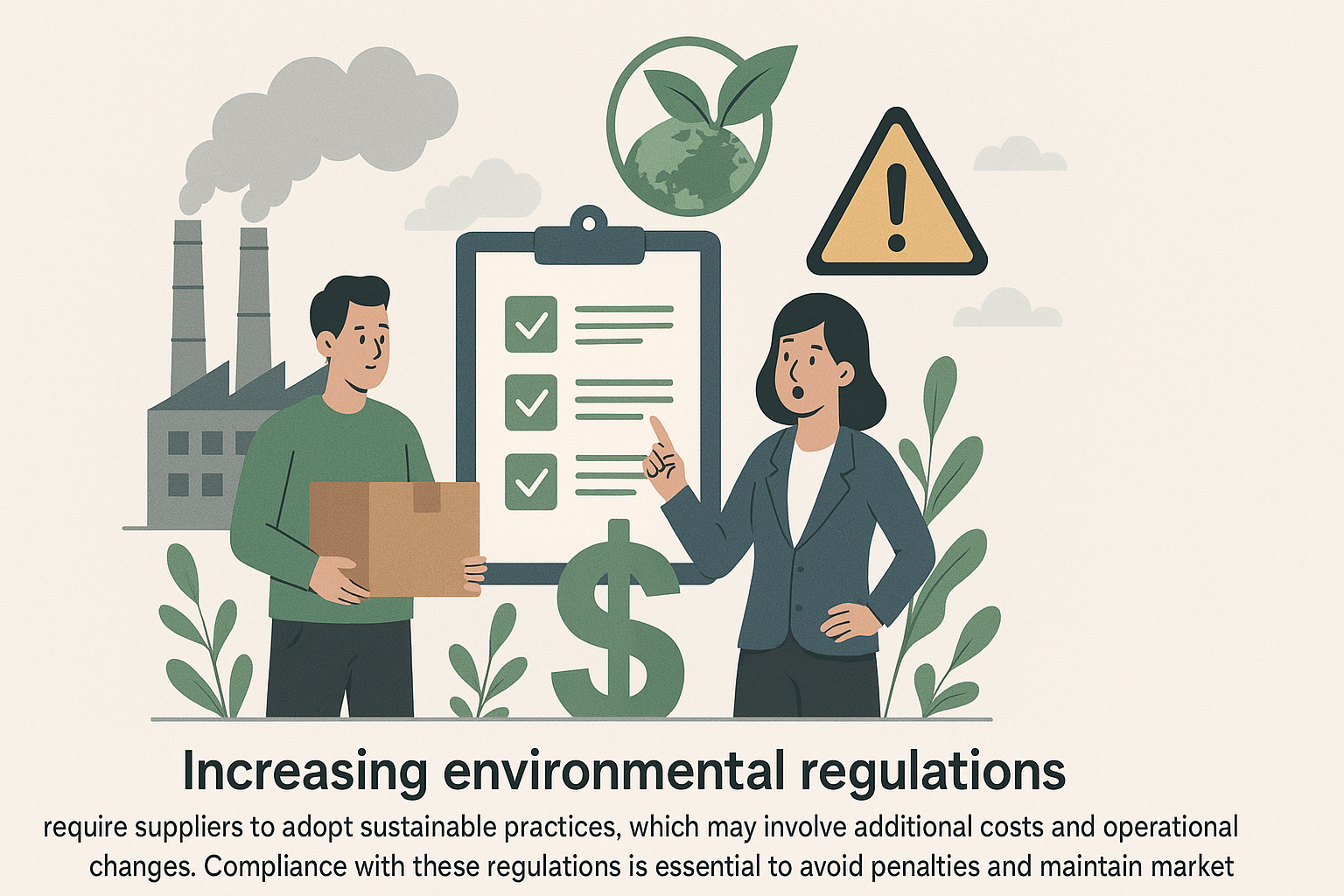
With the global emphasis on sustainability and climate responsibility, environmental regulations are becoming increasingly stringent across industries. Governments and regulatory bodies are enforcing policies that demand businesses—especially suppliers across the value chain—to integrate environmentally friendly and sustainable practices into their operations. These may include reducing carbon emissions, adopting circular economy models, waste reduction strategies, water conservation, and transitioning to green energy.
While the push for sustainability is essential, suppliers often face significant challenges in complying with these new mandates. These include high upfront costs of sustainable technologies, lack of knowledge or tools to measure compliance, operational disruptions during transitions, and complex, non-standardized reporting mechanisms. Non-compliance risks fines, loss of certifications, and reputational damage, impacting market access and customer trust.
This evolving landscape calls for a robust, scalable digital product that enables suppliers to easily navigate, implement, and manage compliance with environmental regulations, while also aligning with broader ESG (Environmental, Social, and Governance) goals. The product must provide real-time tracking, compliance reporting, regulatory intelligence, and cost-optimization tools to ease the adoption of sustainable practices without hindering business operations.
Pain Points
- Complex Regulatory Landscape: Regulations differ across countries, making it difficult to track, interpret, and implement compliance measures globally.
- High Cost of Implementation: Sustainable upgrades and processes often require heavy investments, impacting profitability.
- Data Collection Challenges: Suppliers lack systems to gather real-time, accurate data on emissions, waste, or energy use.
- Manual Compliance Reporting: Many still rely on spreadsheets, leading to errors, delays, and regulatory risk.
- Unclear ROI on Sustainability: Companies struggle to quantify returns on sustainability investments, making buy-in harder.
- Frequent Regulatory Changes: Constant updates in environmental laws require ongoing adaptation, which is resource-intensive.
- Lack of Skilled Personnel: There’s a shortage of experts who understand both operations and environmental compliance.
- Supply Chain Traceability: Difficult to track environmental compliance down the supplier tiers.
- Penalties & Reputation Risk: Non-compliance can lead to hefty fines and damage to brand image.
- Integration Issues: Difficulty in integrating sustainability tracking tools with existing ERP or supply chain systems.
Stakeholders & Their Roles
- Suppliers/Manufacturers: Primary users; responsible for adopting sustainable practices.
- Compliance Officers: Ensure operations align with environmental regulations.
- Sustainability Consultants: Advise on strategy and implementation.
- Regulatory Bodies: Monitor and enforce compliance.
- Customers/Brands: Require sustainable practices from suppliers for their own ESG goals.
- Investors/Shareholders: Interested in ESG metrics and compliance as part of due diligence.
- Tech/Operations Teams: Implement systems for data collection and reporting.
- Legal Teams: Assess regulatory risks and provide interpretations.
Innovations in the Industry
- AI/ML-driven ESG data engines for predictive compliance insights.
- Blockchain for traceable, tamper-proof supply chain sustainability records.
- IoT sensors for real-time emissions and resource usage monitoring.
- SaaS platforms that auto-update regulation databases based on geography.
- Integration of ESG modules within ERPs like SAP and Oracle.
- Low-code/no-code ESG dashboards for non-technical users.
- Lifecycle analysis (LCA) automation for products.
- Digital twins to simulate sustainable operations.
- Scope 3 emissions mapping with AI.
- ESG data rating marketplaces.
Market Maturity & Gaps
The sustainability compliance tech market is currently in a high-growth but unevenly mature state.
- Enterprise Segment: Highly mature. Large enterprises are already using advanced ESG tools like Sphera, Enablon, and Persefoni. They have budgets, consultants, and internal teams dedicated to sustainability.
- Mid-Market Segment: Moderately mature but underserved. Many mid-sized suppliers are aware of sustainability demands but lack the tools, budget, and staff to fully meet them.
- SME Segment: Emerging maturity. SMEs often treat compliance reactively, using spreadsheets or outsourced help, and are still learning the value of long-term sustainability strategy.
Despite growing interest and investment, several critical gaps remain in the current offerings:
- Affordability
Most ESG platforms are priced for large enterprises, putting them out of reach for mid-sized and small suppliers. - Regional Regulatory Intelligence
Regulations vary dramatically by region, and few platforms offer real-time updates localized to geography and language. - Ease of Use
Many tools are too complex for non-technical teams. There’s a need for intuitive, low-learning-curve solutions. - Plug-and-Play ERP Integration
Mid-sized companies often use legacy systems. Most ESG platforms lack pre-built connectors for these environments. - Supplier Traceability Tools
Brands want ESG insights on their entire supply chain, but tools for Tier 2/3 supplier visibility are still limited.
Product Vision
EcoComply Systems is the smart sustainability compliance platform purpose-built for mid-sized suppliers navigating the rising complexity of environmental regulations. Our mission is to democratize access to sustainability compliance by eliminating barriers of cost, complexity, and information opacity.
In a world where regulation changes monthly and environmental accountability is now a market requirement, EcoComply helps suppliers avoid fines, meet buyer expectations, and achieve ESG targets — all without hiring a team of consultants.
The product will offer an intuitive dashboard with real-time compliance scoring, tailored alerts for regional policy updates, automated document generation, emissions and resource tracking modules, and AI-powered recommendations to reduce environmental impact cost-effectively. For procurement teams, EcoComply provides supplier ESG validation and traceability to strengthen their own sustainability claims.
By integrating easily into legacy ERPs and using a modular SaaS pricing model, EcoComply ensures that suppliers, regardless of technical maturity or size, can take charge of their compliance journey. With a mission to keep global supply chains both compliant and green, EcoComply aims to become the go-to compliance partner for 50,000+ companies within five years.
Use Cases
- Track local regulation changes across 50+ countries.
- Automate sustainability report creation for ISO14001, CDP, and ESG audits.
- Calculate Scope 1, 2, and 3 emissions using internal + supplier data.
- Get real-time alerts on non-compliance risks by geography.
- Simulate ROI on proposed sustainable operational changes.
- Generate custom audit trails for specific regulations.
- Score suppliers on sustainability compliance before onboarding.
- Auto-fill regulatory forms with dynamic compliance data.
- Integrate with ERPs like SAP, Oracle, and MS Dynamics.
- Offer multi-language dashboards for global supplier teams.
Summary
As environmental regulations intensify globally, suppliers—especially mid-sized manufacturers—face rising pressure to comply with sustainability mandates. These laws require major operational shifts, investment in green tech, and accurate reporting to avoid fines and maintain partnerships. However, the current market of sustainability tech solutions heavily favors large enterprises, leaving a substantial gap for mid-market suppliers who lack the budget, tools, or teams to manage compliance effectively.
EcoComply Systems addresses this need by offering a streamlined, affordable, and intelligent compliance management platform tailored to suppliers. The product will automate regulatory tracking, sustainability reporting, emissions measurement, and ROI forecasting—empowering suppliers to meet ESG standards without overhauling their operations.
Our research highlights that while giants like Sphera and Enablon serve Fortune 500s, mid-sized firms struggle with high implementation costs, manual tracking, and regulatory complexity. With over $3.4B invested in ESG tech in 2023 alone, the market is mature but still fragmented—especially for small to mid-sized suppliers.
EcoComply’s strength lies in its simplicity and regionally-aware compliance engine. By integrating with existing systems and offering modular pricing, we unlock access for tens of thousands of suppliers globally.
The product is slated for public release in January 2026, aiming to support 50,000+ businesses by 2030. With powerful features like automated audit trails, real-time regulatory alerts, and multilingual dashboards, EcoComply positions itself as the go-to compliance partner for the next wave of sustainable supply chains.