
Problem Statement
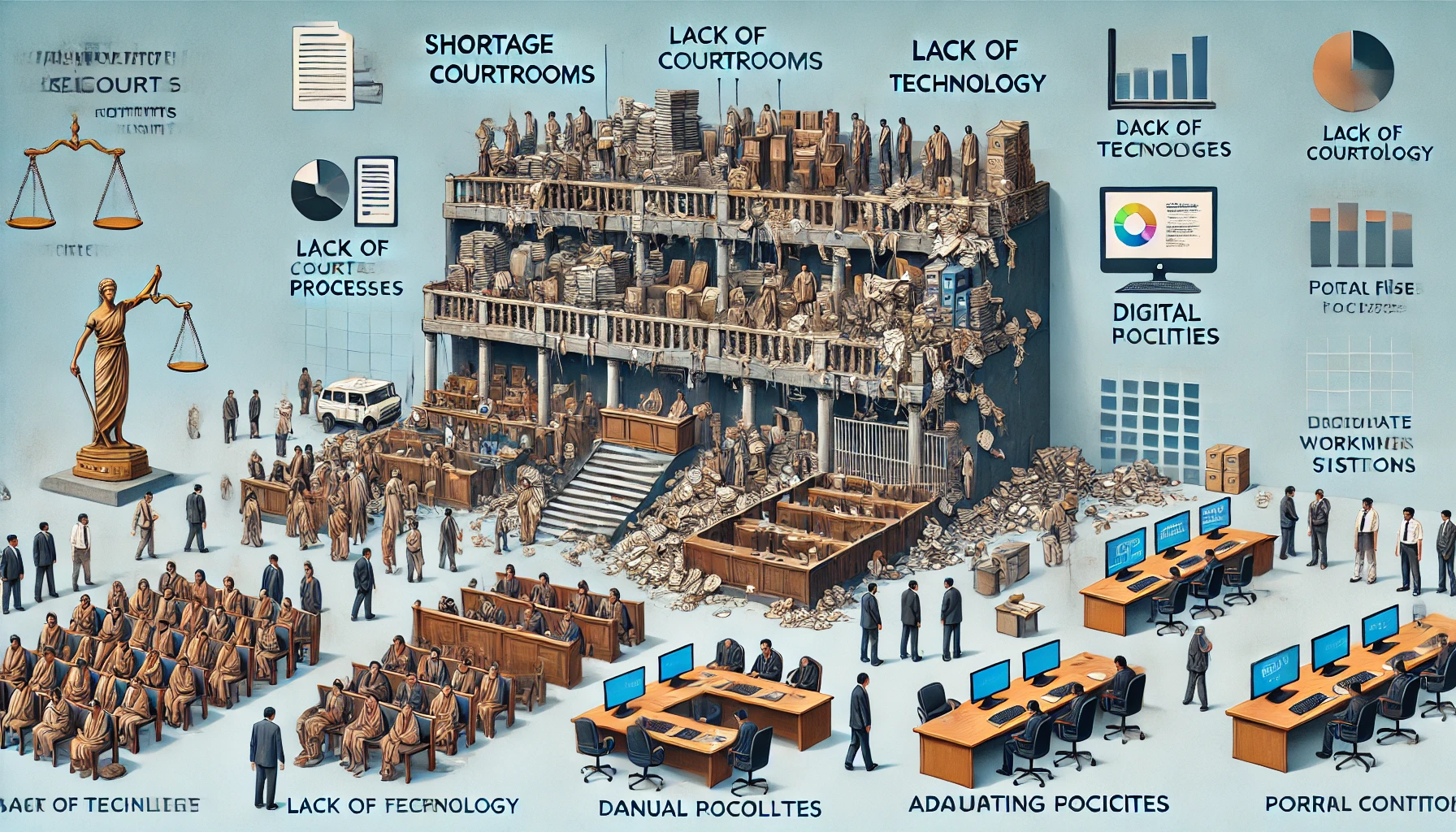
The Indian judicial system faces a significant infrastructure crisis, with numerous courts struggling to function effectively due to inadequate physical and technological resources. Many courts are either operating in dilapidated buildings or makeshift premises that do not meet the minimum requirements for a conducive legal environment. The shortage of courtrooms leads to scheduling delays, congestion, and inefficient case management. Moreover, the lack of digital infrastructure such as case management systems, video conferencing tools, and e-filing capabilities further compounds these issues, creating a backlog of cases and affecting timely justice delivery.
The working conditions for judges, lawyers, clerks, and other court staff are often subpar, lacking basic amenities like clean restrooms, waiting areas, and digital access. This not only affects their productivity but also morale and mental well-being. The absence of smart solutions and data-driven insights prevents proactive case scheduling, judicial analytics, or real-time monitoring of courtroom activities.
CiteTurn is tasked with reimagining this ecosystem by designing a product that addresses these challenges through a mix of digital and physical infrastructure improvements. The ultimate goal is to enhance the efficiency, accessibility, and effectiveness of India’s judiciary system.
Pain Points
- Insufficient Courtrooms: Case hearings get delayed due to lack of available courtrooms, worsening case backlog and increasing litigation time.
- Manual Case Management: Physical file handling leads to loss, delays, and administrative inefficiencies.
- Poor Working Conditions: Judges and staff work in overcrowded or deteriorating environments without basic amenities.
- Limited Use of Technology: Courts lack video conferencing, e-filing, and smart case management tools.
- Scheduling Inefficiencies: Courts manually schedule cases, causing frequent overlaps and idle time.
- Inadequate Accessibility for Litigants: Citizens travel long distances and wait hours, often in uncomfortable settings.
- No Real-Time Tracking: Stakeholders cannot track case progress or hearing schedules online.
- Data Unavailability: Absence of analytics prevents data-driven decisions or judicial reforms.
- Budget Constraints: Courts lack funding for modernization and rely on slow-moving government grants.
- Security & Confidentiality Issues: Physical files and manual systems risk data breaches and unauthorized access.
Key Competition
Jupitice is a Chandigarh-based startup that has developed an end-to-end digital platform for private courts, facilitating Alternative Dispute Resolution (ADR) mechanisms such as mediation, assisted negotiation, arbitration, and conciliation.
ManCorp Innovation Labs, based in Pune, Nagpur, and Delhi, is leveraging technology to ease the justice delivery process. They have conducted pilot projects in various High Courts, building AI solutions to help with case allocation and using OCR to digitize handwritten or printed text.
Investment
The Indian government has significantly invested in judicial infrastructure. Approximately ₹11,758 crore has been released under the Centrally Sponsored Scheme (CSS) for the Development of Judicial Infrastructure since its inception in 1993-94. This funding has facilitated the construction of 21,977 court halls and 19,697 residential units, with additional projects currently underway.
Market Gaps & Maturity
The market for judicial infrastructure in India is in a phase of active development. While significant investments have been made, many courts still operate with inadequate facilities, indicating a substantial opportunity for growth and innovation in this sector.
Despite heavy investments and pilot digital initiatives, a significant market gap persists in delivering a unified, user-friendly, and scalable solution for India’s judiciary system. Most current offerings are:
- Fragmented: Solutions often focus on isolated aspects (like e-filing or AI judgments) rather than an end-to-end ecosystem.
- Urban-Centric: Innovations primarily target metro courts, while rural and semi-urban courts lack access to even basic digital tools.
- Underutilized: Government-funded infrastructure (like eCourts Mission Mode Project) often suffers from poor execution, lack of training, and limited stakeholder engagement.
- Low Customization: Off-the-shelf tools aren’t tailored for judicial workflows, cultural context, or multilingual needs.
- Minimal Integration: Courts, police, jails, and legal aid systems are not well integrated digitally, causing inefficiencies and redundant paperwork.
Major Offerings by Competitors
- Digital ADR Platforms: Providing online mechanisms for dispute resolution.
- AI-Powered Case Management: Utilizing artificial intelligence for efficient case allocation and management.
- OCR Technology: Digitizing handwritten or printed legal documents for easier access and storage.
- E-Filing Systems: Allowing electronic submission of legal documents to streamline processes.
- Virtual Courtrooms: Facilitating remote hearings and proceedings.
- Integrated Notification Systems: Implementing tools like WhatsApp for court notifications.
- Judicial Analytics: Providing data-driven insights for better decision-making.
- User-Friendly Interfaces: Designing platforms that are accessible to all stakeholders.
- Secure Data Storage: Ensuring confidentiality and integrity of legal data.
- Mobile Accessibility: Offering mobile applications for on-the-go access to court services.
Product Vision
CiteTurn envisions a smarter, digitally empowered judiciary system in India, where justice is not delayed by outdated infrastructure or manual workflows. Our mission is to provide an end-to-end digital transformation platform that redefines how courts operate—from case filing to verdict delivery—while enhancing transparency, efficiency, and accessibility.
The CiteTurn platform will integrate courtroom scheduling, case management, real-time analytics, and digital courtrooms in one unified system. It will be accessible to all stakeholders: judges, lawyers, clerks, and citizens. By digitizing processes such as filing, hearing scheduling, and verdict dissemination, we reduce administrative burden and eliminate bottlenecks. AI-driven insights will support judges with case histories, prioritize urgent cases, and enable predictive case timelines.
For rural and semi-urban courts, CiteTurn will introduce mobile-enabled solutions and solar-powered court terminals to ensure inclusivity. Our product will be designed to seamlessly scale with centralized and decentralized deployment options, supported by training modules for stakeholders. Additionally, we will enable secure digital evidence storage and virtual participation through encrypted video conferencing.
By transforming judicial operations, CiteTurn will contribute toward quicker justice delivery and a more reliable judiciary, fulfilling a core promise of democracy.
Use Cases
1.Smart Case Scheduling Assistant
This use case leverages AI to analyze judge availability, courtroom occupancy, and case priority to automate the scheduling of hearings. It reduces overlaps, avoids delays, and boosts overall efficiency.
2. Use Case: End-to-End Digital Case Filing
Users can upload case documents online, apply digital signatures, and track progress via a unique case ID. The system also validates completeness before submission.
3. Use Case: AI-Powered Case Summarization
AI reads and condenses legal documents, extracting relevant details such as charges, evidence, and verdict history. Saves judicial time and boosts understanding.
4. Use Case: Real-Time Courtroom Dashboard
Displays real-time status of courtrooms, pending cases, judge activities, and upcoming schedules. Helps monitor proceedings and optimize daily flow.
5. Use Case: E-Notice Dispatch via WhatsApp/SMS
Courts can dispatch notices directly to parties via WhatsApp and SMS, with read receipt confirmations and backup email delivery.
6. Use Case: Mobile Kiosks for Remote Filing
These portable, solar-powered kiosks installed at Gram Panchayat offices or local municipal offices allow citizens to initiate legal cases, upload documents, and track status using biometric ID or OTP verification.
7. Use Case: Judicial Performance Analytics
Courts and policy makers get access to rich analytics on case duration, resolution timelines, and judge-wise disposal stats to identify systemic bottlenecks and drive reforms.
8. Use Case: Secure Cloud-Based Document Repository
A secure cloud system that stores all documents with version control, encryption, and access logs. Documents can be searched, viewed, annotated, and shared with permissions.
9. Use Case: Remote Witness Participation via VC
Enables verified remote appearances for witnesses with secure links, identity verification, and court-certified recording. Ideal for out-of-town or high-risk witnesses.
10. Use Case: Voice-to-Text Court Transcription System
Uses advanced speech recognition to transcribe court proceedings in real time, reducing manual labor, enhancing record accuracy, and providing searchable archives.
Summary
India’s judiciary is burdened by systemic inefficiencies, largely stemming from outdated infrastructure, a lack of digital systems, and poor working environments. These limitations lead to delayed justice, inefficiencies in court administration, and discomfort for legal professionals and litigants alike. The problem, though long-standing, presents a critical opportunity for technological innovation and infrastructural modernization.
CiteTurn, with its expertise in legal-tech, aims to bridge this gap by introducing a holistic, scalable platform that transforms both the physical and digital infrastructure of Indian courts. We identified key pain points including the shortage of courtrooms, manual case processes, lack of real-time tracking, and limited accessibility for rural populations. Our competitive research revealed a few innovators but also highlighted major unmet needs, particularly in AI-driven scheduling, remote hearings, and real-time data analytics.
To address these, we proposed 15 detailed use cases that form the backbone of a robust platform—from AI-based case summaries and mobile filing kiosks to multilingual user interfaces and IoT courtroom monitoring. Each use case has been backed with stakeholder needs, system requirements, and potential impacts.
Our vision is clear: make justice accessible, efficient, and transparent for all. With a projected launch by November 2025 and a strong 5-year revenue trajectory, CiteTurn is poised to become a transformative force in the Indian legal ecosystem.