
Problem Statement
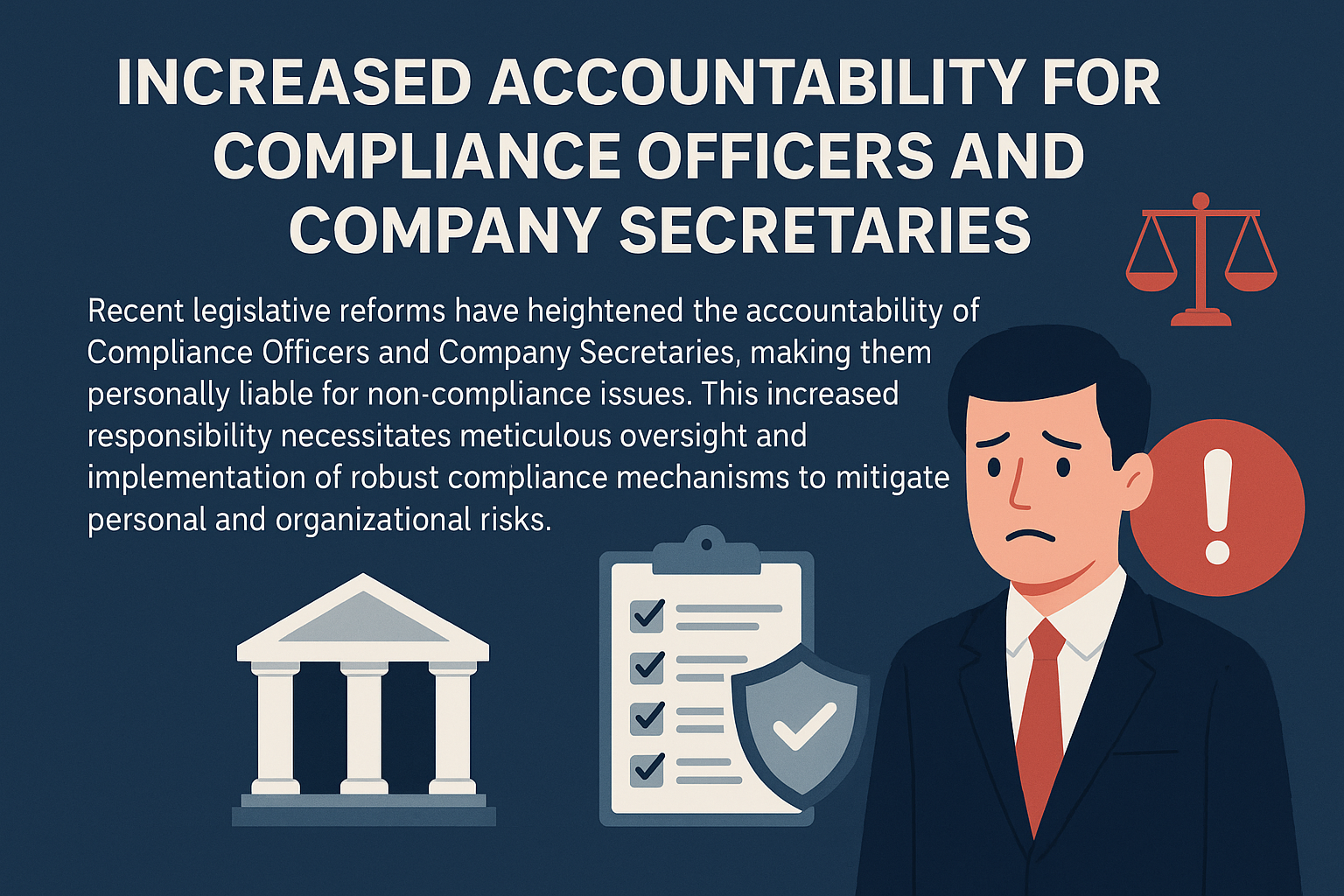
In today’s Regulatory Environment, the role of Compliance Officers and Company Secretaries has evolved dramatically due to recent legislative reforms across various jurisdictions. These reforms have introduced stricter legal frameworks that impose personal accountability for compliance failures, beyond the traditional corporate liability model. As a result, individuals holding these critical positions are now exposed to legal, financial, and reputational risks personally, including fines, sanctions, and even imprisonment in severe cases. This shift demands a heightened level of diligence, proactive risk management, and comprehensive documentation of compliance efforts. Traditional methods of compliance monitoring—often manual, fragmented, or outdated—are no longer sufficient to meet these elevated standards. Companies and their compliance professionals urgently require innovative, streamlined, and tech-driven solutions that ensure timely identification, reporting, and remediation of compliance issues. In this environment, there is a clear need for a centralized, intelligent compliance management platform that not only automates workflows and audit trails but also provides real-time visibility into compliance statuses, training needs, and emerging regulatory risks. Such a system must empower Compliance Officers and Company Secretaries to confidently navigate their roles, safeguard themselves against liabilities, and protect their organizations from non-compliance penalties.
Pain Points
- Personal Legal Liability: Compliance Officers now face direct personal penalties for failures, creating immense stress and risk.
- Fragmented Compliance Processes: Information is often siloed across departments, making oversight difficult and incomplete.
- Manual Monitoring Systems: Reliance on spreadsheets and email trails leads to human errors and missed deadlines.
- Dynamic Regulatory Landscape: Continuous legal updates require real-time system adaptation, overwhelming traditional tools.
- Insufficient Risk Visibility: Lack of dashboards or predictive analytics limits early detection of potential non-compliance areas.
- Poor Documentation Standards: Absence of audit-ready documentation can weaken legal defense during investigations.
- Slow Response to Breaches: Delay in identifying and addressing breaches escalates penalties and damages reputation.
- Training Gaps: Inadequate, infrequent compliance training exposes companies to accidental breaches by uninformed employees.
- High Cost of Specialized Legal Support: Reliance on external legal consultations for every issue increases operational costs.
- Lack of Accountability Tracking: Difficulty in tracking who was responsible for compliance tasks increases risks during audits.
Research Competition
Key Competitors:
- MetricStream: Offers Integrated Risk Management and GRC solutions, including BusinessGRC, CyberGRC, and ESGRC, to assist companies at every stage of their GRC journey.
- AuditBoard: A cloud-based platform for audit, risk, and compliance management, helping organizations streamline internal audits, manage risks, and ensure compliance with various standards.
- NAVEX Global: Provides comprehensive compliance management software, including risk assessments, policy management, employee training, audit management, and incident management.
- Wolters Kluwer: Offers integrated compliance management solutions, focusing on regulatory compliance and risk management.
- Dun & Bradstreet: Provides compliance solutions focusing on data analytics and risk management.
Top Startups:
- Checkr: A Y Combinator-funded startup providing compliance solutions, particularly in background checks and employee screening.
- Conductor AI: Develops AI-driven software to streamline paperwork and compliance processes, having raised approximately $15 million in Series A funding led by Lux Capital.
- Sysnet Global Solutions: Offers cybersecurity, financial, and compliance solutions, with significant funding and a global presence.
- Tookitaki: Provides AI-powered compliance solutions, focusing on financial crime detection and prevention.
- BRYTER: A no-code platform enabling professionals to build compliance applications without programming knowledge.
Market Maturity
The compliance technology market is experiencing significant growth, with the RegTech market valued at $15.8 billion in 2023 and projected to reach $85.9 billion by 2032.
Major Offerings by Competitors:
- Integrated Risk Management
- Audit and Compliance Management
- Policy and Document Management
- Employee Training Modules
- Incident and Case Management
- Regulatory Change Management
- Real-time Reporting and Dashboards
- AI-powered Risk Detection
- Cloud-based Deployment
- Customizable Workflows
Product Vision
The proposed product will be an AI-powered, centralized compliance management platform tailored for Compliance Officers and Company Secretaries facing heightened personal accountability under new legislative reforms. Our vision is to create a comprehensive, intelligent compliance ecosystem that automates manual tasks, ensures real-time risk visibility, and provides legally defensible audit trails.
At its core, the system will integrate modules for task management, regulatory change tracking, incident reporting, employee training, and document management — all aligned to help users navigate a complex and fast-changing regulatory environment confidently. Machine Learning algorithms will detect anomalies, predict potential compliance breaches, and suggest remediation steps. The platform will be fully cloud-native with strict cybersecurity protocols, offering role-based access and full audit capabilities.
By offering dynamic dashboards, mobile accessibility, continuous regulatory updates, and customizable workflows, we aim to transform the compliance function from a reactive burden into a proactive organizational asset. The system will not only protect individuals from personal liability but also help organizations maintain brand integrity and investor confidence.
We envision the product as the gold standard in compliance management — a trusted companion for compliance professionals to anticipate, manage, and report their activities with precision, security, and peace of mind.
Use Cases
- Regulatory Change Alerts: Real-time updates on new laws and regulations impacting the organization.
- Compliance Calendar: Auto-generated schedules and reminders for critical filing and compliance dates.
- Incident Reporting Hub: Centralized location for documenting and managing compliance breaches.
- Audit-Ready Documentation Repository: Secure storage and retrieval system for evidence in case of investigations.
- Training Tracker: Assign, track, and validate employee compliance training.
- Real-time Risk Dashboards: Visualize current compliance health and risk exposure.
- Accountability Matrix: Track task ownership, timelines, and performance metrics.
- Whistleblower Management: Anonymous and secure channel for internal reporting.
- Third-Party Compliance Monitoring: Manage vendors’ and partners’ compliance credentials.
- AI-based Breach Prediction Engine: Identify patterns leading to possible future non-compliances.
1. Use Case: Regulatory Change Management
- Short Info: Track and respond to evolving regulatory frameworks.
- Reference: Pain Point #4 (Dynamic Regulatory Landscape), Vision.
- Stakeholders: Compliance Officers, Legal Teams.
- Elaboration:
Regulations constantly evolve, making it crucial for companies to monitor changes. This module will auto-detect regulatory updates globally, map changes to relevant internal policies, and alert responsible officers instantly. Integration with legal news feeds and regulatory bodies ensures no critical update is missed. The system will also help generate compliance impact reports for the Board.
2. Use Case: Compliance Task Calendar
- Short Info: Auto-scheduling of compliance events and deadlines.
- Reference: Pain Point #3 (Manual Monitoring), Vision.
- Stakeholders: Compliance Officers, Company Secretaries.
- Elaboration:
Missed deadlines are a primary cause of penalties. A smart calendar will pre-populate compliance dates based on geography, industry, and company-specific obligations. Users can set reminders, view tasks in Kanban boards, and auto-prioritize based on risk severity.
3. Use Case: Incident Management System
- Short Info: Report and manage compliance violations.
- Reference: Pain Point #7 (Slow Response to Breaches).
- Stakeholders: Compliance Officers, Employees, Auditors.
- Elaboration:
When a breach occurs, time is critical. This use case will support instant incident logging, categorization, workflow initiation, and automatic assignment to relevant teams. Documentation of corrective and preventive actions (CAPA) will strengthen legal defensibility.
4. Use Case: Audit-Ready Documentation Repository
- Short Info: Secure centralized storage for all compliance evidence and reports.
- Reference: Pain Point #6 (Poor Documentation Standards), Vision, Competition (AuditBoard).
- Stakeholders: Compliance Officers, Legal Teams, Auditors.
- Elaboration:
In case of audits or legal investigations, the availability and integrity of documentation are critical. This repository will serve as a centralized, secure digital vault for storing all compliance-related documents—such as certifications, filings, training logs, audit reports, risk assessments, and incident response documents. It will use blockchain-inspired hashing mechanisms to ensure data integrity and offer advanced search features (including OCR) for quick retrieval. Access controls based on user roles will prevent unauthorized modifications. Versioning systems will maintain the history of changes made to critical documents. Alerts for document expiry (e.g., certifications) will ensure proactive updates. Ultimately, this will empower companies to defend themselves during regulatory inspections confidently.
5. Use Case: AI-Based Breach Prediction Engine
- Short Info: Predict potential compliance breaches before they occur.
- Reference: Pain Point #5 (Insufficient Risk Visibility), Vision, Innovation (AI in Compliance).
- Stakeholders: Compliance Officers, Risk Management Teams, Board of Directors.
- Elaboration:
Prevention is always better than reaction. Using Machine Learning, the platform will analyze historical incidents, internal behavior patterns, training gaps, operational changes, and external regulatory shifts to predict high-risk areas. A dynamic “Compliance Risk Heatmap” will be generated, ranking departments or functions by breach probability. Recommendations for proactive measures will be auto-suggested (e.g., additional training, policy updates, external audits). The engine will continuously learn from new data to refine its predictions over time. By identifying vulnerabilities early, Compliance Officers can take preventive action to mitigate risks — reducing penalties, reputational damage, and personal liability.
Summary
Recent legislative reforms have fundamentally changed the role of Compliance Officers and Company Secretaries, making them personally liable for corporate non-compliance. This shift necessitates a new generation of compliance management systems that are intelligent, proactive, and legally defensible.
Through an in-depth analysis, we identified Compliance Officers (30-55 years, M/F) as the primary users. Their main pain points include personal liability, fragmented monitoring, manual processes, poor risk visibility, and insufficient documentation standards, among others. Stakeholders range from internal teams (legal, audit, board) to external regulators and investors. A competitive landscape study highlighted companies like MetricStream, NAVEX, and AuditBoard actively working in this domain, along with emerging startups like Checkr and Conductor AI. However, current solutions still leave significant gaps — particularly in predictive analytics, accountability tracking, and real-time regulatory change management.
Our product vision focuses on developing an AI-powered, cloud-native compliance management platform. Key features include real-time regulatory tracking, a compliance task calendar, incident management, audit-ready documentation, and an AI-based breach prediction engine.
By addressing both current pain points and future needs, the platform aims to become the definitive compliance solution for organizations, safeguarding Compliance Officers and Company Secretaries from the growing personal and organizational risks they face today.