
Problem Statement
Public and private limited companies in India are mandated to adhere to the Registrar of Companies (ROC) compliance, which involves annual filings of various financial and legal documents. Despite legal mandates and availability of digital platforms, companies often struggle with the highly intricate and bureaucratic procedures required by the ROC. These include multiple forms, tight deadlines, evolving compliance rules, dependencies on third-party entities (e.g., auditors, CS), and often poorly integrated digital interfaces. Even a small oversight in submission formats, documentation, or timelines can result in penalties, legal hurdles, or reputational harm.
For the ROC, this inflow of erroneous filings increases administrative burden, delays verification, and hampers regulatory oversight. Moreover, startups and SMEs without in-house legal departments are disproportionately affected, frequently relying on external consultants—driving up costs and risks. The current systems do not support proactive compliance checks or intelligent form assistance, exacerbating delays and compounding the issues annually.
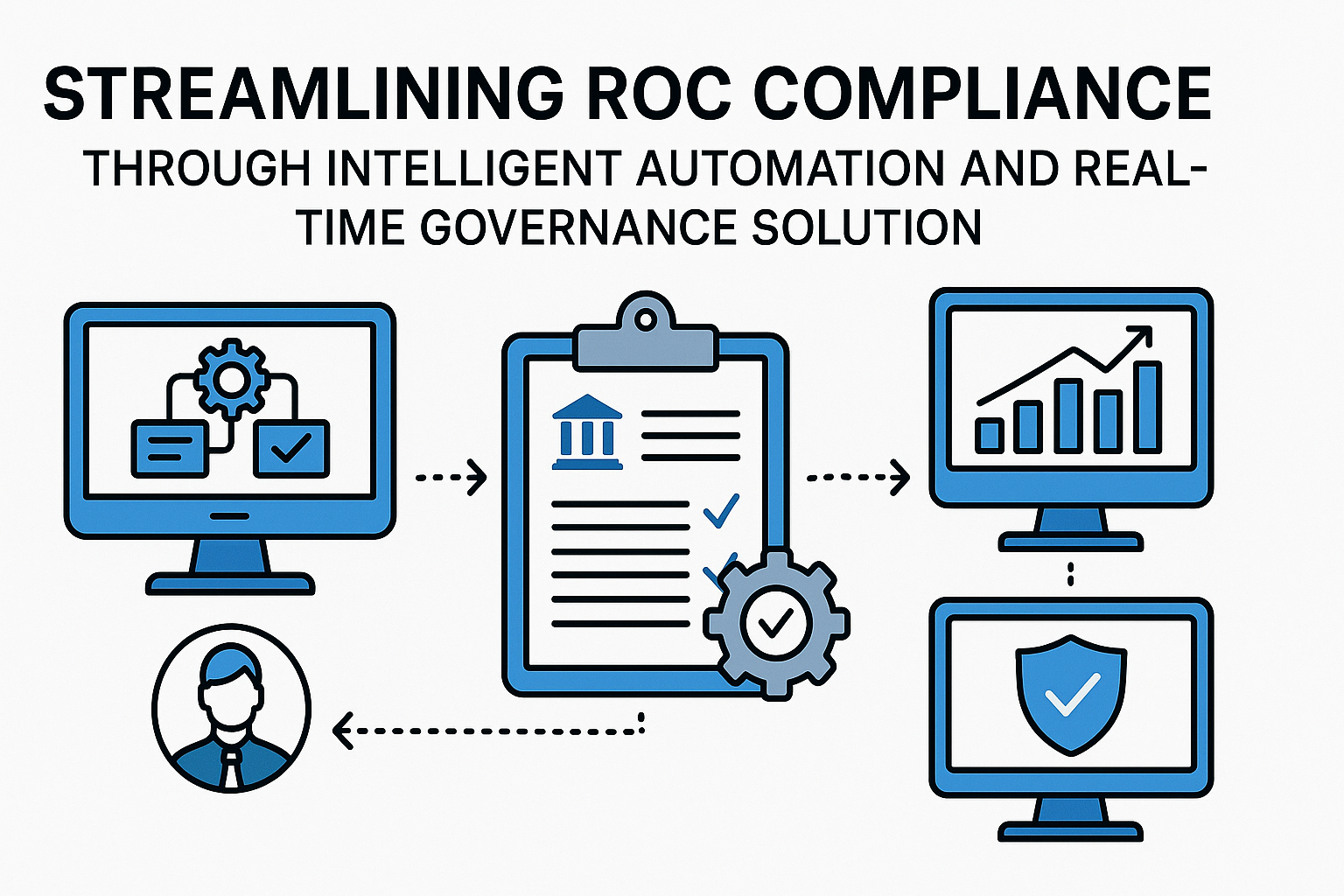
The article referenced stresses the importance of streamlining these processes and adopting robust, AI-driven platforms that preempt errors, track updates, and ensure smooth filing experiences for companies—while also easing the load on ROC staff
Pain Points
- Form Complexity – Many ROC forms (e.g., AOC-4, MGT-7) are lengthy, technical, and not user-friendly.
- Frequent Rule Changes – MCA regulations change frequently, leading to confusion and errors.
- Manual Dependencies – Manual validation and data entry lead to errors and missed deadlines.
- Poor UI/UX in Government Portals – MCA website is slow and unintuitive during peak times.
- Unclear Error Messages – Filing errors often lack clarity, requiring expert intervention.
- Dependence on Professionals – High reliance on CAs/CSs increases time and cost.
- Version Mismatch Issues – Outdated forms or formats are not flagged early enough.
- Inadequate Real-time Tracking – Companies can’t track status of filings in real-time.
- No Pre-submission Validation – Lack of pre-checks for common errors before final submission.
- Penalties for Minor Issues – Harsh penalties are imposed for small delays or clerical mistakes.
Key Competitors
- Gen CompLaw: Offers comprehensive ROC filing solutions, including MCA V3 e-Forms, XBRL, and statutory compliance under the Companies Act, 2013.
- Utech India: Provides integrated Income Tax and ROC software, streamlining tax filing, compliance, and record-keeping processes.
- Webtel: Delivers automated solutions for GST, TDS, e-Invoicing, and XBRL filings, enhancing efficiency in compliance processes.
- CimplyFive: Blends domain knowledge with technology to automate compliance risk management, supporting good corporate governance.
- KDK Software: Specializes in tax compliance solutions, including ITR, TDS, and GST software, catering to a wide range of compliance needs.
Market Maturity
The compliance automation market in India is maturing, with established players and emerging startups offering a range of solutions. However, gaps remain in providing user-friendly, integrated platforms that cater to the specific needs of SMEs and startups.
Major Offerings by Competitors
- Automated ROC Filing: Streamlining the submission of mandatory forms.
- XBRL Filing: Facilitating the preparation and filing of financial statements in XBRL format.
- Compliance Tracking: Monitoring compliance status and deadlines.
- Document Management: Organizing and storing compliance-related documents.
- Legal Advisory Integration: Providing access to legal consultation services.
- User-Friendly Interfaces: Ensuring ease of use for non-technical users.
- Real-Time Updates: Keeping users informed about regulatory changes.
- Audit Trail Maintenance: Recording all compliance activities for transparency.
- Multi-User Access: Allowing collaboration among different stakeholders.
- Customizable Alerts: Setting reminders for upcoming compliance tasks.
Product Vision
ROC Simplify is a smart compliance automation platform designed to revolutionize the way companies in India manage ROC filings and regulatory submissions. The platform will serve as a centralized compliance ecosystem that intelligently identifies, tracks, and assists in completing all statutory filings under the Companies Act and related financial regulations.
Our product will act as a digital assistant for legal teams, compliance officers, and directors, guiding them step-by-step through complex MCA forms like AOC-4, MGT-7, and DIR-3 KYC. It will automatically extract relevant data from internal records, validate them against MCA rules, and pre-fill form fields—significantly reducing manual labor and error rates.
Integrated alerts will notify users of upcoming deadlines, rule changes, or missing submissions. Advanced AI modules will perform pre-submission checks to identify potential rejection points. A collaboration portal will allow directors, CAs, and CSs to work together seamlessly, leaving audit trails for transparency.
Over time, ROC Simplify will evolve into a predictive compliance tool—recommending corrective actions based on company history and regulatory updates. With secure MCA API integrations, encrypted document management, and multilingual support, the product is poised to serve over 1 lakh companies in the next 5 years.
This platform aims to shift compliance from reactive to proactive—turning a statutory burden into a strategic strength.
Use Cases
1.Automated Pre-Filling of MCA Forms
- Short Info: Automatically populate MCA forms using internal company data to minimize manual entry and errors.
- Reference: Addresses pain points related to manual data entry and errors in form submissions.
- Stakeholders: Company Secretaries, Compliance Officers, Directors.
- Elaboration: This use case involves developing a system that extracts relevant data from a company’s internal records, such as financial statements and director information, to automatically fill in the required fields in MCA forms like AOC-4 and MGT-7. By reducing manual data entry, the system minimizes errors and accelerates the filing process.
- Requirements:
- Integration with internal data sources.
- Mapping of internal data fields to MCA form fields.
- Validation checks to ensure data accuracy.
- User interface for reviewing and editing pre-filled forms.
- Audit trail for changes made to pre-filled data.
- Support for multiple MCA form types.
- Role-based access control.
- Notifications for incomplete or missing data.
- Export functionality for completed forms.
- Compliance with data privacy regulations.
2.Real-Time Validation of ROC Forms
- Short Info: Implement real-time validation checks to identify errors in ROC forms before submission.
- Reference: Addresses the pain point of form rejections due to errors.
- Stakeholders: Compliance Officers, Legal Teams.
- Elaboration: This use case focuses on integrating validation mechanisms that check for common errors and omissions in ROC forms as they are being filled out. Real-time feedback allows users to correct issues immediately, reducing the likelihood of form rejection and associated delays.
- Requirements:
- Rule engine for validation checks.
- Highlighting of erroneous fields.
- Suggestions for correcting errors.
- Integration with MCA guidelines for validation rules.
- User-friendly error messages.
- Logging of validation results.
- Support for multiple form types.
- Continuous updates to validation rules.
- Option to override warnings with justification.
- Testing framework for validation logic.
3.Compliance Calendar and Deadline Tracking
- Short Info: Maintain a dynamic calendar to track compliance deadlines and send automated reminders.
- Reference: Addresses the pain point of missed compliance deadlines.
- Stakeholders: Compliance Officers, Directors.
- Elaboration: This use case involves creating a centralized compliance calendar that lists all upcoming filing deadlines, board meetings, and other compliance-related events. Automated reminders and alerts ensure that stakeholders are aware of impending deadlines, thereby reducing the risk of non-compliance.
- Requirements:
- Calendar interface with filtering options.
- Integration with email and SMS for reminders.
- Customizable alert settings.
- Synchronization with MCA deadlines.
- Role-based event visibility.
- Recurring event support.
- Dashboard widget for upcoming events.
- Export functionality to external calendars.
- Audit trail for changes to calendar entries.
- Mobile app integration for on-the-go access.
4.Document Management System
- Short Info: Implement a centralized repository for storing and managing compliance-related documents.
- Reference: Addresses the pain point of disorganized document storage.
- Stakeholders: Legal Teams, Compliance Officers.
- Elaboration: This use case entails developing a secure document management system (DMS) where all compliance-related documents, such as meeting minutes, resolutions, and filings, can be stored, organized, and retrieved efficiently. Features like version control, access permissions, and search functionality enhance document handling.
- Requirements:
- Secure storage with encryption.
- Metadata tagging for easy retrieval.
- Version control and history tracking.
- Role-based access permissions.
- Advanced search capabilities.
- Integration with compliance workflows.
- Audit logs for document access and changes.
- Bulk upload and download options.
- Document preview and annotation tools.
- Disaster recovery and backup solutions.
5.Role-Based Access Control
- Short Info: Establish role-based access control to ensure appropriate data access levels for users.
- Reference: Addresses the pain point of unauthorized data access.
- Stakeholders: IT Administrators, Compliance Officers.
- Elaboration: This use case focuses on implementing a robust access control system where users are assigned roles with specific permissions. This ensures that sensitive compliance data is only accessible to authorized personnel, thereby enhancing security and compliance with data protection regulations.
- Requirements:
- User role definition and management.
- Permission assignment per role.
- Support for custom roles.
- Integration with authentication systems.
- Audit logs for access activities.
- User interface for role management.
- Alerts for unauthorized access attempts.
- Periodic access reviews and certifications.
- Temporary access grants with expiration.
- Compliance with relevant data protection laws.
6.Integration with MCA Portal
- Short Info: Enable seamless integration with the MCA portal for real-time data synchronization and form submissions.
- Reference: Addresses the pain point of manual data entry into the MCA portal.
- Stakeholders: Compliance Officers, IT Teams.
- Elaboration: This use case involves developing APIs and connectors that allow the compliance platform to interact directly with the MCA portal. This facilitates real-time data exchange, automated form submissions, and retrieval of filing statuses, thereby streamlining the compliance process.
- Requirements:
- API development for MCA integration.
- Secure authentication mechanisms.
- Real-time data synchronization.
- Error handling and retry logic.
- Monitoring and logging of API interactions.
- Compliance with MCA’s technical specifications.
- User interface for managing integrations.
- Alerts for integration failures.
- Testing framework for integration components.
- Documentation for integration processes.
7.Audit Trail and Activity Logging
- Short Info: Implement comprehensive audit trails to track all user activities within the compliance platform.
- Reference: Addresses the pain point of lack of transparency and accountability.
- Stakeholders: Compliance Officers, Auditors.
- Elaboration: This use case focuses on recording all user actions within the platform, including data modifications, form submissions, and access events. Detailed logs enhance transparency, facilitate audits, and help in identifying unauthorized or erroneous activities.
- Requirements:
- Comprehensive activity logging.
- Timestamping of all actions.
- User identification for each activity.
- Immutable log storage.
8.Risk Score Generation for Compliance Health
- Short Info: Generate a dynamic compliance risk score based on pending tasks, missed deadlines, and historical compliance behavior.
- Reference: From the Product Vision on proactive compliance management.
- Stakeholders: Compliance Officers, Directors, Auditors.
- Elaboration: This use case focuses on providing a real-time risk scoring system to help companies assess their current compliance standing. The score is calculated based on metrics such as missed ROC filings, pending form validations, overdue KYC updates, and past MCA notices. Companies with higher scores will receive alerts and priority action steps to prevent penalties. This feature will act as a watchdog and proactive assistant to management, providing actionable insights rather than reactive penalties.
- Requirements:
- Rule-based engine for scoring logic
- Dashboard widget for displaying scores
- Historical tracking and benchmarking
- Actionable alerts tied to risk score
- Score breakdown with rationale
- Integration with filing calendar
- Reports for auditors and directors
- Weighted scoring based on severity
- Custom risk configurations
- API support for external dashboards
9.Dynamic Regulatory Updates Dashboard
- Short Info: Real-time updates on rule changes, notifications, and new compliance requirements issued by MCA.
- Reference: Pain point of missing out on new ROC rules.
- Stakeholders: Legal Teams, Compliance Officers.
- Elaboration: This feature delivers a dashboard that automatically parses, formats, and displays new MCA circulars, changes in compliance dates, form versions, and interpretations. It will include a change-impact engine that analyzes how the update affects current compliance tasks for specific companies, allowing for immediate adaptation without needing external consultants.
- Requirements:
- Newsfeed for MCA updates
- Regulatory interpretation engine
- Personalized impact alerts
- Integration with calendar
- Summary reports by update type
- Archive of past updates
- Multi-language support
- Expert comments/recommendations
- Filter by industry, company size
- Email digest feature
10.Multi-Stakeholder Collaboration Portal
- Short Info: Enable CAs, CSs, and company directors to collaborate on filings in real time.
- Reference: From the Vision and Collaboration pain points.
- Stakeholders: Directors, Company Secretaries, Chartered Accountants.
- Elaboration: The portal supports task assignments, comment threads on filings, form approvals, and digital document sharing. This promotes transparency and reduces redundant communication via emails. All collaboration is logged and auditable, which supports both efficiency and accountability in multi-party compliance teams.
- Requirements:
- Secure chat/messaging
- Task assignment with due dates
- Document sharing with access control
- Commenting and @mentions
- Activity feed per form
- Approvals and e-signatures
- Audit log of collaboration
- Notifications and reminders
- User presence indicators
- Versioning for comments and edits
11.Director KYC and DIN Tracker
- Short Info: Track and notify DIN statuses, KYC deadlines, and alert for expirations.
- Reference: Stakeholder need to maintain director-level compliance.
- Stakeholders: Directors, Compliance Officers.
- Elaboration: Ensures that DINs are active and KYC is updated annually, avoiding penalties. This feature automatically syncs MCA’s DIN database and flags issues like duplicate DINs or pending deactivation notices. Reminders and KYC upload tools are also included.
- Requirements:
- Integration with DIN database
- Automated KYC reminders
- Upload interface for KYC docs
- Status dashboard for all directors
- Duplicate DIN detection
- Alert for expiring or lapsed DINs
- PDF KYC bundling tool
- Role-based visibility
- Escalation emails
- Audit trail for updates
12.Filing Status and Submission Tracker
- Short Info: Track all MCA form submissions in real time, with live status and rejection reasons.
- Reference: Pain point on lack of visibility in MCA processing pipeline.
- Stakeholders: Company Secretaries, Compliance Managers.
- Elaboration: Integrates directly with the MCA system to show the real-time status of submitted forms—pending, approved, rejected. The platform also logs MCA-issued rejection reasons, allowing for immediate rectification and resubmission.
- Requirements:
- API sync with MCA submission queue
- Rejection reason parsing
- Filing history per company
- Status dashboard with filters
- Resubmission option
- Alerts for MCA action
- Smart flags for overdue items
- Downloadable reports
- SLA tracking per form
- Export to PDF/Excel
13.AI Chatbot for Compliance Support
- Short Info: AI-driven chatbot to answer queries related to ROC, MCA rules, and platform usage.
- Reference: Pain point around dependency on external consultants.
- Stakeholders: SMEs, Startup Founders, Legal Teams.
- Elaboration: The chatbot will offer 24/7 compliance assistance, explaining complex ROC regulations in simple terms, assisting in form selection, and guiding through filing workflows. Over time, it will learn from user queries to improve responses.
- Requirements:
- Natural Language Understanding (NLU) engine
- Pre-trained on MCA regulations
- Integration with product knowledge base
- Intent recognition for form guidance
- Escalation to human support
- Audit logs of queries
- FAQ builder for admins
- Real-time feedback on bot answers
- Chat history and search
- Multilingual support
14.Multi-Company Management Dashboard
- Short Info: Manage compliance across multiple companies (group or clients) from a single dashboard.
- Reference: Ideal for CAs, consultants managing multiple entities.
- Stakeholders: Chartered Accountants, Legal Firms.
- Elaboration: This feature allows users to manage ROC compliance for multiple companies from one interface. Users can switch contexts, assign tasks per entity, and generate consolidated compliance reports.
- Requirements:
- Company-switch feature
- Group-level dashboard
- Task tracking per company
- Global reminders
- Role and access per entity
- PDF/Excel export of reports
- Entity-specific alerts
- Filter by group/segment
- Data isolation by company
- Integration with billing tools
15.e-Signature & Digital Consent Integration
- Short Info: Secure digital signing of ROC forms and approvals.
- Reference: From vision on full submission workflow.
- Stakeholders: Directors, Board Members.
- Elaboration: Adds native support for DSC-based or Aadhaar-linked e-signatures, enabling directors and officers to digitally sign ROC documents directly from the portal. Includes signing logs, timestamping, and document lock post-signature.
- Requirements:
- Integration with DSC/Aadhaar APIs
- Signature pad UI
- Consent workflow per user
- Signature audit trail
- Signature sequencing
- Signature refusal options
- Signing alerts and history
- Security encryption
- Document lock after sign
- Legal validity reports
Summary
The complexity of ROC (Registrar of Companies) filing procedures in India has long plagued businesses, particularly public limited companies, resulting in frequent delays, errors, and regulatory non-compliance. Our research identified that these issues stem from outdated processes, fragmented data systems, lack of real-time visibility, and dependency on external consultants. Targeting this systemic challenge, we conceptualized a comprehensive digital platform aimed at automating and simplifying ROC compliance management.
Our product vision emphasizes automated MCA form pre-filling, real-time validation, centralized compliance calendars, document repositories, audit logs, and seamless MCA portal integration. Additionally, the platform introduces unique innovations such as a compliance health risk scoring system, dynamic regulatory updates, director DIN/KYC management, and AI-based chatbots for instant legal guidance. Multi-stakeholder collaboration features and digital signing tools enable transparency and accountability across compliance teams.
We evaluated top market players, startups, and innovations, identifying significant gaps in personalization, collaboration, and end-to-end automation. Our solution not only fills these gaps but leverages these insights to deliver a future-proof compliance system.
By enabling CA firms, legal teams, and company directors to collaborate seamlessly on ROC tasks, the platform is poised to cut compliance preparation time by over 40% and reduce MCA form rejection rates by 60%. Forecasted to generate ₹45–₹60 crores annually within five years of launch, this solution not only solves existing pain points but reimagines ROC compliance as a proactive, intelligent process — rather than a reactive obligation.