
problem statement
India’s judiciary lacks a structured and transparent performance appraisal framework for judges, resulting in several inefficiencies. In the current system, judges’ performances are largely immune to objective review, due to the absence of quantifiable metrics, real-time monitoring tools, or independent evaluation protocols. This opacity diminishes institutional accountability, reduces public trust in judicial outcomes, and contributes to a massive backlog of pending cases. Without standardized feedback mechanisms, it becomes impossible to flag issues of delay, inconsistency, or deviation in legal interpretations. High-performing judges also go unrecognized, leading to stagnation in professional motivation and the dilution of meritocracy within the judiciary.
Furthermore, citizens and lawyers have no structured channel to provide constructive feedback, and higher judicial authorities lack a dashboard to evaluate the operational efficacy of lower courts. This results in disjointed performance across jurisdictions, with some courts functioning efficiently and others riddled with delays. In short, the lack of a robust performance appraisal system negatively impacts not only judges but also litigants, the legal fraternity, and the larger justice delivery mechanism in India.
Pain Points
Lack of Standard Metrics: No quantitative method to evaluate judge performance.
No Feedback Loop: Judges don’t receive structured performance feedback.
Inconsistent Judging Standards: Varied quality across courts and judges.
Merit Ignored: High performers receive no formal recognition or reward.
Accountability Void: Poor performers continue without consequence.
No Transparency: Public and stakeholders cannot access performance insights.
Case Backlog: Delays due to inefficiencies go unaddressed.
No Peer Benchmarking: Judges can’t compare their efficiency to peers.
Resistance to Reform: Judges may fear evaluation without a fair, data-backed system.
Lack of Tech Tools: No existing tools to capture real-time performance data.
Stakeholders
- Judges: Subject to the appraisal system.
- Chief Justices / Judicial Administrators: Oversee judge performance.
- Law Ministry / Government: Policy implementation and oversight.
- Litigants / Citizens: Indirect beneficiaries through improved judicial efficiency.
- Bar Council / Lawyers: Rely on fair and timely judgments.
- Court Clerks / Administrative Staff: Support documentation and processes.
- Legal Reform Committees / Think Tanks: Push for systemic reform.
- Media & Civil Society: Influence transparency and public perception.
- Legal Tech Companies: Provide platforms and tools for implementation.
Market Maturity & Gaps
The market for judicial performance evaluation in India is still in its nascent stages. While there are pockets of innovation and proposals, a comprehensive, standardized system is yet to be implemented nationwide.
Major Offerings
Key features from existing and proposed systems include:
- Integration with Digital Platforms: Leveraging e-Courts and NJDG for data collection and analysis.
- Objective Metrics: Using quantifiable data like case disposal rates and working days.
- Qualitative Feedback: Incorporating feedback from peers, litigants, and court staff.
- Transparency: Publicly accessible performance data to enhance accountability.
Product Vision
JudgAI Systems envisions the creation of India’s first AI-powered Judicial Performance Evaluation Platform that brings objectivity, transparency, and accountability to the judiciary. The platform—“JustiMetrics”—will provide a real-time, data-driven appraisal system for judges across all levels. JustiMetrics will integrate seamlessly with existing systems such as the National Judicial Data Grid (NJDG), e-Courts, and court case management systems, enabling collection and analysis of data on case disposal rates, judgment quality, delay patterns, and compliance with procedural standards.
The system will incorporate feedback mechanisms from litigants, peers, and court staff, ensuring a holistic and fair evaluation. Using Natural Language Processing (NLP), it will analyze judgments for consistency, clarity, and legal robustness. A dashboard will present performance heatmaps for Chief Justices and administrators, while judges will have access to private feedback and peer comparisons.
JudgAI’s strength lies in its cross-disciplinary team of AI engineers, legal scholars, and judicial reform experts, enabling it to uniquely balance technological innovation with legal sensibility. Our platform will be designed to respect judicial independence while fostering a culture of self-improvement and recognition for excellence.
Use Cases
1. Judge Self-Evaluation Portal
Judges will be able to log into a secure portal and access monthly reports on their performance. Metrics will include average case disposal time, consistency in judgment quality (analyzed via NLP), and peer benchmarks. It will help them self-assess and identify strengths or areas for improvement without external pressure.
2. High Court Dashboard for Performance Monitoring
The dashboard provides real-time performance tracking across subordinate courts and judges. Filters enable administrators to compare different timeframes, court types, and locations. Anomaly alerts highlight judges with high pendency or inconsistent outputs.
3. NLP-based Judgment Quality Assessment
AI models will evaluate judgments based on linguistic clarity, logical coherence, citation validity, and adherence to precedent. This feature will highlight qualitative aspects beyond simple case count.
4.Court-wise Efficiency Ranking
Each court’s performance is scored using multiple metrics, such as clearance rate, pendency ratio, and judgment turnaround time. Rankings will help in policy decisions and targeted support.
5. Real-time Alerts for Delay Patterns
Using live court data, the system will flag when a judge’s case backlog crosses a threshold or shows a deviation from their norm. Alerts will allow quick intervention and redressal.
6. Promotion Recommendation Reports
This feature generates comprehensive performance dossiers for judges under consideration for elevation or transfer. It consolidates metrics, qualitative feedback, and ranking data into a structured report that panels can review for unbiased decision-making.
7. Litigant Feedback Integration
Litigants will provide structured feedback post-case closure through kiosks, apps, or SMS. Feedback will be anonymized and factored into soft-skill assessment (e.g., behavior, clarity, empathy) of judges without affecting judicial independence.
8.Monthly Peer Benchmarking Reports
Judges receive anonymized reports comparing their efficiency, backlog, and judgment clarity scores against peers from similar courts. Enables self-motivation without public shaming.
9. Training Needs Identification Engine
The platform identifies performance gaps—e.g., case handling time, judgment complexity—and recommends training programs or legal updates. Academies receive lists of judges needing intervention, making training more data-driven.
10. Annual Judicial Awards & Recognition System
Based on accumulated yearly performance data, top judges will be nominated for recognition at judicial events. This promotes motivation, trust, and competitiveness while maintaining integrity through data-based nominations.
Summary
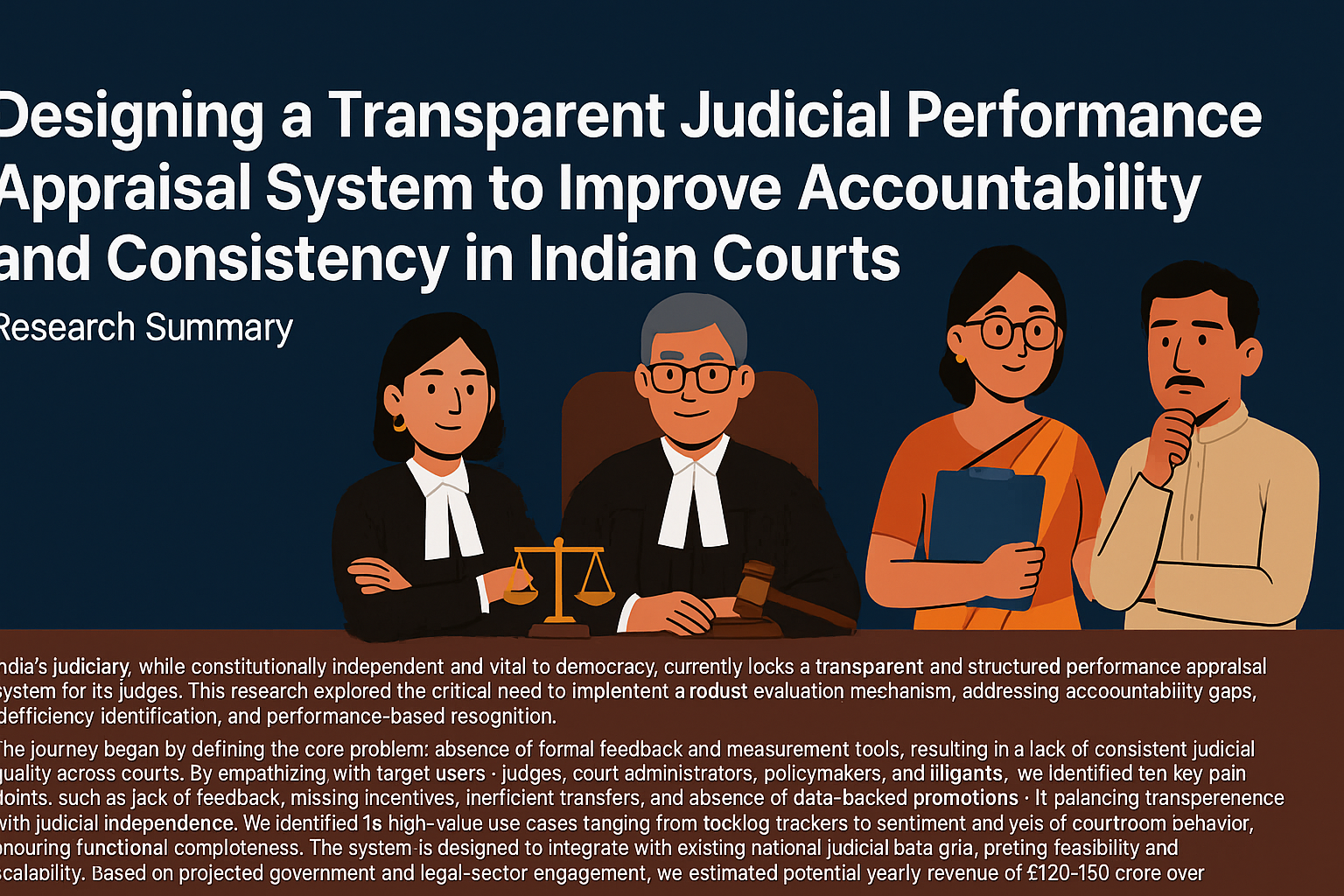
India’s judiciary, while constitutionally independent and vital to democracy, currently lacks a transparent and structured performance appraisal system for its judges. This research explored the critical need to implement a robust evaluation mechanism, addressing accountability gaps, inefficiency identification, and performance-based recognition.
The journey began by defining the core problem: absence of formal feedback and measurement tools, resulting in a lack of consistent judicial quality across courts. By empathizing with target users—judges, court administrators, policymakers, and litigants—we identified ten key pain points, such as lack of feedback, missing incentives, inefficient transfers, and absence of data-backed promotions.
In the competitive research phase, we analyzed initiatives like India Justice Report, eCourts, and international systems in the U.S. and U.K., identifying that most current offerings fall short of actionable performance tracking. Our product vision evolved into a digital, AI-driven platform offering real-time judicial dashboards, peer benchmarking, litigant feedback integration, and automated promotion dossiers—balancing transparency with judicial independence.