
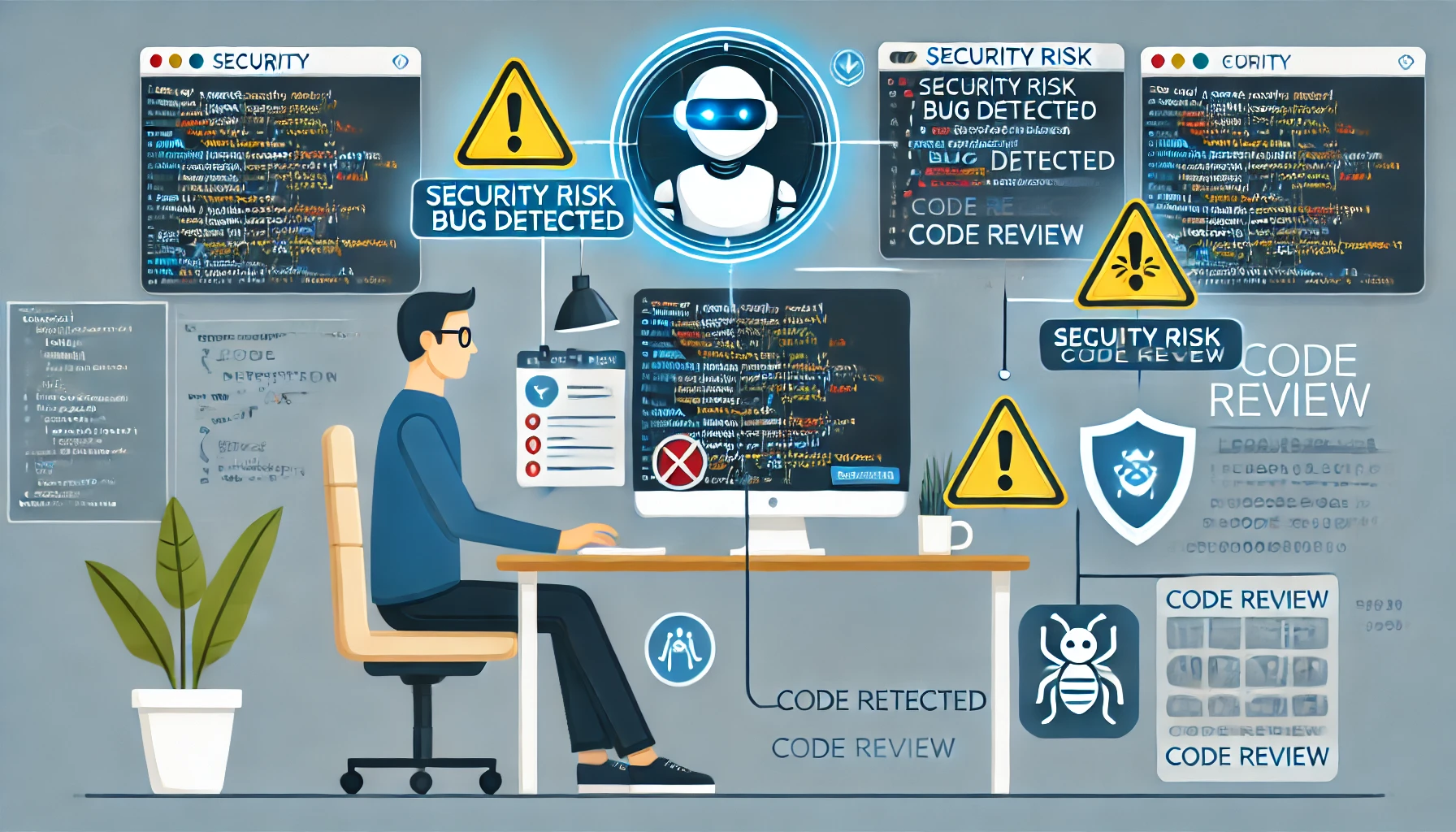
Problem Elaboration
AI-assisted coding tools, such as GitHub Copilot, have significantly improved developer productivity by generating code suggestions and automating repetitive tasks. However, these tools are not perfect—they can introduce serious security vulnerabilities, logical flaws, and compliance issues. Developers relying on AI-generated code may unintentionally integrate insecure or inefficient code into production systems, leading to potential exploits, reliability issues, and maintenance challenges.
Several concerns arise:
- Security vulnerabilities: AI-generated code may lack proper validation, authorization checks, or be susceptible to common exploits (e.g., SQL injection, buffer overflow, hardcoded credentials).
- Logic errors: AI might generate code that appears syntactically correct but contains subtle logic flaws that affect functionality.
- Code quality & maintainability: AI-generated code may not follow best practices, leading to technical debt.
- Compliance & licensing issues: AI tools may produce code snippets derived from open-source projects, potentially violating licensing terms.
- False sense of security: Developers may over-rely on AI suggestions without proper validation, assuming correctness.
Ensuring AI-generated code is secure, reliable, and free of critical bugs requires robust validation mechanisms, automated security scanning, and developer awareness. A new solution must integrate security analysis, logic verification, and best-practice enforcement seamlessly into the development workflow.
Pain Points
- Security Vulnerabilities in AI-Generated Code
- AI tools may produce insecure code (e.g., missing input validation, insecure authentication, buffer overflows), making applications vulnerable to cyberattacks.
- Inconsistent Code Quality & Best Practices
- AI-generated code may not adhere to industry best practices, leading to inconsistent style, inefficiency, and maintainability challenges.
- Logic Errors & Subtle Bugs
- AI may generate syntactically correct code that contains logic errors, which can go unnoticed until after deployment.
- False Sense of Security Among Developers
- Developers may over-rely on AI-generated suggestions without thoroughly reviewing the output, assuming the code is correct and secure.
- Lack of Explainability in AI Suggestions
- AI-generated code lacks context or explanations, making it difficult for developers to understand why a certain approach was suggested.
- Compliance & Licensing Risks
- AI may generate code snippets derived from proprietary or open-source projects with restrictive licenses, leading to legal and ethical concerns.
- Integration Challenges with Existing Codebases
- AI-generated code may not be optimized for the existing software architecture, requiring additional refactoring and modifications.
- Performance & Scalability Issues
- AI-generated code may be inefficient or fail to scale properly in high-load environments, impacting system performance.
- Difficulties in Debugging & Testing AI-Generated Code
- Debugging AI-generated code can be complex, especially if the developer did not fully understand the logic behind the suggestion.
- AI Model Bias & Incomplete Training Data
- AI coding assistants may be trained on incomplete or biased datasets, leading to insecure, outdated, or unreliable recommendations.
Key Competitors & Their Offerings
- GitHub Copilot (Microsoft & OpenAI)
- Uses OpenAI’s Codex model to generate code suggestions.
- Does not guarantee security or correctness of generated code.
- Microsoft introduced Copilot Enterprise, which includes some security improvements.
- AWS CodeWhisperer (Amazon Web Services)
- AI-powered coding assistant with built-in security scanning for vulnerabilities.
- Focuses on compliance, suggesting code that avoids security risks.
- Lacks detailed security enforcement beyond static analysis.
- Google Gemini for Developers
- Provides AI-powered code generation integrated with Google Cloud.
- Does not explicitly focus on security but offers strong language model capabilities.
- DeepCode (Acquired by Snyk)
- AI-powered static code analysis tool that detects vulnerabilities in real-time.
- Strong in security scanning but lacks AI-assisted code generation.
- CodiumAI
- Provides AI-powered code validation by generating test cases for AI-generated code.
- Focuses on improving correctness but does not enforce security standards.
Startups Working on Secure AI Code Generation
- CodiumAI – AI-powered test generation for ensuring AI-generated code correctness.
- GuardRails – AI-driven security scanning for DevSecOps pipelines.
- Replit Ghostwriter – AI-assisted coding integrated into Replit IDE, with some security checks.
- Truffle Security – AI-driven secret detection in code.
- Code Intelligence – AI-powered vulnerability detection in source code.
- Fossa – AI-assisted compliance and license scanning for open-source code.
- Ponicode (acquired by CircleCI) – AI-powered unit test generation.
- Secure Code Warrior – AI-assisted secure coding training and best practices.
- DeepCode (Snyk) – AI-driven static analysis for security vulnerabilities.
- Veracode – AI-assisted security scanning for static and dynamic code analysis.
Recent Investments in AI Code Security
- Snyk raised $196.5M in September 2023 to enhance AI-powered security scanning.
- Replit secured $97.4M in April 2023 to improve AI coding tools and cloud-based development.
- CodiumAI raised $11M in December 2023 for AI-driven test generation.
- GuardRails raised $14.8M in 2023 to enhance AI-driven security in DevSecOps.
- Code Intelligence raised $12M in 2023 for AI-powered vulnerability detection.
Market Maturity & Gaps
Market Maturity:
The AI-assisted coding market is rapidly growing, with major players like Microsoft, AWS, and Google dominating. However, security and correctness enforcement are not yet fully solved. Existing solutions provide static analysis or test generation but do not offer real-time, AI-driven security enforcement for generated code.
Key Gaps in the Market:
- Lack of real-time security enforcement – Current AI coding tools do not actively prevent insecure code generation.
- Limited contextual security feedback – AI tools suggest code but do not explain potential risks in real-time.
- No deep integration between AI code generation and security validation – Security scanning happens after code is written, not during AI code generation.
- Lack of AI-driven automated fixes – Most tools identify security issues but do not auto-correct them using AI.
Product Vision
AI-assisted coding tools have revolutionized software development by increasing productivity and automating repetitive tasks. However, they introduce significant risks, including security vulnerabilities, logic errors, and compliance issues. Existing AI coding assistants generate code, but they do not actively validate, explain, or enforce security best practices in real-time.
Our product, “SecureCode AI”, is an AI-powered coding assistant that ensures secure, reliable, and high-quality AI-generated code by integrating real-time security scanning, contextual feedback, and automated fixes into the development workflow. Unlike traditional static code analysis tools, SecureCode AI proactively prevents insecure code generation instead of merely detecting issues after the fact.
Key Innovations in SecureCode AI
- Real-time security enforcement – AI actively blocks insecure code suggestions before they are accepted.
- Context-aware security insights – AI explains why a suggestion is risky and provides secure alternatives.
- AI-powered automated fixes – The tool not only detects security flaws but also corrects them automatically.
- Seamless IDE integration – Works with VS Code, JetBrains, and cloud-based environments like GitHub Codespaces.
- Compliance & licensing checks – Ensures AI-generated code adheres to open-source licensing policies and regulatory requirements.
- Performance optimization – AI suggests code that is not only secure but also efficient and scalable.
SecureCode AI ensures that every AI-generated line of code is as secure, correct, and maintainable as if it were written by a seasoned security expert.
Use Cases
- Preventing Insecure Code Suggestions
- If AI suggests a vulnerable code snippet (e.g., missing input validation), SecureCode AI blocks it and suggests a secure alternative.
- Real-Time Security Feedback for Developers
- When a developer accepts an AI-generated snippet, SecureCode AI explains potential security risks and provides recommendations.
- Automated Code Fixing for Vulnerabilities
- AI-powered auto-fix functionality corrects common security flaws before the code is committed.
- Seamless IDE Integration
- Works directly inside popular code editors (VS Code, JetBrains, GitHub Copilot) for real-time security insights.
- Automated Compliance Checks
- Ensures AI-generated code complies with OWASP, GDPR, SOC 2, and other industry regulations.
- Context-Aware Secure Coding Guidelines
- AI provides inline documentation on secure coding best practices relevant to the current code context.
- AI-Driven Unit Test Generation
- SecureCode AI auto-generates unit tests to validate AI-generated logic and security.
- Detecting Hardcoded Secrets & Credentials
- Automatically flags and removes hardcoded API keys, passwords, and sensitive data in AI-generated code.
- Performance & Efficiency Optimization
- AI suggests not just secure, but optimized and scalable code for high-performance applications.
- Enterprise Security Dashboard & Reporting
- Provides CTOs, security teams, and compliance officers with real-time insights into AI-generated code risks.
Summary
AI-assisted coding tools like GitHub Copilot and AWS CodeWhisperer have transformed software development by accelerating productivity. However, they introduce critical risks, including security vulnerabilities, logic errors, and compliance issues. Developers often accept AI-generated code without thorough validation, leading to potential exploits and performance inefficiencies.
To address these challenges, we propose SecureCode AI, an AI-powered security layer that integrates directly into IDEs and CI/CD pipelines. Unlike traditional static analysis tools that detect issues after code is written, SecureCode AI proactively prevents insecure code generation in real-time.
Key innovations include:
- Real-Time Security Enforcement: Blocks insecure AI-generated code before acceptance.
- AI-Powered Auto-Fix System: Automatically corrects security flaws with a single click.
- Context-Aware Security Insights: Educates developers by explaining risks and suggesting best practices.
- Compliance & Licensing Checks: Ensures adherence to GDPR, SOC 2, and open-source licenses.
- AI-Driven Unit Test Generation: Creates test cases to validate correctness and security.
With an agile 12-month roadmap, SecureCode AI will launch as an IDE plugin and enterprise security tool, seamlessly integrating with GitHub, GitLab, and AWS development workflows. By ensuring AI-generated code is secure, reliable, and compliant, SecureCode AI will redefine how organizations adopt AI-driven development without compromising security.
Researched By Shubham Thange MSc CA Modern College Pune