
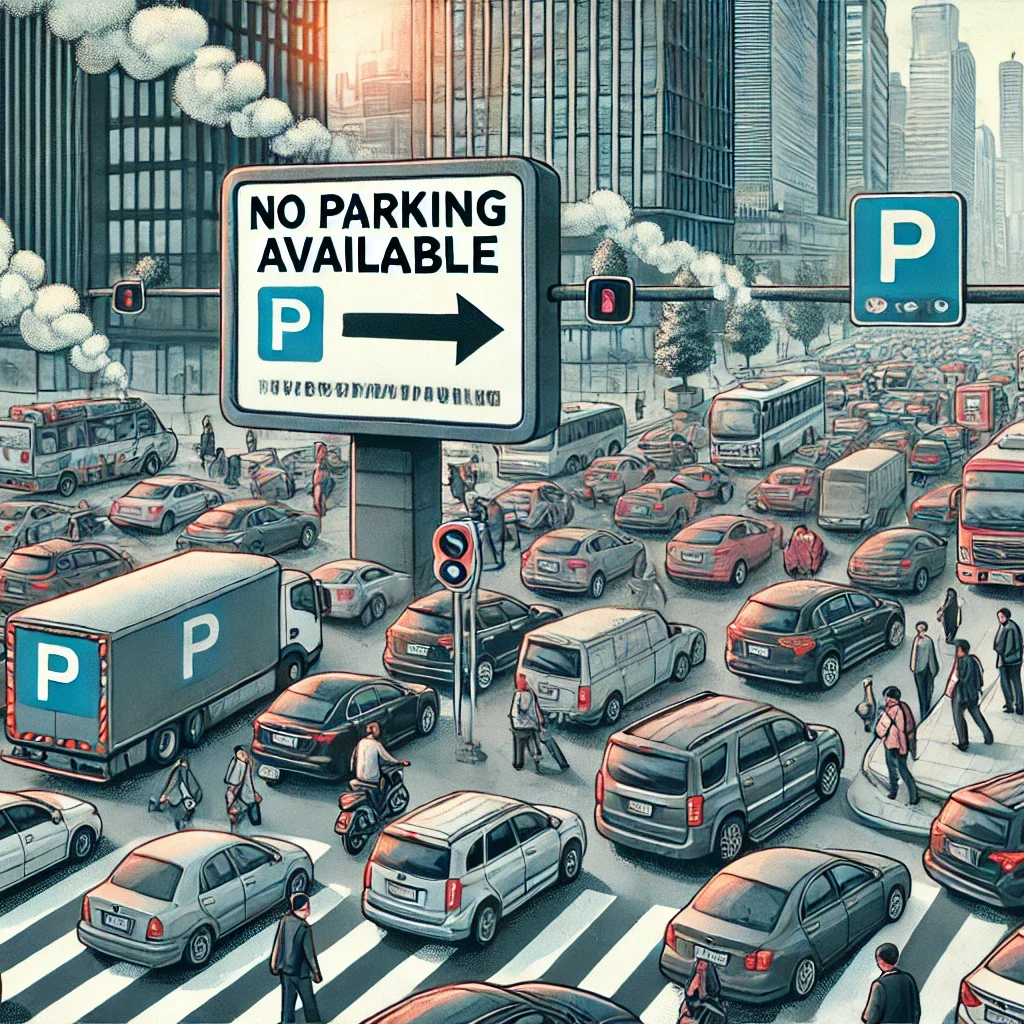
In urban areas, the rising number of vehicles has significantly outpaced the available parking spaces. This mismatch forces drivers to circle around for an average of 20–30 minutes just to find a spot, contributing to severe traffic congestion. The issue is further worsened during peak hours when demand surges and available spots are minimal.
This inefficient parking system results in:
- Increased fuel consumption and emissions, as cars idle and move slowly in search of parking.
- Higher stress levels for commuters, reducing overall city livability.
- Wasted time and productivity loss, affecting daily work schedules and personal plans.
- Lack of real-time parking availability data, making it impossible for drivers to plan ahead.
While some parking solutions exist, they are often fragmented, expensive, or difficult to integrate into existing urban infrastructure. The absence of a smart, tech-driven, real-time parking solution creates inefficiencies for commuters, businesses, and city planners alike. A robust, scalable, and data-driven approach is needed to optimize parking management, reduce congestion, and enhance urban mobility.
Stakeholders & Their Roles
- Commuters & Drivers – Everyday users who struggle to find parking, wasting time and fuel.
- City Authorities & Urban Planners – Responsible for managing urban infrastructure but lack real-time data to optimize parking.
- Parking Lot Owners & Operators – Want to maximize space utilization but face inefficiencies due to outdated systems.
- Businesses & Retailers – Experience loss of customers due to parking difficulties near their establishments.
- Environmental Organizations – Concerned about increased emissions from idling vehicles searching for parking.
- Smart City Technology Providers – Companies aiming to integrate smart parking solutions into urban infrastructure.
- Public Transport Authorities – Impacted by congestion, which slows down buses and other transit services.
Pain Points
- Time Wasted Searching for Parking
- Drivers spend an average of 20–30 minutes finding a spot, causing daily delays and frustration.
- Traffic Congestion Due to Circling Cars
- Vehicles searching for parking contribute up to 30% of urban traffic congestion.
- Fuel Wastage & Increased Emissions
- Idling and slow movement increase fuel consumption, leading to higher carbon emissions.
- Lack of Real-Time Parking Availability Information
- Drivers cannot check for available spots beforehand, leading to inefficiency.
- Inefficient Use of Existing Parking Spaces
- Many lots are underutilized or poorly managed, reducing efficiency.
- High Parking Costs & Payment Inconvenience
- Drivers face unpredictable pricing and lack of digital payment options.
- Limited Integration with Smart City Infrastructure
- Most urban areas lack connected parking systems that work with smart city solutions.
- Lost Business for Local Shops & Restaurants
- Shoppers avoid areas with difficult parking, reducing customer footfall.
- Inaccessible Parking for Disabled & Elderly Users
- Many existing parking systems do not prioritize accessibility.
- Lack of Incentives for Sustainable Parking Behavior
No system encourages carpooling, EV parking, or efficient space use.
Key Competitors & Their Offerings
- SpotHero
- A leading parking reservation app that allows users to find and book parking spots in advance.
- Offers mobile payments and integrations with garages.
- ParkMobile
- Provides cashless parking payments, allowing users to pay via an app instead of meters.
- Offers real-time availability for select locations.
- JustPark
- A UK-based platform that connects drivers with private parking spots, helping optimize unused spaces.
- ParkWhiz
- Focuses on event and city parking, enabling users to pre-book spots near stadiums, theaters, and airports.
- Smart Parking Ltd.
- Develops IoT-based parking solutions with sensors, license plate recognition, and smart payments.
Startups Working on Smart Parking Solutions
- Get My Parking – Cloud-based parking management platform for smart cities.
- Wayleadr – AI-driven last-mile parking optimization for office spaces.
- ParqEx – Peer-to-peer parking space rental.
- Urbanaut – Smart mobility company integrating AI with parking infrastructure.
- ParkBee – Unlocks private parking spaces for public use.
- AirGarage – Helps churches and businesses monetize unused parking spaces.
- Smarking – Analytics-based parking demand management platform.
- Parker – Real-time parking availability tracking.
- FlashParking – Cloud-based parking revenue management.
- Parklio – Smart parking barriers with IoT and mobile controls.
Innovations in Smart Parking
- AI-based Parking Prediction – Machine learning algorithms analyze parking demand.
- IoT Sensors in Parking Lots – Detects availability in real-time.
- License Plate Recognition (LPR) Systems – Enables automatic access and payments.
- Automated Parking Garages – Uses robotic systems to stack cars efficiently.
- Car-to-Infrastructure (C2I) Communication – Vehicles receive parking updates via navigation systems.
- Blockchain-based Parking Payments – Secure, decentralized transactions.
- Dynamic Pricing for Parking Spaces – Adjusts fees based on demand.
- Electric Vehicle (EV) Charging Parking – Dedicated parking with integrated EV charging.
- Parking as a Service (PaaS) – Subscription-based parking for commuters.
- Augmented Reality (AR) Navigation for Parking – AR overlays guide drivers to available spots.
Investment Trends in Smart Parking
- SpotHero raised $50M in Series D funding (2022) to expand its platform.
- ParkMobile acquired by EasyPark Group in 2021 for an undisclosed amount.
- Get My Parking secured $6M in funding (2023) to develop smart parking APIs.
- FlashParking merged with Arrive in 2021 to create a more comprehensive parking solution.
- Total investment in smart parking tech exceeded $5B globally in 2023, with major backing from mobility-focused VC firms.
Market Maturity & Gaps
The smart parking industry is growing rapidly, driven by urbanization and smart city initiatives. However, gaps still exist:
Product Vision: Smart & AI-Driven Urban Parking Optimization
We envision a seamless, AI-powered smart parking system that eliminates the inefficiencies of urban parking by providing real-time availability, predictive analytics, and automated booking for commuters. Our solution will integrate IoT sensors, AI algorithms, and mobile payments to create a frictionless parking experience, reducing congestion, fuel wastage, and emissions.
Our system will feature a centralized platform where drivers can:
✅ Instantly find nearby available parking spots via real-time data.
✅ Receive AI-driven parking predictions to plan ahead.
✅ Book and reserve spots in advance via mobile or in-car navigation.
✅ Use cashless payments via digital wallets or subscriptions.
✅ Access dynamic pricing based on demand to optimize parking costs.
For parking operators and city authorities, our platform will:
✅ Provide analytics & insights for better urban planning.
✅ Use IoT sensors to optimize parking space utilization.
✅ Support automated enforcement using license plate recognition.
✅ Offer EV-friendly parking zones with integrated charging stations.
Use Cases
- Real-Time Parking Availability – Drivers get live updates on vacant spots via mobile and car dashboards.
- AI-Powered Parking Prediction – Machine learning analyzes historical data to predict peak hours and future availability.
- Automated Parking Reservations – Users pre-book parking spaces in high-demand areas.
- Dynamic Pricing for Efficient Utilization – Parking fees adjust based on demand to balance availability.
- IoT-Enabled Smart Parking Sensors – Sensors in lots detect occupancy and update the system in real-time.
- License Plate Recognition for Entry/Exit – No need for tickets; automated access based on plate numbers.
- Seamless Digital Payments – Cashless transactions via mobile apps, wallets, and automated deductions.
- EV Charging & Priority Parking – Dedicated spaces for electric vehicles with integrated charging.
- Traffic & Parking Heatmaps for City Authorities – Insights for better urban planning and infrastructure improvements.
- Gamification & Rewards for Eco-Friendly Parking – Incentives for carpooling, EV usage, and off-peak parking.
Final Summary
Urban parking shortages have led to increased congestion, fuel wastage, and commuter stress, with drivers spending 20-30 minutes searching for a spot. This inefficiency contributes to 30% of city traffic congestion, higher emissions, and loss of productivity. Current solutions are fragmented, expensive, and lack seamless real-time integration with city infrastructure.
Our proposed solution is an AI-powered smart parking system that integrates IoT sensors, real-time data, and predictive analytics to optimize urban parking. Drivers can instantly find and reserve parking spots, reducing search time by up to 50%. The platform supports cashless payments, dynamic pricing, and automated enforcement using license plate recognition. Additionally, it provides analytics dashboards for city planners to enhance infrastructure planning and reduce congestion.
Market research indicates that the smart parking industry is growing rapidly, with over $5B invested globally in 2023. However, major gaps remain, including real-time accuracy issues, lack of AI adoption, and high infrastructure costs. Our competitive advantage lies in seamless smart city integration, AI-driven demand forecasting, and sustainability-focused parking incentives.
The roadmap outlines a 3-year phased development, starting with research, AI modeling, and pilot tests in 3 major cities, followed by expansion to 10+ urban regions. With an estimated $150M+ revenue potential in 5 years, this solution has the potential to transform urban mobility, reduce emissions, and create a frictionless parking experience for millions of commuters worldwide.