
Problem Statement
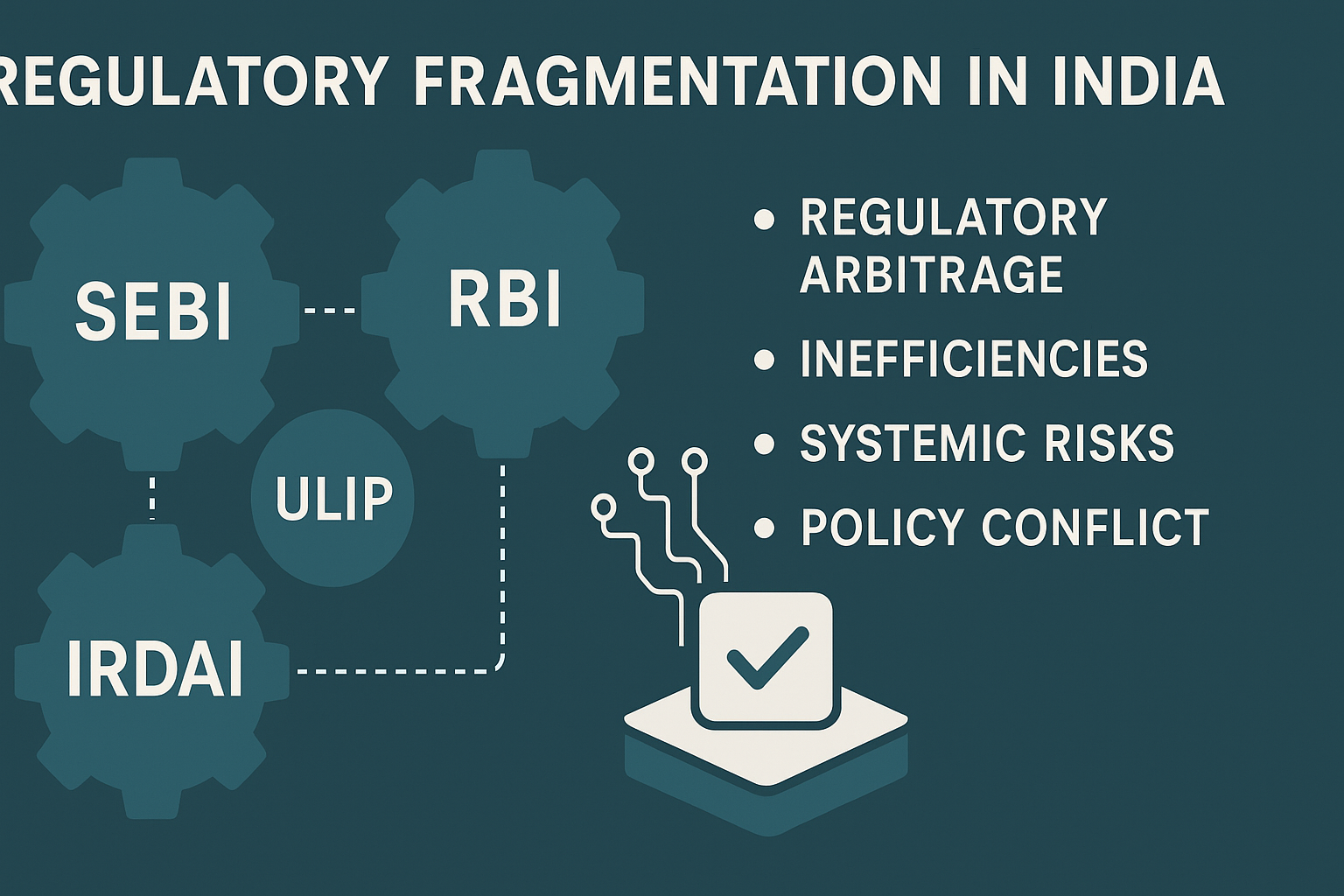
India’s financial ecosystem is regulated by multiple authorities such as SEBI (Securities and Exchange Board of India), RBI (Reserve Bank of India), and IRDAI (Insurance Regulatory and Development Authority of India). While each regulator has its own mandate, the growing overlap in financial products and markets has created gray zones in jurisdiction. This fragmentation leads to several issues—such as regulatory arbitrage, where entities exploit gaps between different regulations; inefficiencies in market functioning; and in some cases, even systemic risks due to lack of unified oversight.
For example, a product like ULIPs (Unit Linked Insurance Plans) blends investment and insurance features—bringing both SEBI and IRDAI into the picture. Yet, without a coordinated mechanism, policies may conflict or overlap, delaying approvals, weakening enforcement, and confusing market participants. Moreover, constraints in data sharing, monitoring, and policy harmonization further exacerbate the issue.
The effectiveness of regulators like SEBI is also undermined by limited resources and their inability to act seamlessly across sectors. The need of the hour is a digital, policy-backed platform that ensures transparent, real-time coordination, fosters shared decision-making, and brings systemic harmony to India’s complex regulatory landscape.
Pain Points
- Overlapping Jurisdictions
Financial products like ULIPs fall under multiple regulators, leading to confusion and regulatory arbitrage. - Regulatory Arbitrage
Entities exploit gaps between regulators to bypass stringent norms, undermining market integrity. - Delayed Decision-Making
Lack of coordination leads to slow responses in policy implementation and crisis management. - Inconsistent Enforcement
Varied interpretations and enforcement of regulations create uncertainty for market participants. - Data Silos
Limited data sharing among regulators hampers comprehensive risk assessment and oversight. - Resource Constraints
Regulators like SEBI face challenges in monitoring due to limited resources and reliance on external data. - Technological Disparities
Differing levels of technological adoption among regulators hinder seamless coordination. - Jurisdictional Conflicts
Disagreements over regulatory boundaries lead to turf wars, affecting policy coherence. - Investor Confusion
Multiple regulators issuing guidelines on similar products create confusion among investors. - Limited Crisis Preparedness
Fragmented oversight impedes unified responses to financial crises, risking systemic stability.
Key Competition
In the realm of enhancing coordination among regulatory bodies like SEBI, RBI, and IRDAI, several initiatives and organizations are noteworthy:
- Financial Stability and Development Council (FSDC): Established in 2010, FSDC acts as a super-regulator, promoting coordination among bodies like RBI, SEBI, IRDAI, and PFRDA to maintain systemic stability.
- Inter-Operable Regulatory Sandbox (IoRS): An initiative by RBI and SEBI, IoRS facilitates testing of innovative hybrid financial products/services that fall within the regulatory ambit of more than one financial sector regulator.
- Reserve Bank of India (RBI): RBI has introduced a new regulatory framework requiring impact analyses and public consultations as part of the rule-making process, aiming to standardize and enhance transparency in formulating and amending financial regulations.
- Insurance Regulatory and Development Authority of India (IRDAI): IRDAI is in active coordination with various agencies/departments to ensure effective implementation of the Anti-Money Laundering/Combating the Financing of Terrorism (AML/CFT) regime in India.
- FinTech Startups: Companies like Perfios, M2P, and Juspay are emerging as key players in the financial technology space, driven by factors such as rising customer experience expectations and regulatory push for modernization.
Maturity of the Market
The Indian regulatory landscape is evolving, with increasing emphasis on coordination and technological integration among regulatory bodies. Initiatives like FSDC and IoRS indicate a move towards more structured and collaborative regulatory frameworks. However, challenges remain in achieving seamless interoperability and comprehensive oversight.
Major Offerings by Competitors
Key features provided by existing initiatives and organizations include:
- Unified Regulatory Frameworks: Efforts to harmonize regulations across different financial sectors.
- Regulatory Sandboxes: Controlled environments for testing innovative financial products and services.
- Public Consultation Mechanisms: Incorporating stakeholder feedback in the regulatory process.
- Impact Analysis Requirements: Assessing the potential effects of new regulations before implementation.
- Data Sharing Protocols: Facilitating information exchange among regulatory bodies.
- Technological Integration: Adopting advanced technologies for regulatory processes and oversight.
- Self-Regulatory Organizations (SROs): Encouraging industry-led regulation and compliance.
- Anti-Money Laundering (AML) Coordination: Collaborative efforts to combat financial crimes.
- Financial Stability Initiatives: Programs aimed at maintaining systemic financial stability.
- Innovation Promotion: Supporting the development and adoption of innovative financial solutions.
Product Vision
India’s financial system is maturing rapidly, but fragmented regulatory oversight threatens its efficiency and stability. ReguLink Solutions envisions a unified regulatory coordination platform to bridge the gap among SEBI, RBI, IRDAI, and other financial regulatory bodies. The goal is to eliminate silos, prevent regulatory arbitrage, and improve the timeliness and clarity of policy decisions.
ReguSync will serve as a secure, real-time, cloud-based platform facilitating multi-agency collaboration through digital dashboards, AI-driven risk insights, and interoperable policy frameworks. The platform will incorporate smart notification systems, regulatory harmonization toolkits, and cross-institutional data sharing capabilities to standardize responses and interpretations of emerging financial products.
The core strength of ReguLink lies in its deep understanding of regulatory systems, ability to leverage emerging technologies like AI and blockchain, and focus on data security and policy compliance. These strengths give us an edge in solving India’s long-standing issue of fragmented oversight.
Concerns remain around policy adoption speed, bureaucratic resistance, and legacy system integration. However, phased onboarding with clear ROI metrics, supported by sandbox testing environments and compliance toolkits, can mitigate these concerns.
With projected adoption by core regulatory agencies and auxiliary institutions, ReguSync can generate approximately ₹300 crore in annual revenue within 5 years, through subscription licenses, data-as-a-service offerings, and strategic government partnerships.
Use Cases
1.Real-Time Regulatory Updates Across Agencies
- Short Info: A centralized system that disseminates real-time regulatory updates from SEBI, RBI, and IRDAI to all stakeholders.
- Reference: Product Vision; Pain Point 1: Delayed dissemination of regulatory changes.
- Stakeholders: Regulatory bodies, financial institutions, compliance officers.
- Elaboration: Currently, financial institutions receive regulatory updates through separate channels, leading to delays and inconsistencies. This use case envisions a unified platform where all regulatory bodies can publish updates simultaneously, ensuring that all stakeholders receive consistent information in real-time. This will enhance compliance and reduce the risk of regulatory breaches due to outdated information.
- Requirements:
- Integration with SEBI, RBI, and IRDAI communication systems.
- Real-time notification system for updates.
- User access management to control information dissemination.
- Audit trail for all updates.
- Multilingual support for broader accessibility.
- Mobile and desktop compatibility.
- Searchable archive of past updates.
- Feedback mechanism for clarification requests.
- Data encryption for secure communication.
- Analytics dashboard to monitor update engagement.
2.Unified Dashboard for Cross-Agency Risk Alerts
- Short Info: A consolidated dashboard displaying risk alerts from all regulatory bodies for proactive risk management.
- Reference: Product Vision; Pain Point 2: Fragmented risk alert systems.
- Stakeholders: Risk management teams, compliance officers, regulatory bodies.
- Elaboration: Financial institutions often struggle with monitoring risk alerts from multiple regulators, leading to potential oversight. This use case proposes a unified dashboard that aggregates risk alerts from SEBI, RBI, and IRDAI, providing a comprehensive view of potential risks. The dashboard will feature real-time updates, categorization of risks, and actionable insights to enable institutions to respond promptly and effectively.
- Requirements:
- Integration with risk alert systems of SEBI, RBI, and IRDAI.
- Real-time data synchronization.
- Customizable alert categorization and prioritization.
- User-specific dashboard views.
- Historical data analysis tools.
- Automated notification system for critical alerts.
- Collaboration tools for internal communication.
- Integration with existing risk management systems.
- Data visualization features for trend analysis.
- Secure access controls and user authentication.
3.Common Framework for Hybrid Financial Products
- Short Info: Development of a standardized regulatory framework for financial products that span multiple regulatory jurisdictions.
- Reference: Product Vision; Pain Point 3: Regulatory ambiguity for hybrid products.
- Stakeholders: Product development teams, legal departments, regulatory bodies.
- Elaboration: Innovative financial products often fall under the purview of multiple regulators, leading to compliance challenges. This use case focuses on creating a common regulatory framework that defines the compliance requirements for such hybrid products. By collaborating with SEBI, RBI, and IRDAI, the platform will provide clear guidelines, approval processes, and compliance checklists, facilitating smoother product development and launch.
- Requirements:
- Collaboration tools for inter-agency communication.
- Database of existing hybrid products and their regulatory requirements.
- Template creation for new product compliance.
- Workflow management for approval processes.
- Version control for regulatory documents.
- Automated compliance checklists.
- Integration with product development tools.
- User training modules on regulatory frameworks.
- Feedback mechanisms for continuous improvement.
- Secure document storage and access controls.
4.AI-Driven Risk Flagging and Impact Analysis
- Short Info: Utilization of artificial intelligence to identify potential risks and analyze their impact across the financial ecosystem.
- Reference: Product Vision; Pain Point 4: Delayed risk identification.
- Stakeholders: Risk analysts, compliance officers, regulatory bodies.
- Elaboration: Traditional risk identification methods are often reactive and time-consuming. This use case introduces AI algorithms that analyze vast datasets to proactively flag potential risks and assess their impact. By leveraging machine learning models, the system can detect patterns, predict emerging threats, and provide actionable insights, enabling stakeholders to implement preventive measures promptly.
- Requirements:
- Integration with internal and external data sources.
- Development of machine learning models for risk prediction.
- Real-time data processing capabilities.
- User-friendly dashboards for risk visualization.
- Alert systems for high-risk scenarios.
- Continuous learning mechanisms for model improvement.
- Data privacy and compliance adherence.
- Collaboration tools for risk mitigation planning.
- Audit trails for AI decision-making processes.
- Scalability to handle increasing data volumes.
5.Encrypted Data-Sharing Channels for Oversight
- Short Info: Secure communication channels enabling confidential data exchange between regulatory bodies and financial institutions.
- Reference: Product Vision; Pain Point 5: Data security concerns in inter-agency communication.
- Stakeholders: IT departments, compliance officers, regulatory bodies.
- Elaboration: The exchange of sensitive information between regulators and institutions is often hampered by security concerns. This use case proposes the implementation of encrypted communication channels that ensure data confidentiality and integrity. Utilizing advanced encryption standards and secure protocols, the platform will facilitate seamless and secure data sharing, enhancing trust and collaboration among stakeholders.
- Requirements:
- Implementation of end-to-end encryption protocols.
- User authentication and access controls.
- Secure file transfer mechanisms.
- Audit logs for all data exchanges.
- Compliance with data protection regulations.
- Integration with existing communication tools.
- Real-time monitoring of data transfer activities.
- Incident response plans for data breaches.
- User training on secure communication practices.
- Regular security assessments and updates.
6.Crisis Response Coordination Modules
- Short Info: A coordinated platform for managing financial crises through collaborative efforts of all regulatory bodies.
- Reference: Product Vision; Pain Point 6: Disjointed crisis management approaches.
- Stakeholders: Crisis management teams, regulatory bodies, financial institutions.
- Elaboration: In times of financial crises, swift and coordinated responses are crucial. This use case envisions a module that brings together all regulatory bodies to collaboratively manage crises. Features include real-time communication tools, shared action plans, resource allocation tracking, and post-crisis analysis capabilities. By centralizing crisis management efforts, the platform aims to mitigate the impact of financial disruptions effectively.
- Requirements:
- Real-time communication channels among stakeholders.
- Crisis action plan templates and customization options.
- Resource allocation and tracking tools.
- Incident reporting and documentation features.
- Integration with external emergency response systems.
- Analytics tools for post-crisis evaluation.
- User access controls for sensitive information.
- Training modules for crisis preparedness.
- Compliance with national crisis management protocols.
- Regular drills and simulations for readiness assessment.
7.Inter-Regulator Document Workflow Automation
- Short Info: Automating document workflows between SEBI, RBI, and IRDAI to enhance efficiency and reduce manual errors.
- Reference: Product Vision; Pain Point 7: Manual document handling leading to delays and inconsistencies.
- Stakeholders: Regulatory bodies, compliance departments, IT teams.
- Elaboration: Currently, document exchanges between regulatory bodies involve manual processes, leading to delays and potential errors. This use case focuses on implementing an automated workflow system that streamlines document creation, approval, and sharing processes. By leveraging workflow automation tools, the system will ensure timely and accurate document handling, enhancing inter-agency coordination and compliance.
- Requirements:
- Integration with existing document management systems.
- Automated routing of documents based on predefined rules.
- Real-time tracking of document status.
- Audit trails for all document actions.
- Role-based access controls.
- Notification system for pending actions.
- Version control and document history maintenance.
- Compliance with data protection regulations.
- User-friendly interface for workflow design.
- Reporting tools for workflow performance analysis.
8.Multi-Level Stakeholder Feedback System
- Short Info: A platform facilitating structured feedback collection from various stakeholders to inform regulatory decisions.
- Reference: Product Vision; Pain Point 8: Lack of structured stakeholder input in regulatory processes.
- Stakeholders: Regulators, financial institutions, industry experts, public representatives.
- Elaboration: Effective regulation requires input from diverse stakeholders. This use case introduces a system that enables regulators to solicit, collect, and analyze feedback from multiple levels, including financial institutions, industry experts, and the public. The platform will support surveys, public consultations, and collaborative forums, ensuring that regulatory decisions are well-informed and inclusive.
- Requirements:
- Survey and feedback form creation tools.
- User authentication and role management.
- Data analysis and visualization tools.
- Integration with communication channels (email, SMS, etc.).
- Multilingual support.
- Anonymity options for respondents.
- Feedback tracking and reporting mechanisms.
- Compliance with data privacy laws.
- Mobile and desktop accessibility.
- Archiving and retrieval of past feedback data.
9.Sandbox Testing for Inter-Sector Innovations
- Short Info: A controlled environment for testing new financial products and services that span multiple regulatory domains.
- Reference: Product Vision; Pain Point 9: Challenges in testing cross-sector innovations due to regulatory silos.
- Stakeholders: Fintech companies, regulatory bodies, financial institutions.
- Elaboration: Innovative financial products often intersect multiple regulatory areas, making testing and approval complex. This use case proposes a sandbox environment where such products can be tested collaboratively by relevant regulators. The sandbox will provide guidelines, monitoring tools, and feedback mechanisms to ensure that innovations are assessed comprehensively and efficiently.
- Requirements:
- Application portal for sandbox participation.
- Defined criteria and guidelines for sandbox entry.
- Monitoring and reporting tools for ongoing tests.
- Collaboration tools for regulators and innovators.
- Data security and confidentiality measures.
- Feedback and evaluation frameworks.
- Integration with existing regulatory systems.
- Exit criteria and pathways for successful tests.
- Training modules for participants.
- Documentation and knowledge sharing repositories.
10.Smart Audit Trails for Compliance and Accountability
- Short Info: Automated tracking of regulatory actions and decisions to enhance transparency and accountability.
- Reference: Product Vision; Pain Point 10: Difficulty in tracking regulatory actions across agencies.
- Stakeholders: Regulatory bodies, compliance officers, auditors.
- Elaboration: Maintaining transparent records of regulatory actions is crucial for accountability. This use case focuses on implementing smart audit trails that automatically log actions, decisions, and communications across regulatory bodies. These logs will be immutable, time-stamped, and easily retrievable, facilitating audits and reviews.
- Requirements:
- Automated logging of system activities.
- Immutable and tamper-proof record storage.
- Time-stamping of all entries.
- User access logs and activity tracking.
- Searchable audit trail interface.
- Integration with existing compliance tools.
- Alert systems for unusual activities.
- Data export options for audits.
- Compliance with legal and regulatory standards.
- Regular backups and disaster recovery plans.
11.Centralized Regulatory Knowledge Repository
- Short Info: A unified platform to store, manage, and disseminate regulatory documents, guidelines, and updates across SEBI, RBI, and IRDAI.
- Reference: Product Vision; Pain Point 11: Disparate information sources leading to inconsistencies.
- Stakeholders: Regulatory bodies, financial institutions, compliance officers, legal teams.
- Elaboration: Regulatory bodies often release guidelines and updates through separate channels, causing confusion and inefficiencies. This use case focuses on creating a centralized repository where all regulatory documents are stored, categorized, and easily accessible. The platform will support version control, search functionalities, and notifications for updates, ensuring that stakeholders have consistent and timely access to regulatory information.
- Requirements:
- Secure storage system with backup capabilities.
- Advanced search and filtering options.
- Version control and document history tracking.
- User access controls and permissions.
- Integration with existing regulatory websites and portals.
- Notification system for document updates.
- Multilingual support for wider accessibility.
- Mobile and desktop compatibility.
- Analytics dashboard for document usage and access patterns.
- Compliance with data protection and privacy regulations.
12.Inter-Agency Training and Capacity Building Platform
- Short Info: A collaborative platform for training programs, workshops, and knowledge sharing among regulatory bodies.
- Reference: Product Vision; Pain Point 12: Lack of coordinated training leading to skill gaps.
- Stakeholders: Regulatory staff, training departments, subject matter experts.
- Elaboration: To ensure consistent understanding and application of regulations, it’s essential for regulatory bodies to engage in joint training and capacity-building initiatives. This use case proposes a platform where SEBI, RBI, and IRDAI can collaboratively develop and deliver training modules, host webinars, and share best practices. Such coordinated efforts will enhance the overall competency and cohesion among regulatory personnel.
- Requirements:
- Learning Management System (LMS) integration.
- Course creation and management tools.
- Webinar and virtual classroom capabilities.
- Assessment and certification mechanisms.
- User progress tracking and reporting.
- Discussion forums and collaborative spaces.
- Resource library for training materials.
- Multilingual support.
- Mobile accessibility.
- Feedback and evaluation tools for continuous improvement.
13.Unified Compliance Calendar
- Short Info: A consolidated calendar highlighting key compliance dates and deadlines across all regulatory bodies.
- Reference: Product Vision; Pain Point 13: Overlapping compliance schedules causing confusion.
- Stakeholders: Financial institutions, compliance officers, regulatory bodies.
- Elaboration: Financial institutions often struggle with tracking multiple compliance deadlines from different regulators, leading to missed obligations and penalties. This use case introduces a unified compliance calendar that aggregates all critical dates, sends reminders, and allows for integration with internal scheduling systems. Such a tool will streamline compliance management and reduce the risk of oversight.
- Requirements:
- Integration with regulatory bodies’ compliance schedules.
- Customizable calendar views (monthly, weekly, daily).
- Automated reminders and notifications.
- Synchronization with external calendar applications (e.g., Outlook, Google Calendar).
- User-specific compliance tracking.
- Mobile and desktop accessibility.
- Role-based access controls.
- Audit trail for compliance activities.
- Reporting tools for compliance status.
- Data encryption and security measures.
14.Regulatory Sandbox for Cross-Sector Innovations
- Short Info: A collaborative environment for testing innovative financial products that span multiple regulatory domains.
- Reference: Product Vision; Pain Point 14: Challenges in regulating cross-sector financial innovations.
- Stakeholders: Fintech companies, regulatory bodies, financial institutions.
- Elaboration: Innovative financial products often intersect various regulatory jurisdictions, making their assessment complex. This use case proposes a regulatory sandbox where such products can be tested under the joint supervision of SEBI, RBI, and IRDAI. The sandbox will provide a controlled environment to assess risks, gather data, and refine regulations, facilitating innovation while ensuring compliance.
- Requirements:
- Application portal for sandbox participation.
- Defined criteria and guidelines for sandbox entry.
- Monitoring and reporting tools for ongoing tests.
- Collaboration tools for regulators and innovators.
- Data security and confidentiality measures.
- Feedback and evaluation frameworks.
- Integration with existing regulatory systems.
- Exit criteria and pathways for successful tests.
- Training modules for participants.
- Documentation and knowledge-sharing repositories.
15.Integrated Risk Assessment Dashboard
- Short Info: A comprehensive dashboard providing real-time insights into systemic risks across the financial sector.
- Reference: Product Vision; Pain Point 15: Lack of consolidated risk visibility across sectors.
- Stakeholders: Regulatory bodies, financial institutions, risk management teams.
- Elaboration: Understanding systemic risks requires a holistic view of the financial sector. This use case focuses on developing an integrated dashboard that aggregates data from various regulators, providing real-time analytics and visualizations. The dashboard will aid in proactive risk identification, trend analysis, and informed decision-making, enhancing the resilience of the financial system.
- Requirements:
- Data integration from SEBI, RBI, and IRDAI systems.
- Real-time data processing and analytics.
- Customizable visualization tools (charts, graphs, heatmaps).
- Risk scoring and alert mechanisms.
- User access controls and permissions.
- Historical data analysis capabilities.
- Mobile and desktop compatibility.
- Integration with reporting tools.
- Compliance with data privacy and security standards.
- Training and support resources for users.
Summary
India’s financial regulatory environment is a complex structure with overlapping jurisdictions across major authorities like SEBI, RBI, and IRDAI. While each regulator plays a vital role in maintaining financial order, the absence of coordinated oversight has led to inefficiencies, regulatory arbitrage, and confusion in compliance enforcement. Products that intersect sectors, such as hybrid financial instruments, face particular challenges due to this fragmentation.
ReguLink Solutions Pvt. Ltd. addresses this systemic flaw with ReguSync, a unified regulatory coordination platform. Through intelligent data-sharing protocols, AI-driven insights, and automated compliance tools, ReguSync facilitates real-time communication among financial regulators and stakeholders. This innovation promotes synchronized policy decisions, risk identification, and harmonized regulatory enforcement.
Our research identified major pain points—such as lack of data interoperability, delays in crisis response, and inconsistent product regulations—and compared existing tools like FSDC and sandbox frameworks. Though the market is evolving, current solutions fall short of fully addressing inter-agency integration.
We mapped out 15 high-impact use cases—ranging from shared compliance calendars and AI-led risk flagging to encrypted communication tools and unified knowledge repositories. With optimistic projections estimating ₹300 crore in annual revenue by 2030, ReguSync sets the foundation for regulatory efficiency and market stability.
Planned for launch in Q1 2026, ReguSync positions itself as the critical digital bridge for India’s regulatory ecosystem.