
problem statement
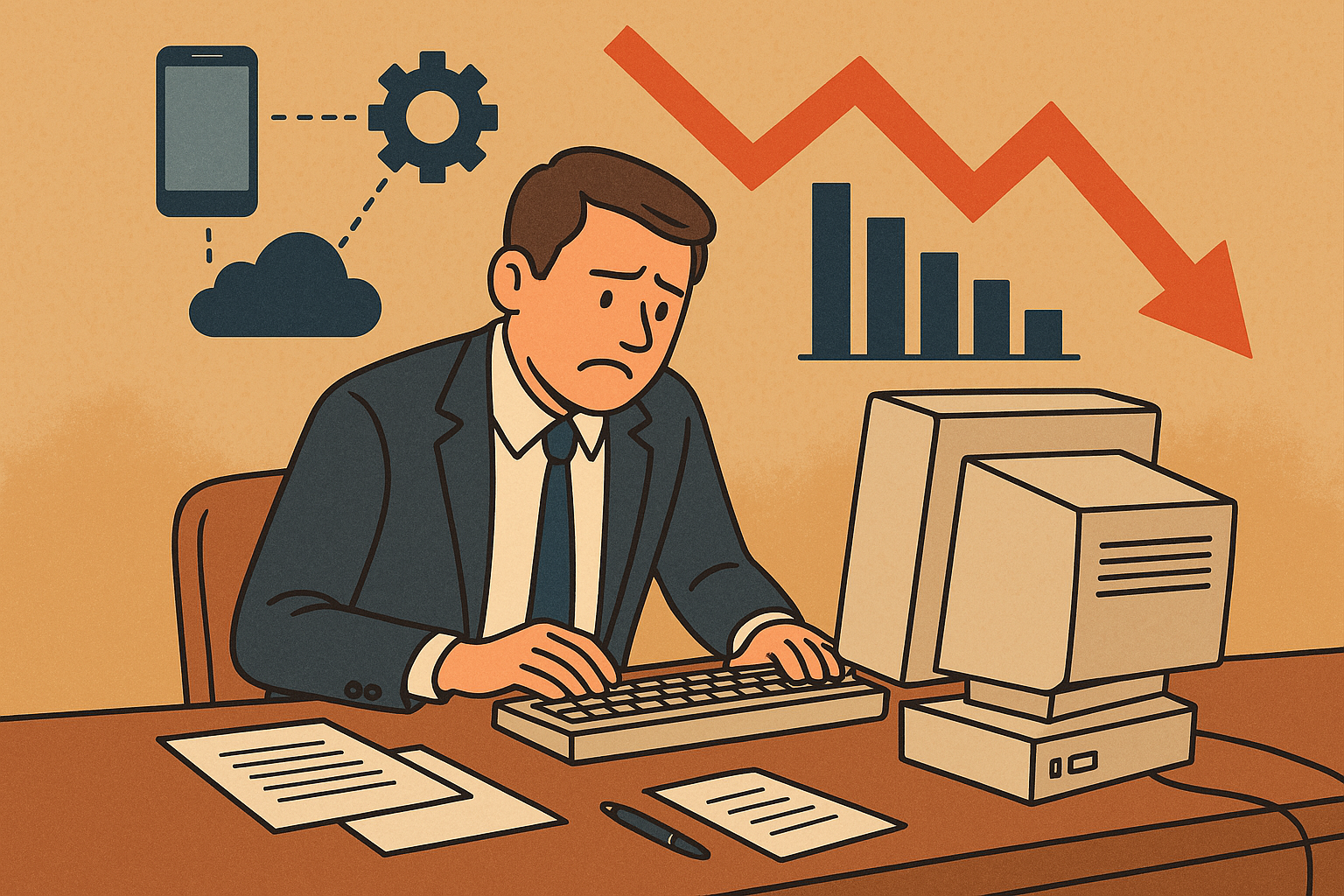
In today’s rapidly evolving digital landscape, companies that fail to embrace modern technologies face significant risks such as operational inefficiencies, poor customer experience, and ultimately, reduced market relevance. As competitors integrate automation, data analytics, AI, and cloud infrastructure to streamline operations and deliver smarter services, lagging businesses encounter increased costs, slower workflows, and challenges in meeting modern consumer expectations.
This technological stagnation often stems from legacy systems, lack of digital expertise, resistance to change, or budget constraints. These obstacles prevent businesses—especially small to mid-sized enterprises—from leveraging transformative tools that can enhance decision-making, customer engagement, and operational scalability.
Moreover, this technology gap widens over time, making it even harder for such businesses to catch up, causing lost market share, employee dissatisfaction, and revenue decline. TechLeap Solutions recognizes this critical issue and aims to bridge the gap by providing tailored tech adoption strategies and platforms to modernize operations efficiently, ensuring businesses remain competitive and future-ready.
Pain Points
- Outdated Systems – Legacy software slows down operations, lacks compatibility with new solutions, and increases maintenance costs.
- Lack of Digital Expertise – Businesses struggle to understand what technologies to adopt and how to use them effectively.
- High Implementation Costs – Upfront costs of modern solutions deter small businesses with limited budgets.
- Employee Resistance – Fear of change or job loss causes pushback on adopting new technologies.
- Integration Issues – Difficulty in integrating new tech with existing infrastructure leads to inefficiencies.
- Security Concerns – Concerns about data breaches and compliance hinder cloud adoption and digital transformation.
- Limited Scalability – Traditional methods limit the ability to scale operations efficiently.
- Poor Customer Experience – Inability to provide digital touchpoints leads to customer dissatisfaction.
- Delayed Decision-Making – Lack of real-time data access slows down critical business decisions.
- Competitive Pressure – Rapidly digitizing competitors reduce market share for tech-lagging businesses.
Stakeholders and Their Roles
- Business Owners – Decision-makers evaluating tech investment
- Operations Managers – Primary users facing daily inefficiencies
- IT Teams – Implement and manage new tech systems
- Employees – Impacted by changes in workflows and tools
- Customers – End recipients of service quality changes
- Investors – Seek growth and sustainability through innovation
- Tech Vendors – Provide tools and support infrastructure
- Consultants – Guide in tech strategy and implementation
Key Competitors
In the realm of digital transformation for small and mid-sized enterprises (SMEs), several companies have established themselves as leaders:
- DataToBiz: Specializes in end-to-end digital transformation solutions, empowering businesses to adopt data-driven models for decision-making.
- Aeologic Technologies: Offers custom digital transformation solutions, including AI-driven automation and cloud migration, tailored to various industries.
- Innowise: A global software development company known for driving digital transformation across industries with over 200 successful projects.
- Intellectsoft: Provides full-cycle digital transformation services to SMBs, startups, and enterprises, including Fortune 500 companies.
- Dell Technologies: Beyond manufacturing, Dell offers digital transformation services like the Unified Workplace and Dell Technologies Cloud.
Innovations in the Industry
- AI Integration: Companies are embedding AI into various business functions to automate tasks and provide insights. For instance, SMEs are using AI-enabled tools to save on personnel costs and increase efficiency.
- Cloud Computing: Transitioning to cloud platforms allows businesses to scale operations and access services remotely, enhancing flexibility.
- Data Analytics: Leveraging big data and analytics helps businesses make informed decisions and personalize customer experiences.
- Internet of Things (IoT): Connecting devices to the internet enables real-time monitoring and management of operations.
- Blockchain Technology: Ensures secure and transparent transactions, which is particularly beneficial in supply chain management.
Market Maturity
- Increased Awareness: SMEs recognize the importance of digital tools in staying competitive.
- Government Initiatives: Programs aimed at enhancing SME digital capabilities contribute to market growth.
- Technological Advancements: Emerging technologies become more accessible and affordable for SMEs.
Product Vision
In a world where technology drives competitiveness, TechLeap Solutions envisions a future where no business is left behind due to digital inertia. “TechLeap One” will be a unified, modular digital transformation platform tailored for small and mid-sized enterprises. It will offer an ecosystem of scalable solutions covering automation, cloud migration, data analytics, cybersecurity, digital marketing, and CRM integration — all within a user-friendly interface.
What sets TechLeap One apart is its focus on accessibility and guidance. The platform will include a built-in Digital Advisor that helps businesses assess their digital maturity and suggests step-by-step modules to implement, based on their goals and current setup. Rather than overwhelming users with a massive system overhaul, we focus on progressive digital growth.
The platform will be offered as a SaaS subscription with optional consulting add-ons. SMEs can select from industry-specific templates and use pre-built connectors for quick integration with existing systems.
In addition to the platform, TechLeap One will offer a learning hub, helping business owners and staff upskill in digital tools, ensuring long-term adoption and ROI.
Use Cases
- Digitizing operations for a local manufacturing unit
- Automating invoice and payroll systems
- Implementing cloud-based inventory management
- Enabling remote collaboration tools for distributed teams
- Integrating CRM with marketing automation
- Real-time analytics dashboard for sales tracking
- AI-based customer service chatbot implementation
- Cybersecurity assessment and policy enforcement
- Website optimization and digital store setup
- E-learning portal for employee digital training
Summary
In today’s competitive landscape, the failure to adopt modern technologies poses significant threats to small and medium enterprises (SMEs), including inefficiencies, increased costs, and lost market share. TechLeap Solutions, understanding these challenges, initiated a deep-dive into the problem to develop a robust digital transformation platform specifically tailored for SMEs. Through extensive analysis, we identified major pain points such as fragmented systems, manual workflows, and the lack of affordable, scalable tech solutions.
Our competitive research revealed that while several companies offer piecemeal solutions, none comprehensively address the unique constraints and scalability needs of SMEs. With a projected annual revenue potential of over $15 million within five years, TechLeap’s proposed product — TechLeap One — aims to fill this gap. The platform offers modular features including cloud migration, process automation, CRM integration, analytics, and cybersecurity — all with an intuitive interface and step-by-step adoption guidance.
We detailed 20 practical use cases ranging from invoice automation to cloud-based inventory and remote collaboration tools. These use cases directly solve pain points with specific requirements ensuring technical feasibility and business impact.