
Problem Statement
The digital divide remains a significant challenge for tech companies. Ensuring equitable access to technology and digital services across different socio-economic groups is essential for fostering inclusive innovation and preventing further inequality. The digital divide refers to the gap between those who have easy access to the internet and digital technologies and those who do not. This disparity can be seen across various dimensions, including income levels, geographic locations, age groups, and educational backgrounds. Those without adequate access to technology are at a disadvantage in terms of education, employment opportunities, healthcare, and social engagement. The COVID-19 pandemic has further highlighted these disparities, as remote work, online education, and telehealth services became essential, leaving those on the wrong side of the digital divide even more isolated. Addressing this issue requires a multifaceted approach that involves improving infrastructure, making technology affordable, enhancing digital literacy, and ensuring that digital content and services are accessible to all. A dedicated platform that integrates these elements can help bridge the digital divide, empowering underserved communities and promoting inclusive growth. Such a platform would support initiatives aimed at expanding broadband access, providing affordable devices, offering digital skills training, and developing accessible digital content.
Pain Points
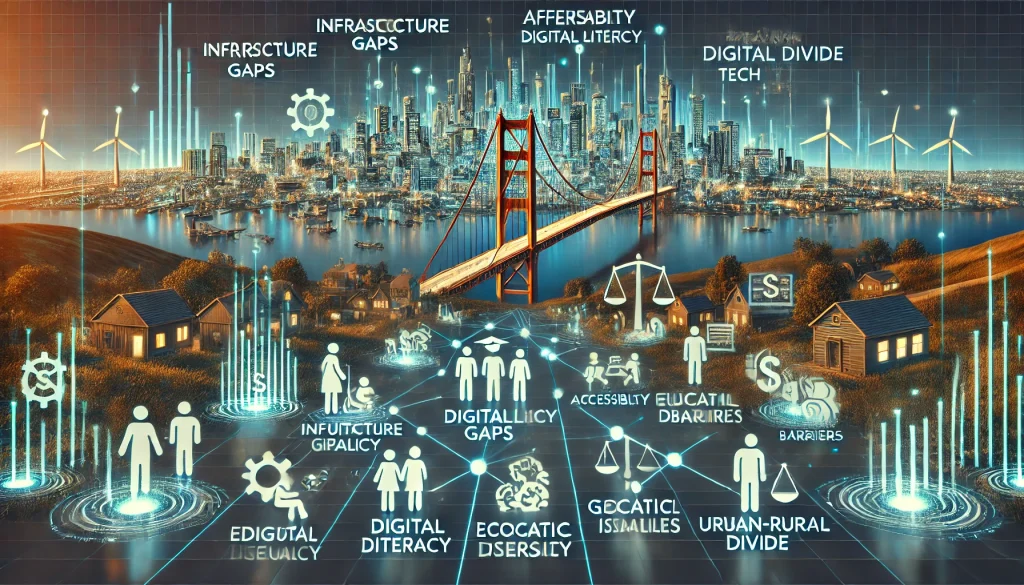
- Infrastructure Gaps: Lack of internet infrastructure in rural and underserved areas.
- Affordability: High cost of internet services and digital devices.
- Digital Literacy: Insufficient digital skills among certain socio-economic groups.
- Accessibility: Digital content and services not accessible to people with disabilities.
- Economic Barriers: Financial constraints limiting access to technology.
- Geographic Disparities: Urban-rural divide in technology access and usage.
- Educational Inequality: Limited access to online educational resources.
- Health Disparities: Inequitable access to telehealth and digital health services.
- Social Isolation: Lack of digital connectivity leading to social exclusion.
- Regulatory Challenges: Navigating policies and regulations to expand digital access.
Future Vision
Our platform envisions a future where equitable access to technology and digital services is a reality for all socio-economic groups. By leveraging advanced technologies such as AI, IoT, and blockchain, the platform will provide comprehensive solutions to bridge the digital divide. AI-driven analytics will identify areas with the greatest need for digital infrastructure and support targeted initiatives to expand broadband access. IoT devices will enable real-time monitoring of connectivity and usage, ensuring efficient resource allocation. Blockchain technology will ensure transparency and accountability in the distribution of digital resources and funds. The platform will also offer affordable devices and subsidized internet services through partnerships with tech companies and ISPs. Digital literacy programs will be integrated, providing training and resources to enhance digital skills. Additionally, the platform will focus on developing accessible digital content and services to ensure inclusivity for people with disabilities. By supporting community-driven initiatives and fostering public-private partnerships, our platform will create a sustainable ecosystem that promotes digital equity and inclusive growth, ensuring that no one is left behind in the digital age.
Use Cases
- Broadband Expansion Initiatives: Supporting projects to build and expand internet infrastructure in underserved areas.
- Affordable Device Programs: Providing low-cost digital devices to underserved communities.
- Subsidized Internet Services: Partnering with ISPs to offer affordable internet plans.
- Digital Literacy Training: Offering programs to enhance digital skills across different age groups and communities.
- Accessible Digital Content: Developing and promoting digital content that is accessible to people with disabilities.
- Telehealth Services: Expanding access to telehealth services in underserved areas.
- Online Education Access: Ensuring equitable access to online educational resources and platforms.
- Community Wi-Fi Projects: Implementing community-driven Wi-Fi access points in urban and rural areas.
- Real-Time Connectivity Monitoring: Using IoT devices to monitor internet connectivity and usage in real-time.
- Blockchain for Transparency: Leveraging blockchain to ensure transparent distribution of digital resources and funding.
Target Users and Stakeholders
- User: Community Leaders, Educators, Healthcare Providers, and Tech Companies
- Age Group: 25-60 years
- Gender: M/F
- Usage Pattern: Regular usage for managing digital access initiatives, training programs, and resource allocation
- Benefit: Enhanced digital equity, improved access to technology, and inclusive growth
- Stakeholders:
- Underserved Communities: Individuals and families with limited access to technology
- Educational Institutions: Schools and universities seeking to provide online education
- Healthcare Providers: Clinics and hospitals offering telehealth services
- Regulators: Government agencies overseeing digital access policies
- Tech Companies and ISPs: Businesses providing technology and internet services
- Non-Profits and NGOs: Organizations advocating for digital equity and inclusive growth
Key Competition
- Google Fiber: Provides high-speed internet services with a focus on expanding access.
- Microsoft Airband Initiative: Expands broadband access in rural areas through partnerships.
- OneWeb: Develops satellite internet to provide global broadband access.
- Starlink: Offers satellite internet services aimed at underserved regions.
- Facebook Connectivity: Projects to bring internet access to remote and underserved areas.
Products/Services
- Google Fiber: High-speed internet services for urban and rural areas.
- Microsoft Airband Initiative: Broadband expansion through public-private partnerships.
- OneWeb: Satellite internet services for global connectivity.
- Starlink: Satellite-based broadband services targeting remote areas.
- Facebook Connectivity: Projects aimed at expanding internet access worldwide.
Active Startups
- Viasat: Provides satellite internet services to remote and underserved areas.
- Kajeet: Offers mobile broadband solutions for education and healthcare.
- Tala: Provides affordable smartphones and internet access in emerging markets.
- Bridgefy: Develops offline messaging apps for areas with limited connectivity.
- Bluesky: Innovates in affordable internet solutions for underserved communities.
- BRCK: Provides rugged internet devices and connectivity solutions in Africa.
- Remix: Offers digital literacy programs and resources for underserved communities.
- Mesh++: Creates solar-powered Wi-Fi networks for rural and remote areas.
- GoTenna: Develops mobile mesh networking solutions for connectivity in off-grid areas.
- Poda: Builds community-based Wi-Fi networks to expand digital access.
Ongoing Work in Related Areas
- AI and Big Data: Identifying connectivity gaps and optimizing resource allocation.
- IoT and Automation: Enhancing real-time monitoring and management of digital infrastructure.
- Blockchain: Ensuring transparency and accountability in resource distribution.
- Digital Literacy: Developing comprehensive training programs to enhance digital skills.
- Public-Private Partnerships: Fostering collaborations to expand digital access and equity.
Recent Investment
- Viasat: $600M in funding for satellite internet expansion, April 2021.
- Kajeet: $55M in Series B funding led by ABS Capital Partners, January 2021.
- Tala: $110M in Series D funding led by RPS Ventures, October 2020.
- Bridgefy: $1.6M in seed funding led by Right Side Capital Management, June 2019.
- BRCK: $3M in Series A funding led by Invested Development, August 2018.
Market Maturity
The market for platforms addressing the digital divide is evolving rapidly. Established companies like Google, Microsoft, and Facebook are leading initiatives to expand internet access, while innovative startups like Viasat, Kajeet, and Bridgefy are developing solutions tailored to underserved communities. Significant investments in AI, IoT, and blockchain are transforming the landscape, enabling more efficient and effective approaches to bridging the digital divide. As the market matures, we expect to see more integrated and advanced platforms that offer comprehensive solutions for expanding digital access and promoting digital equity. These platforms will play a crucial role in ensuring that all socio-economic groups can benefit from the opportunities provided by the digital age.
Summary
The digital divide remains a significant challenge for tech companies. Ensuring equitable access to technology and digital services across different socio-economic groups is essential for fostering inclusive innovation and preventing further inequality. Our proposed platform leverages AI, IoT, and blockchain to provide comprehensive solutions for bridging the digital divide. Key pain points include infrastructure gaps, affordability, digital literacy, accessibility, economic barriers, geographic disparities, educational inequality, health disparities, social isolation, and regulatory challenges.
Target users include community leaders, educators, healthcare providers, and tech companies, with stakeholders encompassing underserved communities, educational institutions, healthcare providers, regulators, tech companies, ISPs, non-profits, and NGOs. Key competitors like Google Fiber, Microsoft Airband Initiative, OneWeb, Starlink, and Facebook Connectivity offer various solutions to expand digital access. Active startups such as Viasat, Kajeet, Tala, Bridgefy, and BRCK are driving innovation in this space. Recent investments highlight significant interest and growth potential in platforms addressing the digital divide.
By addressing these challenges and leveraging advanced technologies, our platform aims to bridge the digital divide, empowering underserved communities and promoting inclusive growth.