
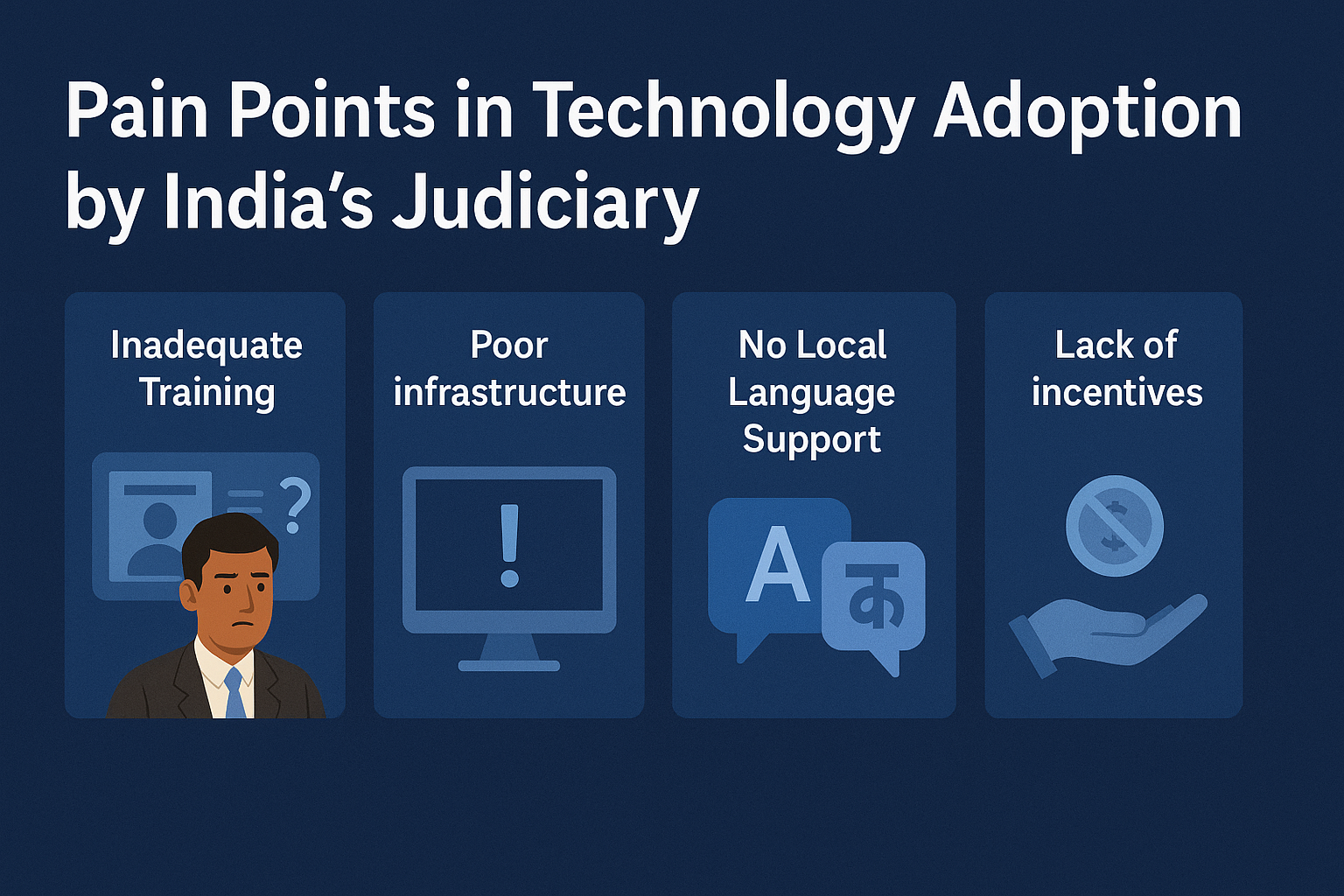
problem statement
Despite the Indian judiciary’s push towards digitization through platforms like e-Courts, a significant gap remains in effective on-ground implementation, especially within lower courts. The root cause is not just technical limitations but a deep-seated lack of digital literacy and operational comfort among judicial officers and court staff. These individuals are often ill-equipped to use available tools such as online case management systems, digital documentation, or virtual hearings. Training modules, where they exist, are either outdated, inaccessible, or poorly tailored to the end-users’ technical levels.
Resistance to change, deeply embedded in the procedural culture of the judiciary, exacerbates the issue. This is particularly evident in district and taluka-level courts where traditional pen-paper systems still dominate. As a result, digital tools meant to expedite hearings, automate documentation, and provide transparency remain largely underused or misused. The outcome is slow case movement, overburdened administrative tasks, and loss of public trust in judicial efficiency.
Pain Points
- Lack of Tech Literacy: Most officers are unfamiliar with basic digital tools, slowing adoption and increasing dependency on paper-based processes.
- Ineffective Training: Available training is generic, sporadic, and doesn’t address real-world usage issues faced by court staff.
- Resistance to Change: Cultural inertia and fear of replacing known processes hinder tech adoption, especially in rural/district courts.
- Underuse of e-Courts Portal: Officers often don’t explore functionalities beyond basic case tracking, wasting potential of the platform.
- No Feedback Loop: User feedback on tech tools is rarely collected or implemented, leading to misaligned features.
- Poor Support System: Lack of quick IT help during failures results in reverting to manual systems.
- Language Barriers: Training and systems are often not localized, making them inaccessible to many non-English speaking staff.
- Obsolete Equipment: Many courtrooms still operate on old hardware, unable to run modern software smoothly.
- Inconsistent Internet Connectivity: Many rural courts face network issues that hinder real-time access and updates.
- Lack of Incentives: No performance or recognition-based motivation for adapting digital practices.
Stakeholders & Roles
- Judicial Officers (Judges, Magistrates) – Primary users of digital court systems.
- Court Clerks and Admin Staff – Daily data entry, document handling, scheduling, and record maintenance.
- Ministry of Law and Justice – Regulatory and funding authority for digital initiatives.
- NIC (National Informatics Centre) – Tech implementers of digital court infrastructure.
- Bar Council and Lawyers – End users affected by system delays and tech literacy.
- Litigants – Citizens expecting faster case resolution.
- Training Providers/NGOs – Partners in educational programs.
- Supreme Court e-Committee – Body directing digitization across courts.
- IT Support Teams – Implement and troubleshoot court technology.
- Policy Think Tanks – Evaluate systemic effectiveness and suggest reforms.
Key Competitors
- e-Courts Project (Government of India): A transformative initiative under the Supreme Court of India, aiming to modernize judicial functions through digital innovation. In Phase III, the project integrates advanced Artificial Intelligence (AI) solutions to enhance case management and administrative efficiency across courts in India.
- ManCorp Innovation Labs: A Pune-based startup leveraging technology to ease the justice delivery process. They have conducted pilot projects in various High Courts, building AI solutions to help with case allocation and using optical character recognition (OCR) to machine encode handwritten or printed text.
- Jupitice: A Chandigarh-based IT startup that has launched an online private digital court to resolve commercial and civil cases through various alternative dispute resolution (ADR) mechanisms.
- APS Judicial Academy: Provides judiciary coaching in India, offering comprehensive study material and mock tests to prepare students for judicial services exams.
- Drishti Judiciary: Powered by Drishti IAS, this platform offers dedicated judiciary coaching, including a 3-year Foundation Course targeting Prelims and Mains, catering to judicial services aspirants.
Market Maturity & Gaps
The Indian judicial system is undergoing significant digital transformation, with substantial government investment and the emergence of legal-tech startups. However, challenges such as resistance to change, lack of adequate training, and infrastructure limitations persist, indicating a market that is evolving but still in the growth phase.
Major Offerings by Competitors
- AI Integration: Advanced AI solutions for case management and administrative efficiency.
- Digital Training: Online training programs for judicial officers and court staff.
- Private Digital Courts: Platforms facilitating alternative dispute resolution mechanisms.
- Judiciary Coaching: Comprehensive courses and study materials for judicial services aspirants.
- OCR Technology: Optical character recognition tools to digitize handwritten or printed text.
Despite existing platforms and initiatives, the following critical issues persist:
- Users lack confidence and clarity in using digital judicial tools effectively.
- Training remains infrequent, generalized, and lacks hands-on engagement.
- There’s minimal localized support in terms of language and culture-specific content.
- No structured motivation or performance incentives for using digital platforms.
- Legacy infrastructure like outdated hardware and poor internet continue to hinder
Product Vision
PD JudiciaryTech envisions becoming the national backbone for digital judiciary enablement. We aim to empower judicial officers and staff across India with easy-to-use, vernacular-based, real-time support systems that transform their interaction with technology. Our platform will offer contextual learning, simulated case scenarios, AI-guided usage assistance, and community-based discussion modules to foster peer support and best practice sharing.
We will integrate tightly with e-Courts and other legal tech infrastructures to ensure users learn on the actual tools they will use daily. A multi-layered access model will allow for differentiated roles—judges, clerks, admin, etc.—to access targeted content and analytics. Offline learning modules and mobile-first access will ensure remote district courts are not left behind.
PD JudiciaryTech will also provide dashboards to central authorities to track training progress, adoption metrics, and suggest policy-level interventions based on ground data. Our system will use gamification and rewards to drive continued participation, with certification pathways tied to judicial career development.
Through regional partnerships with bar councils and judicial training institutes, our product will scale rapidly and responsively. We believe that digital justice isn’t just about case management—it’s about empowering the people who run the courts to own and operate their digital future.
Use Cases
1.Localized e-Courts Training Modules
Develop modular training tailored to regional languages and specific court roles.
2. On-Demand Video Tutorials for Judges and Clerks
Provide a library of concise video tutorials demonstrating the use of digital tools.
3. AI Chatbot for Judicial Tech Help
Implement an AI-powered chatbot to assist users with common digital tool queries.
4. Certification-Based Digital Learning Path
Create structured learning paths with certifications to motivate and track progress.
5.Gamified Learning Dashboard with Leaderboards
Introduce gamification elements to enhance engagement and motivation.
6. Simulated Case Handling Environment
Develop a virtual environment to practice digital case management.
7.Multilingual Support System
Implement comprehensive language support across all digital tools and training materials.
8.Live Webinars with Judicial Experts
Organize regular webinars featuring experts to discuss digital tools and best practices.
Summary
India’s judicial system, despite its embrace of digital initiatives like e-Courts, faces a significant bottleneck in technological adoption due to a lack of training and resistance to change, especially in lower courts. Judicial officers and court staff often struggle with using digital tools effectively, which hampers the pace of case management and document handling. PD JudiciaryTech, a visionary initiative, was conceptualized to bridge this gap by offering a personalized, multilingual, and context-aware digital training platform tailored for the Indian judiciary.
We began by identifying the core pain points: insufficient training, poor infrastructure, absence of local language support, and lack of incentives. Our research revealed that while several platforms and government schemes exist, none fully address these issues in a scalable, user-centric way.
PD JudiciaryTech’s product vision focuses on immersive learning experiences via AI-guided assistance, gamified dashboards, real-time help tools, and simulation-based case management practice. The platform would be modular, accessible offline, and fully integrated with systems like e-Courts. It also includes live webinars, certification pathways, and performance analytics to ensure long-term adoption.