Problem Statement
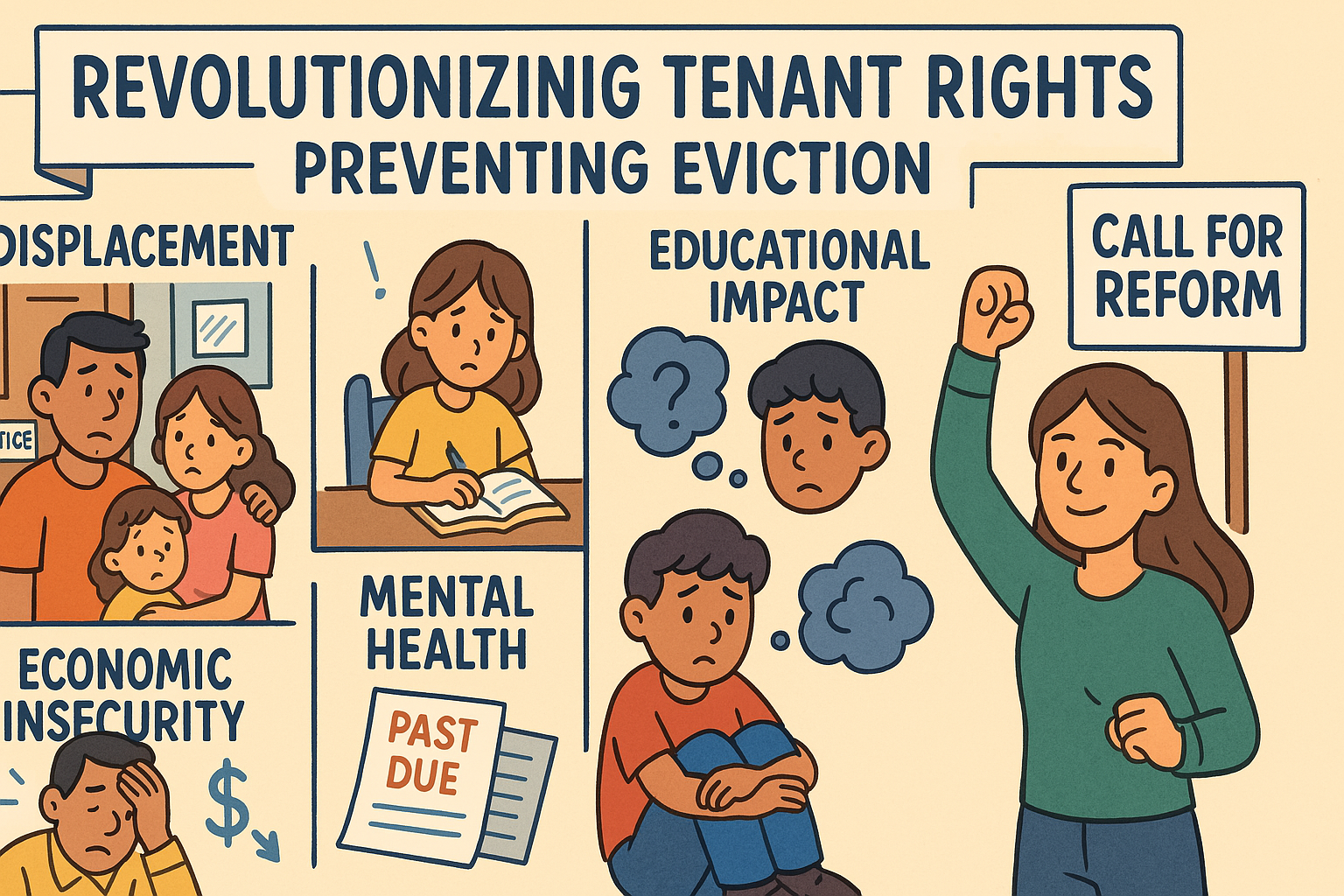
Evictions are a significant and growing concern across many urban and suburban areas, often disproportionately affecting low-income and marginalized communities. The act of eviction disrupts not just housing stability but also the broader fabric of family life, community continuity, and children’s development. When families are forced out of their homes, they frequently face homelessness, school displacement, job loss, and mental health crises. Children, in particular, are severely impacted—experiencing educational disruptions, stress, anxiety, and trauma that can have long-term consequences on their academic and emotional growth.
These ripple effects extend to schools, social services, and community health systems, creating strain on local infrastructure. The process of eviction is not only traumatic but often opaque and difficult to navigate, leaving tenants with little support or knowledge of their rights. Simultaneously, landlords and property managers may struggle with inconsistent rental income and legal complexities.
Thus, the eviction crisis is not merely a housing issue—it is a multifaceted social challenge with legal, educational, emotional, and economic dimensions, demanding innovative, empathetic, and systemic solutions.
Pain Points
- Legal Complexity: Tenants don’t understand their rights or how to fight unfair eviction notices.
- Lack of Early Warning: Most families only realize the seriousness of eviction when it’s too late.
- Limited Legal Aid Access: Legal support is overloaded and inaccessible to most vulnerable groups.
- Educational Disruption: Children are pulled out of schools due to forced relocations, affecting performance.
- Mental Health Decline: Families, especially kids, experience anxiety, depression, and trauma due to housing instability.
- Poor Communication Channels: Tenants and landlords lack a transparent, neutral system for mediation.
- Emergency Shelter Shortage: Temporary housing options are few, leading to homelessness or unsafe arrangements.
- Financial Strain: Unexpected legal costs and relocation expenses worsen financial instability.
- Lack of Centralized Help: Support services are scattered; users struggle to find all help in one place.
- Repeat Evictions: Once evicted, families struggle to find stable housing again, starting a vicious cycle.
Key Competitors
Several organizations and initiatives are actively addressing eviction prevention:
- Eviction Lab: Provides real-time eviction data through its Eviction Tracking System, aiding policymakers and advocates in identifying and responding to eviction hotspots. Eviction Lab
- Enterprise Community Partners: Focuses on preserving affordable housing and preventing evictions, particularly among BIPOC communities, through coordinated support for residents and landlords. enterprisecommunity.org
- HUD’s Eviction Protection Grant Program (EPGP): A federal initiative expanding access to legal services for low-income tenants at risk of eviction, funding organizations across multiple states. HUD User
- Emergency Rental Assistance Program (ERA): Administered by the U.S. Treasury, this program has provided over $46 billion to support housing stability for eligible renters during the COVID-19 pandemic. enterprisecommunity.org+5U.S. Department of the Treasury+5U.S. Department of the Treasury+5
- Eviction Innovation: A Stanford University project profiling various eviction prevention initiatives, including court-based programs, legal services, and technology solutions. evictioninnovation.org
Investment Landscape
Significant investments have been made in eviction prevention:
- HUD’s EPGP: Allocated $40 million in FY 2023 and 2024 to 21 recipients across 16 states, expanding legal services for tenants. HUD User
- ERA Program: The U.S. Treasury’s ERA programs have collectively provided over $46 billion to support housing stability for eligible renters. U.S. Department of the Treasury
Market Maturity
The eviction prevention sector is evolving, with increased attention from federal programs, non-profits, and startups. However, challenges remain in scaling solutions, ensuring equitable access, and integrating services across jurisdictions.
Major Offerings by Competitors
Key features provided by existing programs and platforms include:
- Legal Assistance: Access to legal representation and advice for tenants facing eviction.
- Rental Assistance: Financial support to cover rent arrears and prevent eviction.
- Mediation Services: Facilitating communication between landlords and tenants to resolve disputes.
- Data Tracking: Monitoring eviction trends to inform policy and intervention strategies.
- Educational Resources: Providing tenants with information on their rights and available support.
- Technology Tools: Platforms like the Tenant Power Toolkit assist tenants in responding to eviction notices. Mitchell Hamline Open Access+2evictioninnovation.org+2hhrctraining.org+2
- Court Diversion Programs: Initiatives that offer alternatives to formal eviction proceedings.Business Insider
- Community Partnerships: Collaborations between non-profits, government agencies, and legal services to provide comprehensive support.
- Emergency Housing: Temporary shelter options for families facing immediate eviction.
- Financial Literacy Programs: Educational sessions to help tenants manage finances and avoid future housing instability.Midland Reporter-Telegram
Product Vision
Vision:
We aim to build a unified, intelligent, and compassionate digital platform designed to prevent evictions and mitigate their long-term effects, particularly on families with children. By integrating legal, financial, educational, and emotional support into a single digital hub, we empower vulnerable households to navigate the complex eviction landscape with dignity and clarity.
The platform will offer proactive alerts by linking with municipal and court databases, alerting users to lease issues or pending legal notices. An AI-guided assistant will simplify the legal process, helping users respond to notices, understand their rights, and access local aid. Through smart mapping and case management, users can quickly connect with nearby legal aid, emergency rental assistance, and temporary housing services.
For families with school-age children, the platform will coordinate with school districts to ensure continuity in education and emotional care. This includes maintaining digital school records, facilitating virtual classes if relocation disrupts attendance, and assigning caseworkers when needed.
By focusing on early intervention, education continuity, and systemic partnerships, we aim not only to prevent evictions but to reduce their downstream societal costs. Our vision is a world where housing instability is met with structured support—not chaos.
Use Cases
- Receive real-time alerts of impending eviction filings.
- Automatically generate legal responses to eviction notices.
- Connect with free or subsidized legal services nearby.
- Access rental aid with pre-filled application templates.
- Mediate with landlords through a guided communication tool.
- View and save personal housing and legal documents.
- Identify nearby schools and continue children’s education digitally.
- Get psychological support referrals for children.
- Track eviction trends in your zip code.
- Join peer-support networks for community strength.
1. Use Case: Eviction Alert Notification System
- Short Info: Alerts users when eviction filings are detected.
- Reference: Vision, Pain Point #2, Eviction Lab data.
- Stakeholders: Tenants, Courts, Platform Admins
- Elaboration: The system scans public court records and rental data to detect potential eviction filings or lease violations. It then sends SMS/email/app notifications to tenants. Early alerts give users time to act before court hearings or final notices.
- Requirements:
- Integration with municipal court data
- Tenant account linking to address
- AI pattern recognition engine
- Real-time push notification service
- Alert prioritization by urgency
- User opt-in and opt-out
- Dashboard with eviction timeline
- Secure data handling
- Multilingual alert options
- Eviction history logs
2. Use Case: Legal Response Generator
- Short Info: Auto-generates court responses to eviction notices.
- Reference: Pain Point #1, Legal Aid Tools from Stanford’s Tenant Toolkit
- Stakeholders: Tenants, Legal Aid Orgs, Courts
- Elaboration: Based on user-uploaded notices or court data, the system guides tenants in filing appropriate legal documents. It uses templates and conditional logic to customize responses and offers e-filing integration where available.
- Requirements:
- OCR for scanned legal docs
- Dynamic legal templates
- Step-by-step wizard UI
- E-filing integration API
- Attorney review option
- Translation support
- Filing deadline alerts
- Legal terminology tooltips
- Secure document storage
- Signature authentication
3. Use Case: Legal Aid Matchmaker
- Short Info: Connects tenants with local legal support.
- Reference: Vision, HUD’s EPGP
- Stakeholders: Tenants, Legal Services, Social Workers
- Elaboration: Tenants in need of legal help are matched to providers based on location, case type, and urgency. Includes scheduling tools and digital intake forms to reduce bottlenecks in the aid process.
- Requirements:
- Legal aid directory
- Matching algorithm
- Appointment scheduler
- Intake form builder
- Provider dashboards
- Waitlist alerts
- Case handoff system
- Feedback/rating system
- Multilingual support
- Referral tracking
4. Use Case: Emergency Rental Aid Connector
- Short Info: Helps tenants apply for rental assistance quickly.
- Reference: ERA Program, Pain Point #8
- Stakeholders: Tenants, Housing Authorities, Financial Aid Providers
- Elaboration: This module aggregates aid programs by state and matches tenants to relevant options. It pre-fills applications, gathers required documents, and tracks submission statuses.
- Requirements:
- Aid program database
- Eligibility checker
- Application autofill
- Document uploader
- Status tracker
- SMS/email reminders
- Secure document vault
- Multiple application support
- Case worker integration
- Success analytics dashboard
5. Use Case: Tenant-Landlord Mediation Tool
- Short Info: Facilitates structured negotiation before court.
- Reference: Pain Point #6, Stanford’s Mediation Programs
- Stakeholders: Tenants, Landlords, Mediators
- Elaboration: A digital mediation tool that encourages settlement outside court. Both parties can exchange terms, chat asynchronously, and upload agreements. A neutral third-party mediator can step in when needed.
- Requirements:
- Secure two-way chat
- Agreement builder
- Escalation path to mediator
- Timed sessions
- E-signatures
- Notification system
- Document upload
- Case transcript logs
- Legal template library
- User verification
6. Use Case: Document Vault & Housing File Manager
- Short Info: Stores rental agreements, notices, and legal docs securely.
- Reference: Pain Point #9, Vision
- Stakeholders: Tenants, Legal Aid, Caseworkers
- Elaboration: Offers a centralized digital vault for users to upload, organize, and access all housing-related documents. Helps legal representatives and social workers collaborate using shared access to specific files.
- Requirements:
- Encrypted document storage
- Folder-based organization
- Permission-based access
- Upload scanner integration
- File versioning
- Download tracking
- Doc viewer with annotations
- Search and tag system
- Integration with legal systems
- Multilingual file naming
7. Use Case: Education Continuity Module for Children
- Short Info: Supports children’s education during displacement.
- Reference: Pain Point #4, Vision
- Stakeholders: Parents, Schools, Children, Social Workers
- Elaboration: Ensures smooth transfer or continuation of schooling by integrating with school databases. Offers virtual classes, transfer guidance, and academic record syncing to help displaced students avoid disruption.
- Requirements:
- School data sync API
- Transfer support tool
- Virtual classroom access
- Emergency tuition waiver info
- Parent-student dashboard
- Emotional wellness alerts
- Integration with caseworkers
- Homework backup & sync
- School search directory
- Attendance tracking
8. Use Case: Mental Health Referral Engine
- Short Info: Connects families to psychological support services.
- Reference: Pain Point #5, HUD & Community Health Systems
- Stakeholders: Tenants, Health Providers, NGOs
- Elaboration: Helps identify emotional distress signals based on interaction data and questionnaires. Matches users to low-cost therapists, school counselors, or community wellness programs.
- Requirements:
- Screening questionnaire
- AI-based behavior pattern tracker
- Mental health provider list
- Appointment booking
- Follow-up alert system
- Anonymous support chat
- Crisis escalation button
- User mood diary
- Support resource library
- Consent form integration
9. Use Case: Real-Time Eviction Trend Map
- Short Info: Visualizes eviction rates by region.
- Reference: Eviction Lab, Pain Point #10
- Stakeholders: Policymakers, NGOs, Researchers, Advocates
- Elaboration: A heat map of ongoing eviction activity sourced from court data and tenant reports. Helps target resources and shape policy responses based on regional patterns and surges.
- Requirements:
- Geolocation data API
- Dynamic map rendering
- Time slider for trends
- Drill-down to zip code
- Data export function
- Policy heat zone overlays
- Tenant report layer
- Public/private data toggle
- Mobile and web versions
- Weekly snapshot feature
10. Use Case: Smart Tenant Onboarding Wizard
- Short Info: Customizes experience based on user’s situation.
- Reference: Vision, User Empathy
- Stakeholders: Tenants, Platform Admin
- Elaboration: First-time users are walked through an intelligent onboarding process. System identifies eviction risk level, family situation, and suggests tools, legal paths, or school continuity measures tailored to the user’s profile.
- Requirements:
- Situation-based questionnaire
- Risk scoring algorithm
- Customized dashboard setup
- Recommended actions panel
- Progress tracker
- Video orientation
- Accessibility features
- Skip/resume logic
- Legal jurisdiction setup
- Language preference selector
Summary
Evictions profoundly disrupt lives, leading to housing instability, community fragmentation, and adverse outcomes for children, including educational setbacks and emotional distress. Our research identifies critical pain points: limited access to legal aid, lack of early warning systems, inadequate communication channels between tenants and landlords, and insufficient support for children’s education continuity during housing transitions.
While existing programs like HUD’s Eviction Protection Grant Program and the Emergency Rental Assistance Program provide essential support, gaps remain in delivering integrated, user-centric solutions. Innovative initiatives, such as Stanford’s Eviction Innovation project, highlight the potential of technology-driven interventions but often lack scalability and comprehensive integration.
Our proposed solution envisions a unified digital platform that proactively addresses eviction risks through real-time alerts, AI-guided legal assistance, streamlined access to rental aid, and mediation tools to facilitate tenant-landlord negotiations. Recognizing the unique challenges faced by families with children, the platform will also offer resources to ensure educational continuity and emotional support during housing disruptions.
By leveraging technology to centralize resources and support, this initiative aims to empower vulnerable populations, reduce the incidence of evictions, and foster resilient communities. The anticipated impact includes improved housing stability, enhanced educational outcomes for children, and strengthened community ties.