
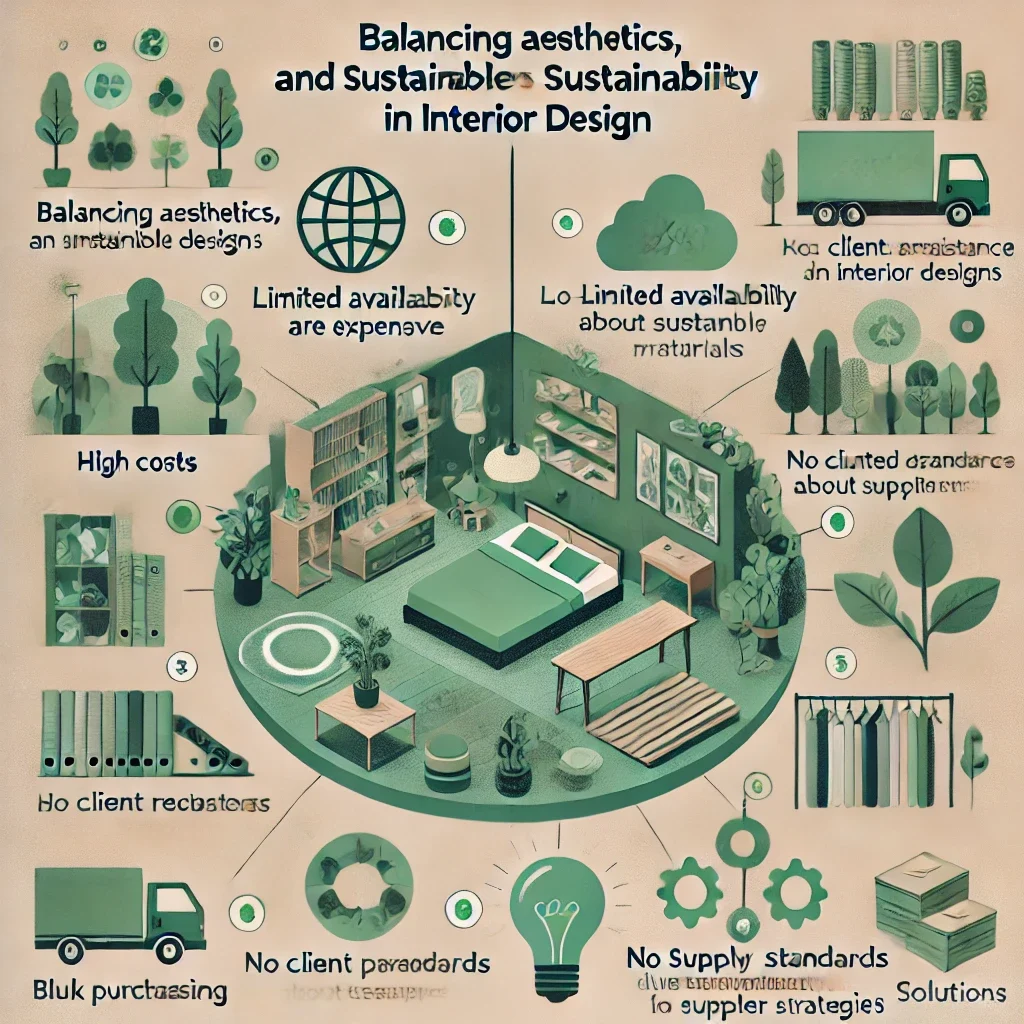
problem statement:-
Sustainable interior design aims to create aesthetically pleasing and functional spaces while minimizing environmental impact. However, designers face multiple challenges in this pursuit. One major hurdle is the availability and cost of sustainable materials—many eco-friendly options are either expensive or hard to source, making it difficult for designers to work within client budgets. Additionally, traditional design practices often prioritize aesthetics and cost over sustainability, leading to resistance from clients who may be unaware of the long-term benefits of green design.
Moreover, the interior design industry lacks standardized guidelines for sustainability, leaving designers to navigate multiple certifications and conflicting information. While some advancements in sustainable materials exist—such as recycled wood, low-VOC paints, and biodegradable textiles—these options are not always accessible or affordable for small-scale designers. Another challenge lies in convincing manufacturers and suppliers to invest in sustainable production processes, as many still prioritize cost efficiency over environmental responsibility.
Ultimately, the industry needs innovative solutions that make sustainable interior design more accessible, cost-effective, and widely accepted. This includes better education for designers and clients, improved supply chains for sustainable materials, and technological advancements that streamline the use of eco-friendly alternatives.
Stakeholders & Their Roles
- Interior Designers – Professionals responsible for creating functional and aesthetically pleasing spaces while integrating sustainability.
- Clients/Homeowners – Individuals seeking beautifully designed spaces, often hesitant about sustainable options due to costs or lack of awareness.
- Material Suppliers & Manufacturers – Companies providing raw materials, often prioritizing cost-efficiency over sustainability.
- Architects – Collaborate with interior designers, sometimes facing similar sustainability challenges.
- Construction Companies – Implement sustainable design choices, often constrained by availability and pricing of materials.
- Government & Regulatory Bodies – Establish guidelines and policies for sustainable practices but may lack enforcement.
- Environmental Organizations & NGOs – Advocate for greener building solutions and push for sustainable regulations.
Pain Points
- High Costs of Sustainable Materials – Eco-friendly materials are often more expensive than traditional ones, limiting their adoption.
- Limited Availability & Supply Chain Issues – Sustainable materials are not always readily available, leading to long lead times and design compromises.
- Client Resistance & Lack of Awareness – Many clients are unaware of the benefits of sustainable design, making it difficult to convince them.
- Aesthetic vs. Sustainability Trade-Off – Some sustainable materials may not offer the same visual appeal as conventional options, affecting design choices.
- Lack of Standardized Guidelines & Certifications – Conflicting sustainability certifications make it difficult for designers to choose the right materials.
- Low Industry Adoption – Many interior designers and builders are hesitant to shift toward sustainable practices due to lack of training or perceived inefficiencies.
- Difficulty in Measuring Sustainability Impact – There is no universal method for evaluating the long-term benefits and impact of sustainable designs.
- Limited Eco-Friendly Product Innovations – The industry still lacks a wide variety of innovative, high-quality, and affordable sustainable materials.
- Challenges in Retrofitting Existing Spaces – Implementing sustainability in older buildings is complex and often expensive.
- Regulatory Barriers & Lack of Incentives – Governments may not provide enough incentives for sustainable design, making it less appealing for businesses and clients.
Target Users
- User: Interior Designers & Homeowners
- Age Group: 25-50 years
- Gender: M/F
- Usage Pattern: Designers use sustainable resources daily in projects, but struggle with sourcing and affordability. Homeowners engage occasionally when renovating or designing new spaces.
- Benefit: Designers can access sustainable materials more easily, and homeowners can enjoy eco-friendly spaces without high costs.
Key Competitors & Their Offerings
- Interface, Inc. – A global leader in sustainable flooring, known for carbon-neutral carpet tiles and circular economy initiatives.
- Herman Miller – Offers eco-friendly furniture using recycled and renewable materials with Cradle-to-Cradle certification.
- Bamboo Flooring Company – Specializes in sustainable bamboo flooring as an alternative to hardwood.
- Benjamin Moore (Eco Spec Paints) – Produces low-VOC, eco-friendly paints to improve indoor air quality.
- Etsy (Handmade & Reclaimed Products) – A marketplace for artisans selling upcycled and sustainable home décor items.
Startups Focused on Sustainable Interior Design
- Plant Prefab – Prefabricated eco-friendly homes using sustainable materials.
- Smile Plastics – Creates decorative panels from recycled plastics for furniture and interiors.
- StoneCycling – Develops high-end bricks and tiles made from upcycled construction waste.
- Evrnu – Produces textiles from recycled fabrics for sustainable upholstery.
- Honext – Manufactures construction boards from industrial waste fibers.
- Material Bank – A digital platform helping designers source sustainable materials quickly.
- HempWood – Offers wood alternatives made from compressed hemp fibers.
- Miniwiz – Specializes in upcycling waste materials for innovative interior solutions.
- Foresso – Creates engineered wood panels using timber waste and bio-based resins.
- Biovate Hygienics – Develops biodegradable and sustainable cleaning solutions for interior spaces.
Innovations in Sustainable Interior Design
- 3D-Printed Recycled Furniture – Using waste plastics and bio-based resins to create custom furniture.
- Carbon-Negative Building Materials – Innovations like mycelium-based insulation and carbon-sequestering concrete.
- Smart Glass Technology – Adaptive glass that reduces energy consumption for heating and cooling.
- Biophilic Design Integration – Incorporating nature into interiors to enhance well-being and air quality.
- Self-Cleaning & VOC-Absorbing Paints – Advanced coatings that purify indoor air.
- Circular Economy Furniture – Furniture that can be easily disassembled and recycled.
- Modular Sustainable Interiors – Prefabricated, reusable interior panels reducing waste.
- Solar-Powered Smart Lighting – LED systems powered by integrated solar panels.
- Upcycled Textile Wall Panels – Acoustic panels made from fashion and textile industry waste.
- AI-Driven Sustainable Material Selection – AI platforms helping designers pick the most sustainable materials based on project needs.
Recent Investments in Sustainable Interior Design
- Interface, Inc. secured a $200M green bond investment (2023) for sustainability-focused product innovation.
- Material Bank raised $175M in Series D funding (2022) to expand its sustainable material marketplace.
- Plant Prefab secured $30M in funding (2022) for scaling eco-friendly prefabricated homes.
- Evrnu raised $15M (2023) to expand its recycled textile production.
- Smile Plastics received £2.5M (2023) to increase recycled plastic panel production.
Market Maturity & Gaps
The sustainable interior design market is growing rapidly, with more companies investing in eco-friendly solutions. However, significant gaps remain:
- Affordability remains a barrier, as sustainable materials are often priced higher than conventional options.
- Supply chain inefficiencies make sourcing sustainable materials complex and time-consuming.
- Client education is lacking, leading to resistance against green design solutions.
- Many sustainable innovations are still in early-stage adoption, requiring broader industry acceptance.
Product Vision
The future of interior design must seamlessly blend aesthetics with sustainability, ensuring that eco-friendly choices are both beautiful and accessible. Our product—EcoDesign Hub—will be an AI-powered digital platform that simplifies sustainable interior design by offering a curated marketplace for eco-friendly materials, an AI-driven recommendation engine, and a community-driven knowledge hub.
EcoDesign Hub will act as a one-stop solution where designers, homeowners, and manufacturers can connect to source verified sustainable materials at competitive prices. Through AI-powered analysis, designers can compare materials based on sustainability metrics, cost-effectiveness, and availability—removing the complexities of eco-friendly sourcing. Our platform will also integrate a circular economy model, encouraging the resale and repurposing of sustainable materials to reduce waste.
To tackle affordability, we will partner with material suppliers to bulk-purchase eco-friendly materials, reducing costs for designers and homeowners. Our educational hub will provide resources on sustainable design practices, empowering designers and clients with the knowledge they need to make informed choices.
With seamless integration into existing design software (e.g., AutoCAD, SketchUp), EcoDesign Hub will allow real-time visualization of sustainable material applications. Our mission is to make sustainability the standard, not the exception—by providing a tech-driven, cost-effective, and community-backed solution that transforms the interior design industry.
Use Cases of the Product
- AI-Powered Sustainable Material Selection – Designers receive recommendations based on cost, eco-certifications, and availability.
- Sustainable Marketplace – Homeowners and designers can purchase verified eco-friendly materials.
- Bulk Purchasing for Cost Reduction – Partnering with suppliers to make sustainable materials more affordable.
- Circular Economy Resale Model – Users can resell surplus sustainable materials.
- Real-Time Sustainability Impact Calculation – AI tool calculates carbon footprint reductions for each design choice.
- AR & VR Visualization for Material Application – Users can see how materials will look in real-life settings.
- Integration with Design Software – Direct plug-in for AutoCAD, SketchUp, and Revit.
- Sustainable Design Certification Support – Platform helps users navigate LEED, WELL, and other green certifications.
- Educational Hub & Community Forum – Articles, courses, and expert Q&A on sustainable design.
- Subscription-Based Sustainability Reports – Businesses and designers get insights on sustainability trends and material innovations.