
Problem Statement:
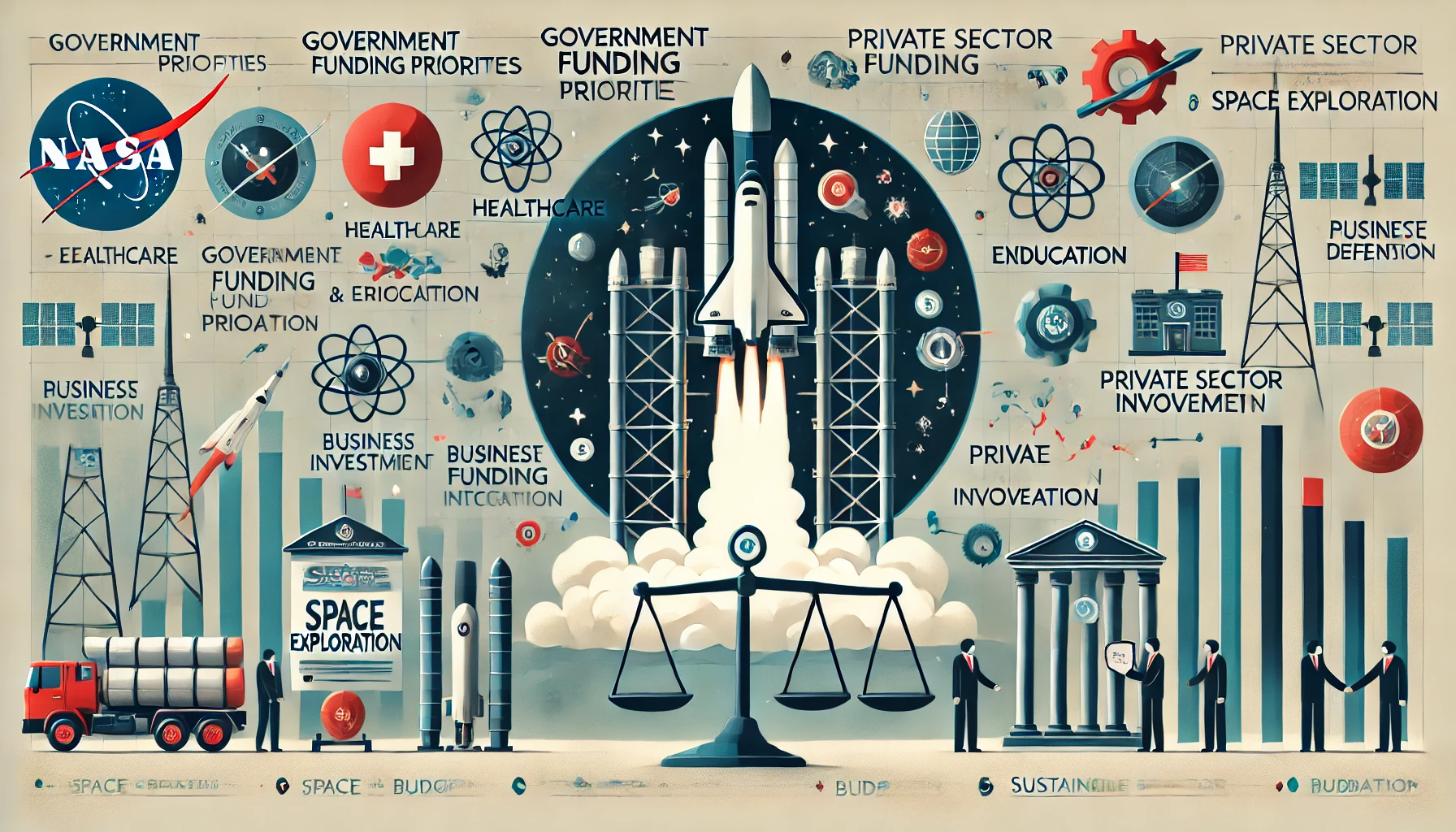
Space exploration is one of humanity’s most ambitious endeavors, promising significant technological advancements, potential access to extraterrestrial resources, and a deeper understanding of the universe. However, it is an inherently expensive field requiring vast investments in research, cutting-edge technology development, and mission execution. Traditionally dominated by government-funded programs, space exploration often faces budgetary constraints due to competing domestic priorities, such as healthcare, education, and defense. This leads to limited funding availability and, consequently, a slower pace of innovation.
In recent years, there has been a push toward increasing private sector participation in space exploration to offset government costs and foster innovation. However, sustainable collaboration models between public and private entities are still underdeveloped, and funding mechanisms for such ventures remain fragmented. Additionally, the absence of scalable solutions to reduce costs in space exploration creates barriers to entry for private companies, limiting competition and progress.
The key challenge is to develop cost-efficient, scalable technologies and sustainable funding models that can unlock new possibilities in space exploration. Simultaneously, there’s a need to define clear roles and incentives for private companies, ensuring a balanced partnership that aligns with both commercial and governmental objectives.
Pain Points :
- High Costs: Launches, R&D, and mission execution require billions, making space exploration inaccessible for smaller private companies.
- Budget Constraints: Governments face pressure to allocate funds to other pressing domestic needs, creating irregular financing for space programs.
- Unclear Roles: Lack of clear public-private collaboration frameworks leads to inefficiencies and delays in achieving exploration goals.
- Funding Risks: High financial risk deters private investors from entering the space exploration domain, limiting innovation.
- Scalability Issues: Current technologies and systems are not cost-efficient or scalable, leading to recurring high expenses.
- Lack of Incentives: Private companies lack sufficient incentives to invest in long-term space exploration due to unclear profitability.
- Regulatory Barriers: Complicated legal frameworks and international policies create additional hurdles for private-sector involvement.
- Limited Knowledge Sharing: Proprietary technologies restrict collaboration between governments and private firms, slowing innovation.
- Public Perception: Taxpayers often view space exploration as unnecessary, increasing scrutiny on government spending.
- Sustainability Gaps: Many missions lack strategies for cost-effective reuse of equipment and technology, making long-term efforts expensive.
Product Vision :
The product vision is to develop an Integrated Space Collaboration Platform (ISCP) that addresses the high costs and inefficiencies in space exploration by combining scalable technologies, funding mechanisms, and public-private collaboration frameworks. This platform will serve as a one-stop solution for space agencies, private companies, and investors, fostering innovation and sustainability in space exploration.
The ISCP will focus on three core pillars:
- Cost Optimization: Develop scalable technologies, such as modular space systems and reusable components, to significantly lower mission costs.
- Funding and Collaboration: Provide a transparent framework for public-private partnerships, incentivizing private sector involvement while ensuring government oversight.
- Global Accessibility: Create pathways for smaller organizations and startups to access the market through shared resources, standardized regulatory support, and financial assistance.
By leveraging cutting-edge technologies such as AI for mission planning, 3D printing for manufacturing, and blockchain for funding transparency, the ISCP will enable space exploration that is not only sustainable but also inclusive and efficient. The platform will also include a knowledge-sharing hub to facilitate open collaboration among stakeholders.
Over the next five years, the platform aims to reduce mission costs by 30%, attract $1 billion in private investments, and support 100+ successful collaborations between governments and private entities.
Use Cases of the Product:
- Cost-Effective Mission Planning: AI tools to optimize mission timelines and costs.
- Reusable Hardware Marketplace: A platform for buying/selling pre-used space components.
- Public-Private Funding Hub: A blockchain-enabled system for managing transparent public-private funding pools.
- Collaborative Mission Execution: Tools for multi-organization collaboration on missions.
- Space Debris Management: Partnerships with debris removal companies like Astroscale.
- Shared Launch Platforms: Affordable launch slots for smaller players.
- Knowledge-Sharing Network: Open access to research and technological advancements.
- Modular Space Stations: Infrastructure for scalable space station designs (partnering with companies like Axiom).
- Regulatory Compliance Tools: Automated solutions for meeting international space exploration regulations.
- Market Entry for Startups: Financial aid and resource sharing for new entrants.
Summary :
Space exploration holds immense potential for humanity, but it is burdened by high costs, funding constraints, and sustainability challenges. Government agencies often face tight budgets due to competing domestic priorities, while the private sector struggles to find profitable and accessible pathways for participation. This creates a fragmented ecosystem with limited collaboration and innovation.
To address these challenges, the proposed Integrated Space Collaboration Platform (ISCP) offers a transformative solution. The ISCP focuses on cost optimization, funding transparency, and public-private partnerships. It leverages cutting-edge technologies like AI, 3D printing, and blockchain to lower costs, enhance collaboration, and democratize access to space exploration. Key features include a reusable hardware marketplace, a public-private funding hub, shared launch platforms, and automated regulatory compliance tools.
The ISCP also aims to support startups and smaller organizations, breaking down barriers to market entry and fostering innovation. By facilitating partnerships and creating a knowledge-sharing network, it ensures global accessibility and long-term sustainability.
Over five years, the platform is projected to generate $1.01 billion in revenue, reduce mission costs by 30%, and support over 100 successful collaborations. With an optimistic launch date of Q4 2026, this initiative promises to redefine the future of space exploration and make it a sustainable, inclusive endeavor.
Researched By: Shubham Thange MSc CA Modern College Pune