
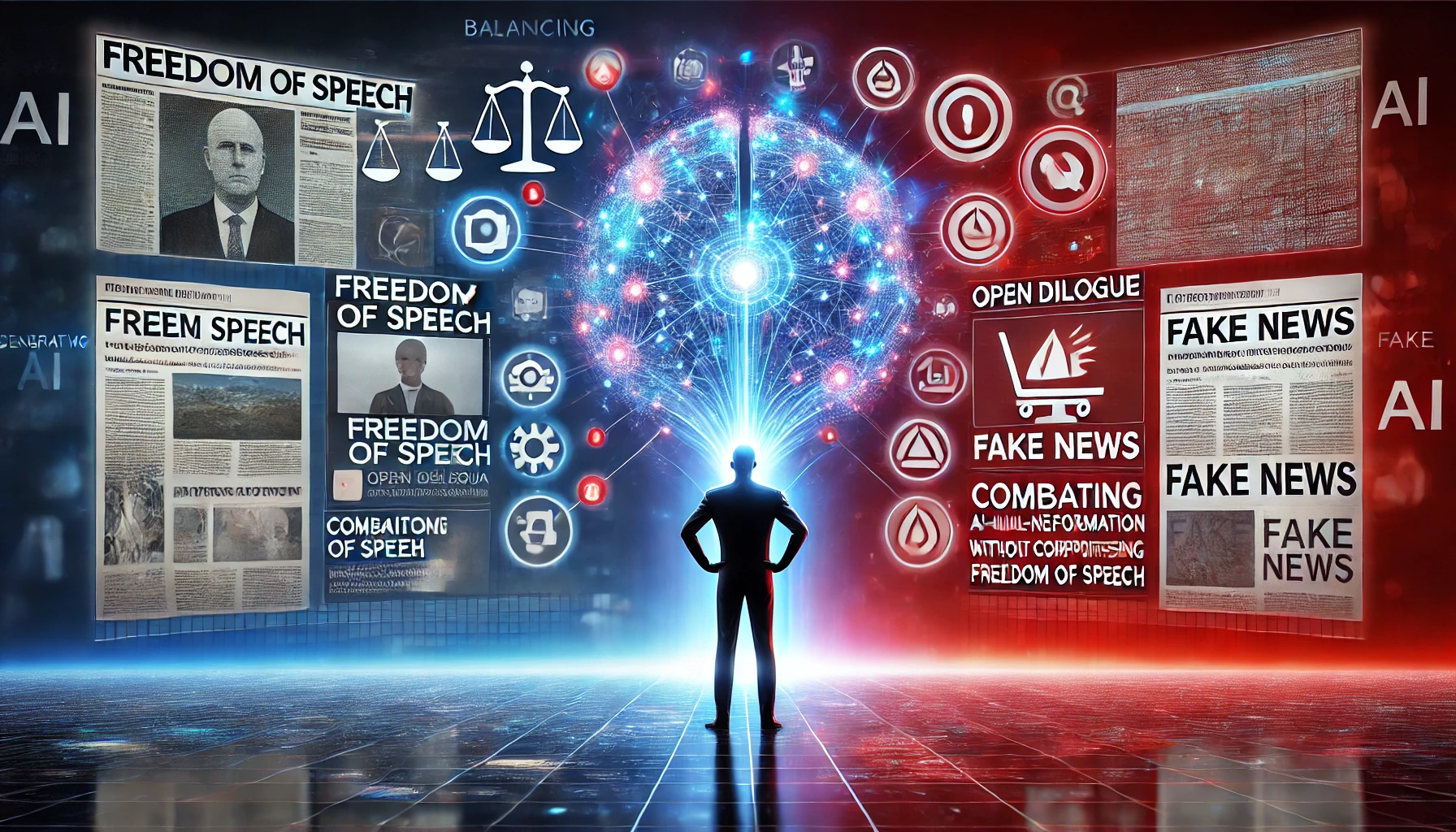
Problem Elaboration
Generative AI models have demonstrated remarkable capabilities in generating text, images, and even videos that are highly realistic. However, this power comes with risks—one of the most pressing being the creation and spread of misinformation and propaganda. AI-generated fake news can deceive people, manipulate public opinion, and even destabilize societies. The challenge lies in designing AI systems that can effectively prevent misinformation without restricting freedom of speech, which is a fundamental human right.
Several factors contribute to this problem:
- Deepfakes & Synthetic Media: AI-generated videos and images can be used to impersonate real people or fabricate events.
- Bias in AI Training Data: AI models may learn biases from their training data, unintentionally amplifying misleading narratives.
- Lack of Accountability: It is difficult to trace the origin of misinformation once it spreads.
- Real-Time Generation & Spread: AI-generated misinformation spreads rapidly via social media, often before fact-checkers can intervene.
- Balancing Censorship & Free Speech: Over-policing content could lead to suppression of legitimate voices, raising ethical concerns.
Pain Points
- Rapid Spread of Misinformation – AI-generated fake news spreads faster than fact-checkers can verify it, making damage control difficult.
- Difficulty in Detecting AI-Generated Content – Current detection methods struggle to differentiate between real and fake AI-generated content.
- Deepfake Manipulation of Public Figures – AI is used to create false narratives by impersonating politicians, celebrities, or influential figures.
- Bias in AI Content Moderation – AI filters may unfairly censor certain viewpoints, affecting free speech and public discourse.
- Lack of Traceability & Accountability – No clear way to track the origin of AI-generated misinformation once it spreads.
- Ethical & Legal Challenges – Existing laws struggle to regulate AI-generated misinformation without infringing on civil rights.
- Weaponization of AI by Malicious Actors – Governments, extremist groups, and cybercriminals exploit AI to spread propaganda or disinformation campaigns.
- Limited Public Awareness & Media Literacy – Many users cannot distinguish between real and fake AI-generated content.
- Economic Impact on Media Industry – Traditional journalism suffers financial losses due to declining trust in media sources.
- Challenges in Regulating Social Media Platforms – Tech companies struggle to balance profit motives with responsibility for curbing misinformation.
Key Competitors & Their Offerings
- OpenAI
- Product: ChatGPT, DALL·E, and AI content moderation tools
- Focus: Ensuring responsible AI use with content filtering and detection techniques
- Limitations: Struggles with bias control and misinformation detection at scale
- Meta (Facebook, Instagram, WhatsApp)
- Product: AI-powered fact-checking and content moderation
- Focus: Identifies and labels false information on social media
- Limitations: Effectiveness varies by region, AI moderation can be biased
- Google (Jigsaw, DeepMind)
- Product: Fact-checking AI tools, real-time misinformation detection
- Focus: Uses AI for verifying sources and identifying deepfakes
- Limitations: Detection accuracy depends on training data and evolving AI-generated content
- Microsoft (Azure AI, Newsguard Partnership)
- Product: AI-driven misinformation tracking for enterprise users
- Focus: Enterprise-level AI solutions for content moderation
- Limitations: Not widely available to general users
- NewsGuard
- Product: AI-assisted rating system for online news sources
- Focus: Verifies credibility of news websites using AI and human reviewers
- Limitations: Subscription-based, not an automated prevention tool
Startups Working in This Space
- Logically AI – Uses AI to identify and counter misinformation.
- Blackbird.AI – Focuses on detecting disinformation campaigns.
- Deeptrace – Develops AI to detect deepfakes in videos and images.
- Truepic – Provides AI-powered authentication for digital media.
- Fakespot – AI for detecting fake product reviews and online scams.
- Full Fact – AI-assisted fact-checking platform.
- Reality Defender – AI-driven deepfake detection system.
- Sensity AI – Specializes in detecting synthetic media and deepfakes.
- AdVerif.AI – Uses AI to detect misleading advertisements and fake news.
- Socratic AI – AI-powered media literacy and critical thinking tools.
Innovations in AI-Driven Misinformation Detection
- AI-Powered Deepfake Detection – Using adversarial networks to identify manipulated media.
- Blockchain-Based Content Verification – Securing media authenticity with immutable ledgers.
- Explainable AI for Fact-Checking – AI models that transparently justify credibility scores.
- Automated Source Verification – AI models that cross-reference news with reliable sources.
- Social Graph Analysis for Fake News – Detects disinformation networks using AI algorithms.
- Cryptographic Watermarking for AI-Generated Content – Embedding invisible signatures to trace AI outputs.
- AI-Powered Real-Time News Monitoring – Identifies viral misinformation before it spreads.
- Synthetic Media Fingerprinting – Registers digital assets for AI-powered authentication.
- Human-AI Hybrid Fact-Checking – Combining human expertise with AI to verify facts faster.
- Crowdsourced AI Fact-Checking Networks – Community-driven AI models that evolve with misinformation trends.
Recent Investments in AI Misinformation Solutions
- Reality Defender raised $15 million in September 2024 for AI deepfake detection.
- Logically AI secured $30 million in February 2025 to expand AI misinformation detection.
- Blackbird.AI received $25 million from investors in 2024 for AI-driven disinformation tracking.
- Google invested $100 million in AI-driven misinformation detection projects in 2023-2024.
- Meta launched a $50 million fund for AI research combating deepfake misinformation in 2024.
Market Maturity & Gaps in Current Solutions
The market for AI-driven misinformation detection is growing, with major tech firms and startups making significant progress. However, key gaps remain:
- Scalability Issues – Existing solutions struggle to verify misinformation at the speed it spreads.
- Over-Reliance on Centralized Fact-Checkers – Raises bias concerns and potential censorship issues.
- Lack of Real-Time Interventions – Many tools focus on post-detection instead of prevention.
- Limited Public Adoption – Many fact-checking solutions are not widely accessible.
- Weak AI Accountability Frameworks – No clear legal frameworks for AI-generated misinformation.
Product Vision
The fight against misinformation requires an AI-driven yet ethical solution that balances content authenticity with the right to free speech. Our product, TruthShield AI, will be an AI-powered misinformation prevention system that operates in real-time to detect, verify, and trace misleading content before it spreads.
How TruthShield AI Works:
- Real-Time AI Misinformation Detection – Our system will analyze text, images, and videos for misinformation before it is published. It will flag potential fake content and provide users with source credibility scores.
- Decentralized AI Fact-Checking Network – Rather than relying on centralized fact-checkers, we will develop a crowdsourced AI verification model where experts and users contribute to improving the AI’s accuracy.
- Blockchain-Based Content Authentication – AI-generated media will be watermarked and traceable to differentiate between authentic and synthetic content.
- Explainable AI – Users will see why a piece of content is flagged, with transparent reasoning instead of black-box moderation.
- Cross-Platform Integration – Our API will integrate with social media, news platforms, and messaging apps, ensuring misinformation is tackled at its source.
- AI Literacy & User Education – Our system will provide real-time alerts and educational insights to help users identify misleading content themselves.
By proactively stopping misinformation at the point of creation and fostering transparent, decentralized fact-checking, TruthShield AI will empower individuals while preserving freedom of speech.
Use Cases
- Social Media Integration – Real-time fact-checking plugin for platforms like Twitter, Facebook, and YouTube.
- Journalist Assistance Tool – AI that helps reporters verify sources before publishing.
- AI-Powered Browser Extension – Users can detect misinformation while browsing the web.
- WhatsApp & Messaging Fact-Checking Bot – AI chatbot that verifies forwarded messages.
- Blockchain Digital Signature for AI Content – Ensures that AI-generated media is watermarked and traceable.
- Government & Policy Advisory Tool – Helps policymakers track AI-driven disinformation campaigns.
- Enterprise Fake News Detection – Companies can prevent fake news from damaging their brand reputation.
- Crowdsourced Fact-Checking Network – Users contribute to verifying misinformation using a decentralized AI model.
- Educational AI for Schools – Helps students learn media literacy and how to identify misinformation.
- Global Language Support – AI detects misinformation in multiple languages, including low-resource ones.
Summary
The Problem
Generative AI models have made it easier to create highly realistic but false narratives, leading to rapid misinformation spread. Fake news, deepfakes, and AI-generated propaganda can mislead the public, manipulate elections, and destabilize societies. However, efforts to prevent misinformation risk infringing on freedom of speech. The challenge is to develop an AI-driven misinformation prevention system that is accurate, scalable, and transparent while preserving democratic values.
The Solution: TruthShield AI
TruthShield AI is a real-time misinformation detection and prevention system that uses AI, blockchain authentication, and decentralized fact-checking to tackle fake news before it spreads. Unlike traditional fact-checkers that work after content goes viral, TruthShield AI proactively detects and flags misleading content at the point of creation.
Key Features
Real-Time AI Misinformation Detection – Detects and flags false/misleading content before it spreads.
Decentralized Fact-Checking Network – Users and experts contribute to AI verification, reducing bias.
Blockchain-Based Content Authentication – Cryptographic watermarks trace AI-generated content origins.
Explainable AI for Transparency – AI provides reasons for flagging content, increasing trust.
AI Browser Extension & Social Media Integration – Real-time fact-checking for news and social media posts.
WhatsApp & Messaging Fact-Checking Bot – Users can verify forwarded messages instantly.
Enterprise API for News & Government – Organizations can use AI to detect misinformation at scale.
Educational AI for Media Literacy – AI-driven tools to educate users on misinformation detection.
Global Language Support – AI model trained to detect misinformation across multiple languages.
Government & Policy Advisory Tool – AI tracks misinformation trends for policymakers.
Researched By Shubham Thange MSc CA Modern college Pune