
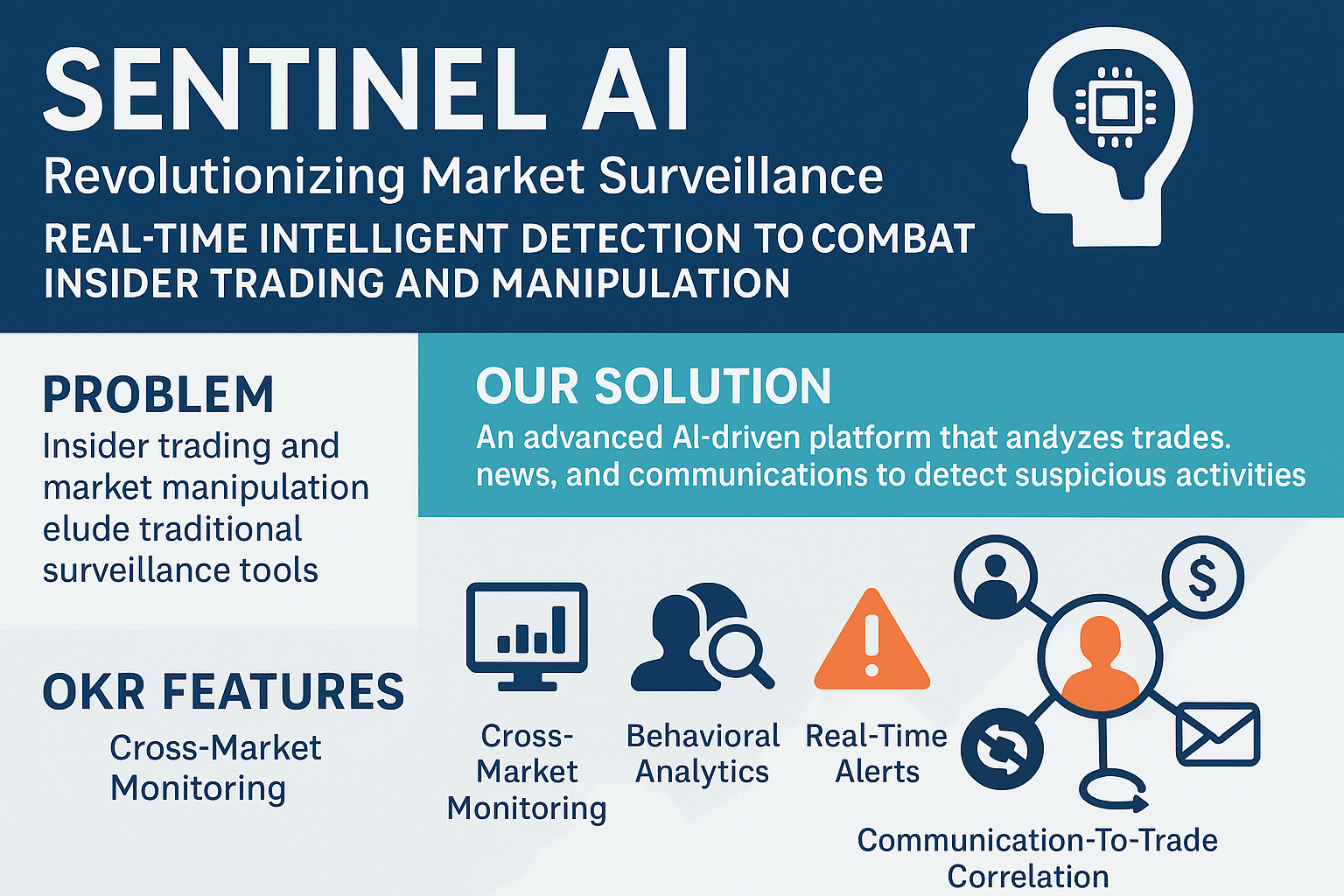
Problem Statement
Market manipulation and insider trading present a significant threat to the integrity, transparency, and fairness of financial markets. These malpractices not only erode investor confidence but also destabilize the market’s natural price discovery mechanism. Despite regulatory frameworks such as those enforced by the Securities and Exchange Board of India (SEBI), detection and prevention remain complex due to the sophisticated and covert nature of such activities.
Insider trading typically involves the exploitation of non-public, material information for unfair gains, while market manipulation includes tactics like pump-and-dump schemes, spoofing, front-running, and misinformation dissemination. The quasi-judicial nature of SEBI’s proceedings mandates strict adherence to due process, often slowing down enforcement.
Current surveillance systems are often reactive and depend heavily on manual investigation and traditional statistical models, which lag behind modern-day trading strategies fueled by artificial intelligence and high-frequency trading. This creates an urgent need for advanced, real-time, AI-driven surveillance systems that can analyze vast volumes of trading data, social media chatter, and news feeds to identify suspicious activities and facilitate swift enforcement actions.
The objective is to develop an intelligent, proactive surveillance system to uphold market integrity and support regulators like SEBI in their enforcement mission.
Pain Points
- Data Overload
Surveillance teams struggle to process massive volumes of market and social data manually. - Delayed Detection
Most tools identify irregularities post-facto, limiting proactive intervention. - Lack of Integrated Intelligence
Disconnected systems for trades, news, and communications impede holistic analysis. - Evasive Tactics by Offenders
Sophisticated manipulation techniques (e.g., spoofing, layering) evade traditional detection. - Regulatory Fragmentation
Jurisdictional overlaps and legal boundaries slow down coordinated enforcement. - Inadequate AI Capabilities
Existing tools lack adaptive models capable of identifying evolving fraudulent patterns. - Low Signal-to-Noise Ratio
Many alerts generated are false positives, reducing investigative efficiency. - Poor Data Quality and Inconsistency
Inaccurate or missing trade data impairs accurate anomaly detection. - Manual Investigation Dependency
Human-intensive case building leads to longer resolution cycles. - Limited Visualization Tools
Investigators lack intuitive dashboards for real-time pattern recognition.
Key Competitors
Several companies have developed advanced surveillance systems to detect and prevent market abuses:
- Nasdaq SMARTS: Utilizes AI and machine learning to monitor trading activities across multiple markets in real-time, identifying fraudulent activities like spoofing and insider trading.
- NICE Actimize: Offers real-time monitoring, customizable alerts, and comprehensive reporting to detect complex trading patterns indicative of market abuse or insider trading.
- ACA Group: Provides surveillance solutions that detect insider trading and market manipulation under global regulatory standards, enhancing risk management.
- Kaizen Reporting: Combines trade and communications monitoring to detect market abuse, offering features like automated detection and multi-channel communications monitoring.
- Trapets: Delivers comprehensive trade monitoring to detect anomalies or patterns in trading data, identifying complex trading activities.
Market Maturity
The market for trade surveillance systems is mature, with established players offering robust solutions. However, the evolving nature of market manipulation tactics necessitates continuous innovation and adaptation.
Identified Gaps
Despite the advanced features of current solutions, certain gaps persist:
- Integration Challenges: Difficulty in seamlessly integrating various data sources, including social media and news feeds.
- High False Positives: Existing systems often generate numerous false alerts, leading to inefficiencies.
- Adaptability: Need for systems that can quickly adapt to new and sophisticated market manipulation tactics.
- Cost Barriers: High implementation and maintenance costs can be prohibitive for smaller firms.
Product Vision
The future of financial markets depends on proactive and intelligent oversight systems that can ensure fairness, transparency, and compliance in real-time. Our product vision is to build “Sentinel AI” – a next-generation, AI-powered surveillance platform that detects, predicts, and prevents market manipulation and insider trading.
Sentinel AI will combine multi-source data ingestion, including trades, order books, news feeds, regulatory filings, and even social media, to deliver a comprehensive behavioral map of the market. By leveraging machine learning, natural language processing, and anomaly detection algorithms, Sentinel AI will identify irregular patterns, hidden relationships, and non-obvious connections that point to potential market abuse.
Unlike legacy systems that react post-facto, Sentinel AI will focus on real-time alerting and early intervention. With customizable workflows and seamless integration into SEBI and stock exchange systems, our solution will empower surveillance officers and compliance teams to act swiftly and confidently.
This platform will be built with a modular, cloud-native architecture to scale with market data volume and support ongoing regulatory evolution. Through advanced visualizations and intuitive dashboards, users will gain deep insights into potential threats and case-building tools with chain-of-custody tracking to support legal enforcement.
The ultimate goal is to restore investor trust, enhance regulatory efficiency, and establish Sentinel AI as the standard in global market surveillance solutions.
Use Cases
1.Real-time Detection of Insider Trades
- Short Info: Detects unusual trading activity linked with non-public events.
- Reference: Pain Point #2, Competitor Feature #1, Vision: Real-time alerting.
- Stakeholders: SEBI Analysts, Compliance Officers, Market Analysts.
- Elaboration: The system will track price movements and volume spikes before public news, linking accounts to insiders via communication metadata, social connections, or transaction patterns. Alerts will trigger before significant corporate announcements.
- Requirements:
- Ingest real-time trade and news data.
- Track trader identity and relationship graph.
- Pattern matching to historical insider trades.
- NLP on filings and news.
- Integration with communication metadata.
- Alert scoring algorithm.
- Real-time dashboard for alerts.
- User tagging and role mapping.
- Alert confirmation via case builder.
- Audit trail for evidence.
2.Detection of Spoofing and Layering
- Short Info: Identifies fake order placements and cancellations.
- Reference: Pain Point #4, Competitor Feature #2, Vision: Pattern identification.
- Stakeholders: SEBI, Exchange Surveillance, Legal Teams.
- Elaboration: Sentinel AI will monitor rapid order entries and cancellations around critical price levels. If a pattern of fake orders followed by trades on the opposite side is found, it flags as spoofing.
- Requirements:
- Order book data ingestion.
- Millisecond-level timestamping.
- Cancellation-to-execution ratio tracker.
- Pattern recognition for layering behavior.
- Heatmap visualization of spoof attempts.
- Side-switching tracker.
- Entity-level flagging.
- Violation scoring engine.
- Backtest engine for behavior validation.
- Automated alert logging.
3.Social Media and News Monitoring
- Short Info: Detects market rumors linked to insider trading.
- Reference: Pain Point #3, #5, Vision: Multi-source monitoring.
- Stakeholders: SEBI, Market Analysts, Data Providers.
- Elaboration: Using NLP, the system will extract and classify sentiment and named entities from platforms like Twitter, Reddit, and financial news outlets. It will correlate posts with stock movements, flagging spikes tied to social activity.
- Requirements:
- Social media scraping tools.
- NLP models for sentiment and entities.
- Timeline correlation with market data.
- Rumor classification models.
- Alert mechanism for sudden buzz.
- Dashboard for media timelines.
- Integration with trade alerts.
- Filter by topics (e.g., earnings, mergers).
- Fact-checking API integration.
- Model feedback loop for learning.
4.Behavioral Profiling of Traders
- Short Info: Builds baseline behavior profiles for anomaly detection.
- Reference: Pain Point #6, Vision: Adaptive surveillance.
- Stakeholders: Compliance Officers, Surveillance Team, SEBI.
- Elaboration: The system will build profiles based on trader actions, volumes, instruments, and times. Deviations from these patterns will be flagged, enabling early detection of risky behavior.
- Requirements:
- Historical data analysis engine.
- Dynamic profiling models.
- Feature extraction (volume, frequency, counterparty).
- Cluster analysis for peer behavior.
- Drift detection logic.
- Profile deviation alerts.
- Comparison dashboards.
- Profile update mechanism.
- Role-based profile visibility.
- Suspicious behavior scoring.
5.Automated Case Creation and Bundling
- Short Info: Automatically compiles evidence and links it to an alert.
- Reference: Pain Point #9, Vision: Efficiency in enforcement.
- Stakeholders: Legal Teams, SEBI, Investigators.
- Elaboration: Once an alert is validated, the system compiles trade history, communication records, news, and trader relationships into a digital casefile with timestamps, user actions, and notes.
- Requirements:
- Case ID generation.
- Evidence bundling engine.
- Timeline builder for activities.
- Role annotations.
- Communication transcript linking.
- Visual flowchart generation.
- Export in legal formats.
- Case status tracking.
- Collaboration tools.
- Access control per team.
6.Cross-Market Arbitrage Abuse Detection
- Short Info: Detects illegal profit strategies across exchanges.
- Reference: Pain Point #4, Vision: Real-time cross-market detection.
- Stakeholders: SEBI, NSE/BSE, Compliance Analysts.
- Elaboration: By aggregating trade data from multiple exchanges, the system will identify attempts to exploit pricing inefficiencies by rapid buy-sell orders. If a pattern is found that violates fair market conduct, an alert is triggered.
- Requirements:
- Cross-exchange trade feed integration.
- Time-synced data normalization.
- Arbitrage margin calculator.
- Pattern recognition engine.
- Market snapshot comparator.
- Alert mechanism for repeated patterns.
- Historical replay function.
- Multi-venue reporting interface.
- User tagging by entity or trader ID.
- Regulatory rule mapping.
7.Voice and Email Surveillance Integration
- Short Info: Correlates trade actions with communication records.
- Reference: Pain Point #3, #6; Vision: Unified intelligence.
- Stakeholders: Compliance Teams, Internal Audit, SEBI.
- Elaboration: Uses speech-to-text, OCR, and NLP to analyze trader emails, calls, and chats for suspicious language tied to insider trading or manipulation. Correlation with trading actions supports deep investigations.
- Requirements:
- Email/chat ingestion tools.
- Voice call transcription (STT).
- NLP keyword detection.
- Sentiment/emotion analysis.
- Timestamps and trade linkage.
- Risk term dictionary updates.
- Multi-language support.
- Alert consolidation into cases.
- Secure storage of media files.
- Legal access provisioning.
8.Pattern Replay and Training Simulator
- Short Info: Enables replay of past manipulative events for training.
- Reference: Vision: Education and transparency tools.
- Stakeholders: Regulatory Trainees, Exchange Interns, Compliance Trainers.
- Elaboration: This module recreates historic market manipulation events on-screen with annotations, showing trade flows, communications, and system alerts. Used for regulatory training and internal education.
- Requirements:
- Playback interface with timeline controls.
- Visual market activity mapping.
- Event annotation capability.
- Multi-source overlay (news, chat, orders).
- Scenario templates.
- Performance scoring module.
- Case quiz generator.
- Role-specific perspectives.
- Feedback submission.
- Certification report generator.
9.Entity Relationship Mapping
- Short Info: Visualizes hidden links between traders and organizations.
- Reference: Pain Point #1, #3; Vision: Proactive surveillance.
- Stakeholders: SEBI, Legal Teams, Compliance.
- Elaboration: Automatically builds a graph of all relationships based on common identifiers like IP, contact numbers, locations, or emails. Reveals proxy trading, shell entities, or coordinated trades.
- Requirements:
- Graph database backend.
- Entity normalization (aliases, IDs).
- Link strength scoring.
- Visualization tools.
- Custom filter options.
- Alert tagging to graph nodes.
- Historical graph evolution.
- Export to investigation tools.
- Security-based relationship cluster.
- Manual override and merge.
10.Alert Prioritization Engine
- Short Info: Scores alerts by severity and regulatory priority.
- Reference: Pain Point #7, Vision: Efficiency in monitoring.
- Stakeholders: Surveillance Teams, Compliance Analysts.
- Elaboration: Applies AI models to assign urgency scores to alerts based on trade size, frequency, trader history, and proximity to market events. Reduces false positives and investigative overload.
- Requirements:
- Scoring algorithm development.
- Contextual data ingestion (events, profiles).
- Alert clustering.
- Historical pattern feedback loop.
- Color-coded UI indicators.
- Risk flag toggling.
- Explanation engine (why this score).
- Escalation automation.
- Integration with team workflows.
- Customizable scoring rules.
11.Regulatory Rule Compliance Mapping
- Short Info: Ensures trade patterns are mapped to applicable laws.
- Reference: Pain Point #5, Vision: Legal defensibility.
- Stakeholders: SEBI Legal, Brokers, Surveillance Officers.
- Elaboration: Translates regulatory frameworks (like SEBI PFUTP, PIT) into system logic and maps flagged patterns to specific breaches, enabling legal-grade case building and reporting.
- Requirements:
- Regulatory rules database.
- Mapping engine for law-to-patterns.
- Explanation module.
- Automated PDF generation.
- Legal reference tagging.
- Case linkage system.
- Regulatory template support.
- Dynamic law update integration.
- Breach severity classification.
- Precedent example linking.
12.Communication-to-Trade Correlation
- Short Info: Flags when communication precedes trading spikes.
- Reference: Pain Point #3; Vision: Cross-data analytics.
- Stakeholders: Surveillance Officers, Investigators.
- Elaboration: Identifies correlations between internal/external communication and unusual trading activity. An alert triggers if a stock is discussed and trades spike within a time window.
- Requirements:
- Timestamp sync across data types.
- Communication sentiment analysis.
- Trade anomaly detection.
- Correlation model.
- Dynamic window sizing.
- Alert generation.
- Alert-to-case pipeline.
- Visualization of timelines.
- Role-based access control.
- Feedback tagging.
13.Geo-Fencing of Trade Activities
- Short Info: Detects trades from unauthorized or risky locations.
- Reference: Pain Point #8; Vision: Risk controls.
- Stakeholders: Compliance Teams, SEBI.
- Elaboration: Uses IP and device location data to detect trades from locations outside regulatory jurisdictions or flagged areas. Immediate alerts are triggered for possible proxy trading or VPN masking.
- Requirements:
- IP geolocation tool.
- Device fingerprinting.
- Authorized geo-map definition.
- Blacklist/whitelist config.
- Alert scoring engine.
- Multi-factor authentication trigger.
- Trading freeze option.
- Geofencing visualization.
- Location change tracking.
- Compliance report generation.
14.Historical Trend Analytics
- Short Info: Provides long-term views on abuse trends by sector or instrument.
- Reference: Pain Point #1, Vision: Intelligence-led oversight.
- Stakeholders: SEBI, Exchanges, Policy Makers.
- Elaboration: Analyzes multi-year data to detect trends in types of violations, volume spikes, or repeated offenders. Enables policymakers to draft better rules and identify loopholes.
- Requirements:
- Data warehouse integration.
- Time-series trend engine.
- Sectoral classification.
- Abuse type tagging.
- Repeat offender identification.
- Dashboards and reports.
- Chart generation tools.
- Export in regulatory formats.
- Scenario filter panel.
- Drill-down navigation.
15.End-to-End Investigator Workbench
- Short Info: Central hub for all investigative actions.
- Reference: Pain Point #10, Vision: Unified interface.
- Stakeholders: SEBI, Legal Officers, Compliance Analysts.
- Elaboration: This workspace will offer a single window for reviewing alerts, analyzing data, linking evidence, initiating actions, and preparing legal documents. Designed for speed, transparency, and security.
- Requirements:
- Alert dashboard.
- Multi-tabbed evidence viewer.
- Case annotation tools.
- Collaboration panel.
- File export module.
- Task tracker.
- Secure login.
- Notification center.
- Integrated visualization engine.
- Archive and restore functionality.
Summary
Market manipulation and insider trading remain enduring challenges for financial markets, significantly undermining investor trust and regulatory effectiveness. Despite frameworks like SEBI’s stringent compliance mandates, the covert and adaptive nature of these malpractices outpaces traditional surveillance tools. The need for proactive, AI-driven, and real-time detection systems is more critical than ever.
Our solution, Sentinel AI, is envisioned as a comprehensive market surveillance platform that uses AI, machine learning, and behavioral analytics to identify manipulative behaviors such as spoofing, layering, and insider trading. The system correlates trades, news, and communication data in real time to flag suspicious activities and trigger high-confidence alerts. Through features such as cross-market monitoring, sentiment analysis from social media, and communication-to-trade correlation, Sentinel AI ensures no potential abuse goes undetected.
A detailed analysis of existing competitors such as Nasdaq SMARTS, NICE Actimize, and ACA Group revealed a strong market maturity but also clear gaps: fragmented data integration, high false positives, and inadequate behavioral modeling. Sentinel AI addresses these through an entity relationship graph, adaptive profiling, and predictive analytics modules.
The solution is expected to serve regulatory analysts, stock exchanges, and compliance officers, empowering them to reduce investigation time, improve enforcement efficiency, and comply with evolving legal mandates. With a targeted launch in May 2026, Sentinel AI aims to become the benchmark platform for trade surveillance, supporting regulators like SEBI in fostering a transparent, fair, and abuse-free financial ecosystem.