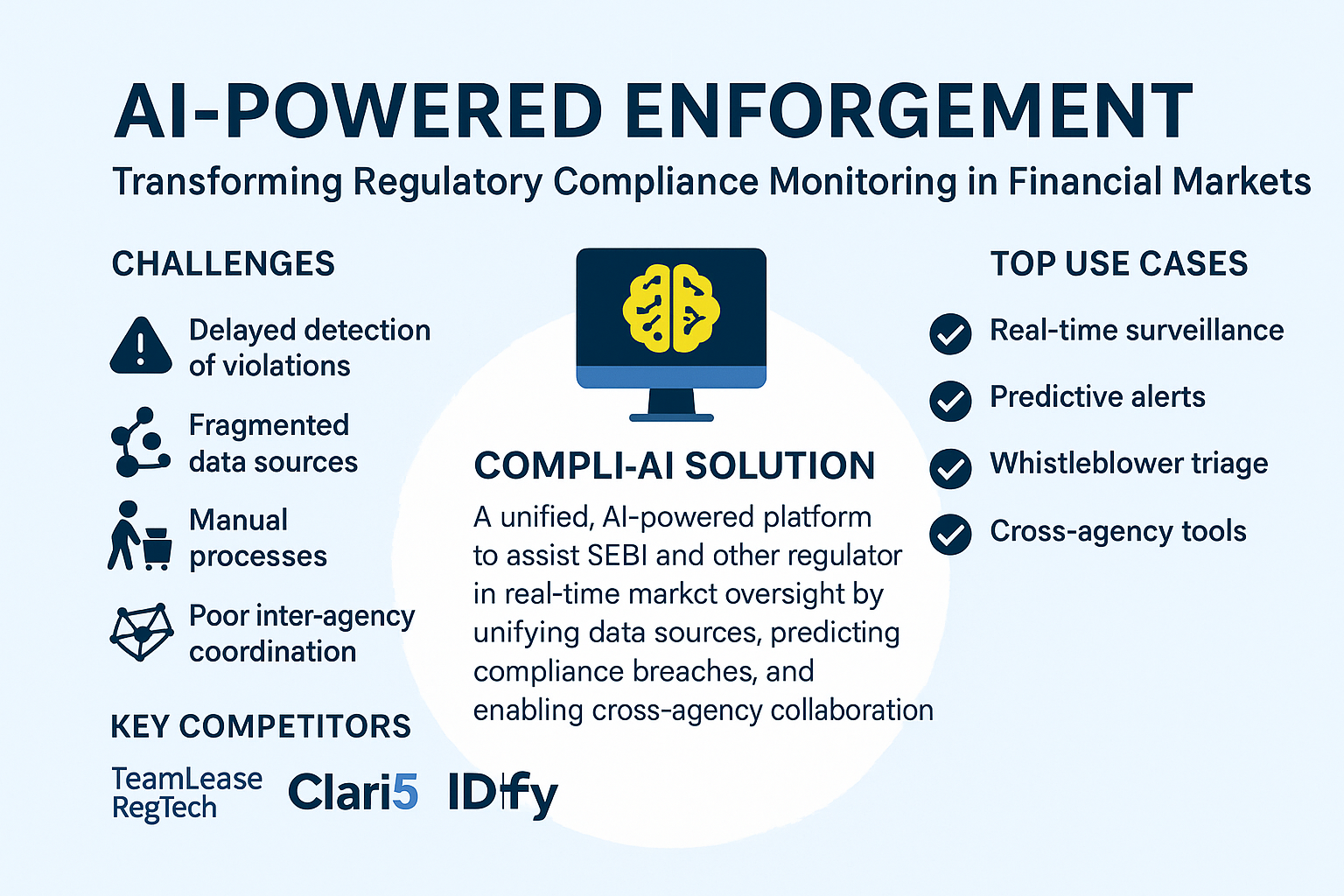
Problem Statement
India’s securities market is one of the largest and most intricate financial ecosystems in the world, comprising thousands of entities including listed companies, brokers, asset managers, and intermediaries. The Securities and Exchange Board of India (SEBI) is mandated to ensure fair practices, investor protection, and systemic integrity. However, the enforcement of regulations across such a vast network is fraught with challenges. Resource constraints—both human and technological—hinder the real-time and comprehensive surveillance of market behavior.
SEBI’s enforcement mechanisms often struggle with delayed legal proceedings, outdated monitoring systems, and the inability to swiftly act on violations. The complexity of financial instruments, cross-border transactions, and digital trading platforms further complicates oversight. Additionally, coordination gaps between SEBI and other regulatory bodies like RBI, IRDAI, and global counterparts impede unified enforcement actions. These inefficiencies can lead to undetected market manipulation, insider trading, and financial fraud.
There is an urgent need for an AI-driven compliance monitoring platform that can automate surveillance, provide real-time alerts, predict non-compliance trends, and facilitate efficient inter-agency collaboration. Such a solution would significantly bolster SEBI’s enforcement capability, minimize regulatory arbitrage, and enhance market integrity.
Pain Points
- Delayed Detection
By the time violations are detected manually, significant damage has already occurred, making enforcement reactive rather than preventive. - Legal Backlog
Prosecution of violations is delayed due to overburdened tribunals and lengthy legal procedures, reducing the deterrence effect of enforcement. - Insufficient Automation
Manual processes dominate monitoring workflows, slowing down investigations and creating dependencies on individual analysts. - Resource Constraints
SEBI lacks sufficient manpower and data scientists to process the volume of data generated daily in the market. - Coordination Silos
Limited real-time collaboration between SEBI, RBI, and other agencies weakens the impact of cross-domain regulatory action. - Data Fragmentation
Market data is stored across unconnected systems, making it difficult to create a consolidated picture of suspicious activities. - Inefficient Whistleblower Handling
Whistleblower inputs are often under-utilized due to the absence of structured analysis tools and anonymized communication channels. - Outdated Surveillance Tools
Legacy systems don’t scale with modern financial instruments like derivatives, algo-trading, or international funds. - Lack of Predictive Insight
Current systems don’t proactively flag potential violations based on historical or behavioral trends. - Information Overload
Analysts are overwhelmed with massive data sets and noise, making it difficult to prioritize real risks over false positives.
Key Competitors
- TeamLease RegTech
India’s leading compliance management software company, offering solutions like RegTrack for tracking, automating, and auditing compliance across various laws. - CustomerXPs (Clari5)
Provides real-time financial crime risk management solutions, focusing on fraud detection and compliance for banking institutions. - IDfy
Specializes in identity verification and background checks, aiding in KYC compliance and fraud detection using AI-driven solutions. - Protean eGov Technologies
Formerly NSDL e-Governance, it offers digital public infrastructure and e-governance solutions, including compliance-related services for various government initiatives. - Lawrbit
Provides global compliance management solutions, integrating regulatory intelligence across multiple countries to assist enterprises in managing regulatory risks.
Market Maturity
The Indian RegTech market is in a growth phase, driven by increasing regulatory complexities and the need for digital compliance solutions. Government initiatives like Digital India and regulatory sandboxes by SEBI and RBI are fostering innovation in this space.
Major Offerings by Competitors
- Automated Compliance Tracking: Real-time monitoring and alerts for compliance deadlines and obligations.
- Regulatory Intelligence: Continuous updates and analysis of regulatory changes.
- Fraud Detection: AI-driven tools to identify and prevent fraudulent activities.
- KYC/AML Solutions: Streamlined processes for customer verification and anti-money laundering compliance.
- Litigation Management: Tools to manage legal cases and documentation.
- Risk Assessment: Evaluating and mitigating compliance risks.
- Audit Trails: Maintaining records of compliance activities for accountability.
- Inter-agency Collaboration: Platforms facilitating information sharing between regulatory bodies.
- User-friendly Dashboards: Visual representations of compliance status and metrics.
- Mobile Accessibility: Access to compliance tools via mobile devices for on-the-go monitoring
Product Vision
The vision is to build “COMPLI-AI”, a next-gen AI-powered regulatory compliance enforcement and monitoring platform tailored for SEBI and allied financial regulators in India. In a market as vast and dynamic as India’s securities ecosystem, real-time vigilance, predictive oversight, and streamlined enforcement are critical. COMPLI-AI will become SEBI’s digital sentinel, using artificial intelligence to continuously monitor market behavior, detect suspicious activities, and predict possible compliance breaches before they occur.
COMPLI-AI will unify disparate datasets—transaction logs, filings, market data, surveillance inputs—into one platform and apply intelligent correlation models to detect anomalies. The platform will feature automated workflows for red-flag alerts, dashboard-based violation tracking, and intelligent case escalation. Through robust APIs, it will ensure seamless coordination between SEBI, RBI, IRDAI, and even global regulators.
A secure, anonymized whistleblower submission system will be built in, with AI ranking inputs for urgency and credibility. Machine learning will identify repeat patterns of violations, while NLP engines summarize regulatory documents and ongoing legal cases for faster interpretation.
By transforming regulatory monitoring from a manual, fragmented process into a proactive, data-intelligent operation, COMPLI-AI will not just detect but deter non-compliance. Its rollout will start with SEBI, followed by expansion to state regulators and financial intermediaries.
Use Cases
1.Real-Time Market Anomaly Detection
- Short Info: Leverage AI to monitor and detect unusual trading patterns in real-time.
- Reference: Vision #1, Pain Points #1, #8, Competition #1.
- Stakeholders: SEBI Surveillance Officers, Stock Exchanges, Technology Vendors.
- Elaboration: Implement AI algorithms to continuously analyze trading data across exchanges, identifying anomalies such as sudden spikes in volume or price, which may indicate market manipulation or insider trading. The system should provide real-time alerts to surveillance officers for immediate action.
- Requirements:
- Integration with exchange data feeds.
- AI models trained on historical trading data.
- Real-time alert generation.
- Dashboard for monitoring anomalies.
- User access controls.
- Audit trail for detected anomalies.
- Scalability to handle large data volumes.
- API for data sharing with other agencies.
- Automated report generation.
- Machine learning model retraining capabilities.
2.Predictive Compliance Violation Alerts
- Short Info: Utilize machine learning to forecast potential compliance breaches.
- Reference: Vision #2, Pain Points #9, Competition #2.
- Stakeholders: SEBI Compliance Officers, Legal Advisors, Financial Institutions.
- Elaboration: Develop predictive models that analyze historical compliance data to identify patterns leading to violations. The system should proactively alert compliance officers about entities at risk, allowing for preemptive measures.
- Requirements:
- Historical compliance data repository.
- Predictive analytics engine.
- Risk scoring mechanism.
- Notification system for alerts.
- Integration with case management systems.
- User interface for reviewing predictions.
- Feedback loop for model accuracy improvement.
- Data visualization tools.
- Security protocols for sensitive data.
- Compliance with data protection regulations.
3.AI-Driven Whistleblower Report Triage
- Short Info: Implement AI to assess and prioritize whistleblower reports.
- Reference: Vision #3, Pain Points #7, Competition #3.
- Stakeholders: SEBI Legal Advisors, Whistleblowers, Compliance Officers.
- Elaboration: Create a secure platform where whistleblowers can submit reports anonymously. AI algorithms will analyze the content to determine credibility and urgency, ensuring that high-priority cases are addressed promptly.
- Requirements:
- Secure submission portal.
- Natural language processing for content analysis.
- Priority scoring system.
- Integration with case management tools.
- Anonymity preservation mechanisms.
- Audit logs for submissions.
- User notification system.
- Data encryption protocols.
- Multilingual support.
- Compliance with whistleblower protection laws.
4.Cross-Agency Investigation Collaboration
- Short Info: Facilitate coordinated investigations between SEBI and other regulatory bodies.
- Reference: Vision #4, Pain Points #5, #6, Competition #4.
- Stakeholders: SEBI, RBI, IRDAI, Enforcement Directorate.
- Elaboration: Develop a collaborative platform that allows different regulatory agencies to share information, assign tasks, and track the progress of joint investigations, enhancing efficiency and reducing duplication of efforts.
- Requirements:
- User access controls for different agencies.
- Shared case management system.
- Secure communication channels.
- Document sharing capabilities.
- Audit trails for all activities.
- Real-time updates and notifications.
- Integration with existing agency systems.
- Data encryption standards.
- Role-based access to sensitive information.
- Compliance with inter-agency data sharing agreements.
5.NLP-Based Legal Document Summarization
- Short Info: Use natural language processing to summarize lengthy legal documents.
- Reference: Vision #5, Pain Points #2, #9, Competition #5.
- Stakeholders: SEBI Legal Advisors, Compliance Officers, Judiciary.
- Elaboration: Implement NLP tools to automatically generate concise summaries of legal documents, such as judgments and regulatory filings, enabling quicker understanding and decision-making by legal professionals.
- Requirements:
- Integration with legal document repositories.
- Advanced NLP algorithms.
- User interface for reviewing summaries.
- Search functionality within documents.
- Multilingual support.
- Annotation tools for legal professionals.
- Version control for documents.
- Export options for summaries.
- Data security measures.
- Compliance with legal data handling standards.
6.Behavioral Pattern Analysis of Repeat Violators
- Short Info: Analyze historical data to identify patterns among repeat offenders.
- Reference: Vision #6, Pain Points #1, #9, Competition #2.
- Stakeholders: SEBI Enforcement Officers, Compliance Analysts.
- Elaboration: Develop analytical tools that examine past violations to detect recurring behaviors or tactics used by repeat offenders, aiding in proactive monitoring and enforcement.
- Requirements:
- Historical violation database.
- Behavioral analysis algorithms.
- Visualization tools for pattern recognition.
- Alert system for identified patterns.
- Integration with compliance monitoring systems.
- User interface for analysts.
- Reporting tools for management.
- Data anonymization features.
- Machine learning model training capabilities.
- Compliance with data privacy regulations.
7.Regulatory Trend Analysis and Forecasting
- Short Info: Predict future regulatory trends using data analytics.
- Reference: Vision #7, Pain Points #3, #9, Competition #1.
- Stakeholders: SEBI Policy Makers, Compliance Officers, Financial Institutions.
- Elaboration: Utilize data analytics to examine past regulatory changes and market behaviors, forecasting potential future regulations and helping institutions prepare in advance.
- Requirements:
- Historical regulatory data repository.
- Predictive analytics models.
- Visualization dashboards.
- Scenario analysis tools.
- User interface for policy makers.
- Integration with external data sources.
- Alert system for predicted changes.
- Reporting tools for stakeholders.
- Data validation mechanisms.
- Compliance with data governance policies.
8.Automated Compliance Reporting System
- Short Info: Implement a system for entities to submit compliance reports automatically.
- Reference: Vision #8, Pain Points #3, #9, Competition #2.
- Stakeholders: Financial Institutions, SEBI Compliance Officers, Auditors.
- Elaboration: Develop a standardized digital platform where regulated entities can submit periodic compliance reports. The system should validate submissions against predefined criteria, flag inconsistencies, and provide real-time feedback to entities, ensuring timely and accurate reporting.
- Requirements:
- Standardized reporting templates.
- Automated data validation checks.
- Secure submission portal.
- Integration with internal compliance systems.
- Real-time feedback mechanism.
- Audit trail for submissions.
- User access controls.
- Notification system for deadlines.
- Data analytics for trend analysis.
- Compliance with data protection regulations.
9.Blockchain-Based Record Keeping
- Short Info: Utilize blockchain technology to maintain immutable records of transactions and compliance activities.
- Reference: Vision #9, Pain Points #2, #9, Competition #5.
- Stakeholders: SEBI IT Department, Financial Institutions, Auditors.
- Elaboration: Implement a blockchain-based system to record all compliance-related activities, ensuring transparency and immutability. This approach enhances trust in the regulatory process and simplifies audits by providing a tamper-proof ledger of all actions.
- Requirements:
- Blockchain infrastructure setup.
- Smart contract development for compliance rules.
- Integration with existing compliance systems.
- User interface for accessing records.
- Access controls and permissions.
- Data encryption protocols.
- Scalability to handle large volumes of data.
- Disaster recovery mechanisms.
- Training for stakeholders.
- Compliance with legal standards for digital records.
10.Centralized KYC Repository
- Short Info: Create a centralized repository for Know Your Customer (KYC) data accessible to all financial entities.
- Reference: Vision #10, Pain Points #3, #6, Competition #3.
- Stakeholders: Financial Institutions, SEBI, RBI, Customers.
- Elaboration: Develop a unified KYC platform where customer information is stored and verified once, reducing redundancy and enhancing efficiency. Financial entities can access this data with customer consent, streamlining onboarding and compliance processes.
- Requirements:
- Secure KYC data storage.
- Verification mechanisms.
- User consent management system.
- APIs for data access by authorized entities.
- Audit logs for data access.
- Data encryption and protection measures.
- Integration with existing KYC systems.
- User interface for customers to manage their data.
- Compliance with data privacy laws.
- Disaster recovery and backup solutions.
11.AI-Powered Risk Assessment Tool
- Short Info: Develop an AI tool to assess the risk profile of financial entities based on various parameters.
- Reference: Vision #11, Pain Points #1, #9, Competition #2.
- Stakeholders: SEBI Risk Assessment Team, Financial Institutions, Auditors.
- Elaboration: Implement an AI-driven system that analyzes financial data, compliance history, market behavior, and other relevant factors to assign risk scores to entities. This aids regulators in prioritizing oversight and interventions.
- Requirements:
- Data aggregation from multiple sources.
- Machine learning algorithms for risk scoring.
- User interface for viewing risk profiles.
- Integration with compliance monitoring systems.
- Alert system for high-risk entities.
- Feedback loop for model improvement.
- Data visualization tools.
- Security measures for sensitive data.
- Compliance with regulatory standards.
- Training for users on interpreting risk scores.
12.Mobile Application for Investor Grievance Redressal
- Short Info: Develop a mobile app for investors to lodge complaints and track their resolution status.
- Reference: Vision #12, Pain Points #7, #9, Competition #4.
- Stakeholders: Investors, SEBI Grievance Redressal Team, Financial Institutions.
- Elaboration: Create a user-friendly mobile application that allows investors to submit grievances, upload supporting documents, and monitor the progress of their complaints. The app should facilitate communication between investors and the concerned regulatory departments.
- Requirements:
- User registration and authentication.
- Complaint submission form.
- Document upload functionality.
- Real-time status tracking.
- Push notifications for updates.
- Multilingual support.
- Integration with SEBI’s grievance redressal system.
- Data encryption for user information.
- Feedback mechanism.
- Compliance with mobile app security standards.
13.Training Portal for Compliance Officers
- Short Info: Establish an online portal offering training modules for compliance professionals.
- Reference: Vision #13, Pain Points #4, #9, Competition #5.
- Stakeholders: Compliance Officers, SEBI Training Division, Financial Institutions.
- Elaboration: Develop an e-learning platform providing up-to-date training materials, courses, and certifications for compliance officers. This ensures that professionals stay informed about regulatory changes and best practices.
- Requirements:
- User registration and profile management.
- Course catalog with various modules.
- Interactive learning materials.
- Assessment and certification system.
- Progress tracking dashboard.
- Discussion forums for peer interaction.
- Integration with SEBI’s HR systems.
- Mobile compatibility.
- Data analytics for course effectiveness.
- Compliance with e-learning standards.
14.Public Disclosure Dashboard
- Short Info: Create a dashboard displaying compliance statuses and enforcement actions for public viewing.
- Reference: Vision #14, Pain Points #7, #9, Competition #1.
- Stakeholders: General Public, Investors, SEBI, Media.
- Elaboration: Develop a transparent platform where the public can access information about the compliance status of financial entities, ongoing investigations, and enforcement actions taken by SEBI. This promotes accountability and informed decision-making among investors.
- Requirements:
- Data aggregation from enforcement systems.
- User-friendly interface.
- Search and filter functionalities.
- Regular data updates.
- Mobile responsiveness.
15.Integrated Communication and Collaboration Platform
- Short Info: Develop a centralized platform for seamless communication and collaboration among SEBI departments and external stakeholders.
- Reference: Vision #15, Pain Points #4, #9, Competition #5.
- Stakeholders: SEBI Departments, Financial Institutions, Compliance Officers, Auditors.
- Elaboration: Create a secure and centralized communication platform that facilitates real-time collaboration among SEBI departments and external stakeholders. This platform should support document sharing, discussion forums, and project management tools to enhance coordination and efficiency in regulatory processes.
- Requirements:
- User authentication and role-based access control.
- Secure messaging and file sharing capabilities.
- Discussion forums and knowledge bases.
- Project and task management tools.
- Integration with existing SEBI systems.
- Audit trails for all communications.
- Mobile and desktop accessibility.
- Notification and alert systems.
- Data encryption and compliance with cybersecurity standards.
- User training and support resources.