
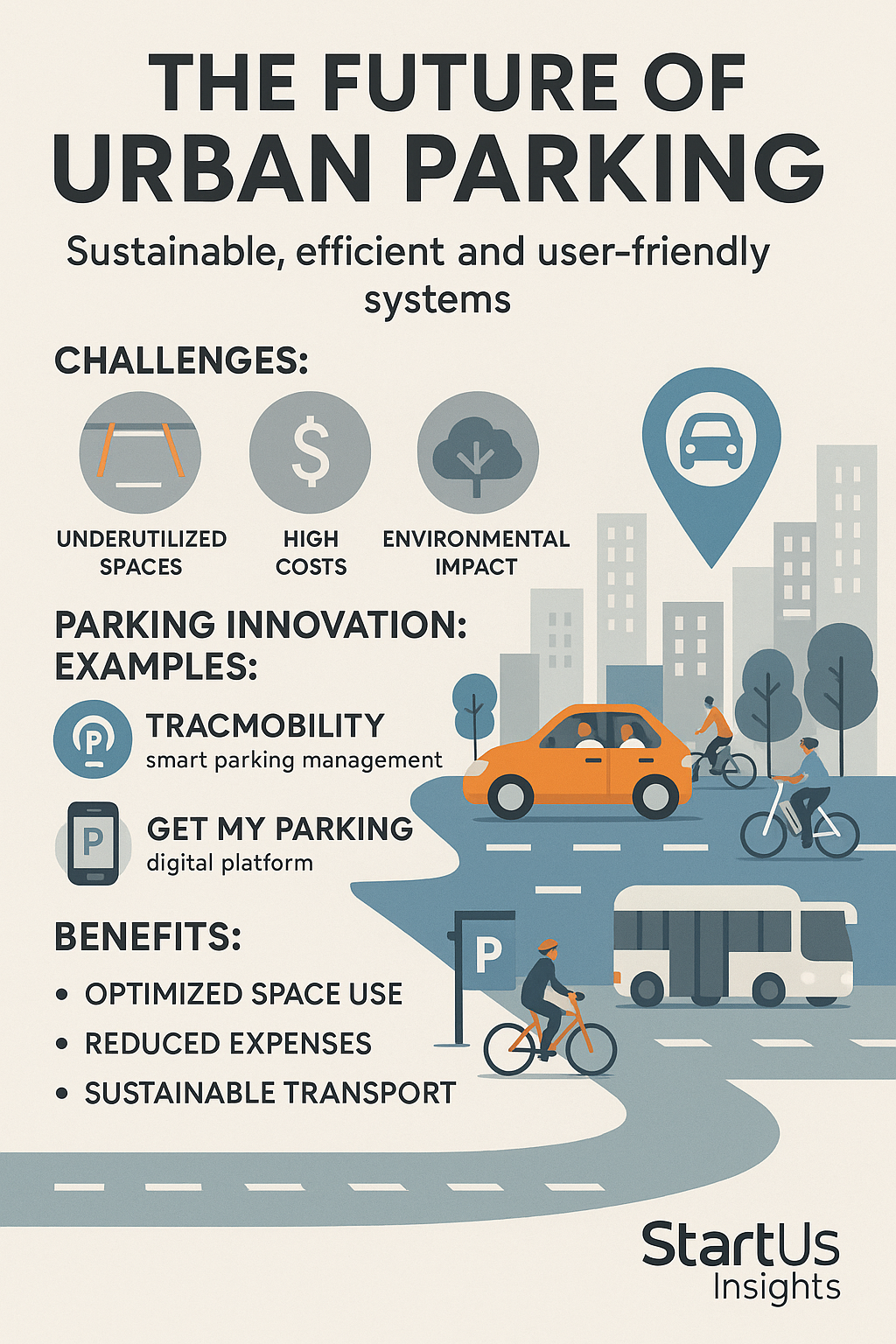
Cities and businesses are burdened by the high cost of maintaining and expanding parking infrastructure. This includes not only the physical cost of land, construction, and maintenance, but also the opportunity cost of dedicating valuable urban space to parked vehicles that often remain idle for 95% of the time. As urban populations grow and land becomes scarcer, dedicating prime real estate to parking lots becomes increasingly unsustainable. Moreover, underutilized parking spaces lead to inefficient land use and contribute to urban sprawl, traffic congestion, and environmental degradation.
Instead of expanding parking infrastructure, future-focused urban planning should prioritize shared mobility solutions — such as car-sharing, ride-hailing, micro-mobility (e.g., e-scooters, bikes), and public transit integration — that can significantly reduce individual car ownership and, consequently, the need for parking. This paradigm shift requires intelligent platforms that connect users with shared transportation options in real time, supported by data-driven urban policies and infrastructure planning tools.
UrbanParkTech aims to develop a holistic solution to transition cities and businesses away from parking dependency, towards an ecosystem of shared, sustainable, and smart mobility.
Stakeholders & Their Roles:
- Urban Commuters – Daily users of transportation services affected by limited parking and mobility options.
- City Planners & Municipalities – Decision-makers responsible for land use, zoning, and urban development.
- Real Estate Developers – Builders of commercial and residential properties who must comply with parking space regulations.
- Businesses & Retailers – Owners who allocate part of their land for customer/staff parking.
- Transportation Service Providers – Car-sharing, micro-mobility, and public transit operators who can offer alternatives.
- Parking Lot Management Companies – Operators directly affected by demand for traditional parking.
- Environmental Agencies – Advocates for sustainability who monitor urban emissions and land use.
- Investors in Urban Infrastructure – Funders of projects who seek ROI from forward-looking infrastructure.
- Logistics Companies – Need efficient delivery systems often hindered by lack of optimized curbside usage.
- Residents of High-Density Areas – Often experience congestion and competition for limited parking.
Pain Points:
- High Cost of Land for Parking – Prime urban real estate is consumed by low-utility parking, limiting better land use.
- Underutilization of Parking Spaces – Most private vehicles remain parked ~95% of the time, leading to wasted infrastructure.
- Congestion & Emissions from Parking Search – Drivers spend time and fuel searching for parking, increasing traffic and pollution.
- Regulatory Burden on Developers – Zoning laws force developers to add parking, inflating construction costs and reducing space for units.
- Disincentivization of Shared Mobility – Current city layouts and policies favor personal car use over shared transit models.
- Inflexible Use of Urban Space – Fixed parking structures can’t easily be repurposed, locking cities into outdated designs.
- Retail Business Losses – Customers may avoid stores in areas with difficult or expensive parking options.
- Inadequate Last-Mile Connectivity – Lack of micro-mobility and shared transit leads to reliance on personal vehicles.
- Fragmented Mobility Ecosystem – Lack of integrated platforms leaves users switching between disconnected apps for travel needs.
- Environmental Impact – Increased surface parking contributes to heat islands and runoff pollution in cities.
Key Competitors
Uber: A global leader in ride-hailing, Uber is expanding into autonomous mobility through partnerships, such as with Pony AI, to introduce robotaxis in the Middle East later this year .Investopedia
Lyft: A major U.S.-based ride-sharing company, Lyft has diversified into bike and scooter rentals, aiming to provide comprehensive urban mobility solutions.
Lime: Specializing in shared electric scooters and bikes, Lime is the world’s largest micromobility provider, focusing on reducing urban congestion and emissions .McKinsey & Company
Turo: A peer-to-peer car-sharing platform, Turo enables private car owners to rent out their vehicles, promoting efficient use of existing resources.
SpotHero: A digital parking marketplace in North America, SpotHero connects drivers with available parking spots, optimizing urban parking utilization .F6S+1TechCrunch+1
Tracmobility: A UK-based startup offering smart parking management solutions, integrating IoT sensors and software to optimize parking space utilization and reduce congestion .StartUs Insights
Envoy: Provides electric vehicle-sharing services to residential and commercial properties, partnering with developers to offer sustainable transportation options .INVERS+1skidata.com+1
Beam: A Southeast Asian e-scooter company encouraging users to park in designated spots via app-based incentives, promoting organized urban mobility .Micromobility
Movmi: A consultancy specializing in shared mobility services, Movmi collaborates with transit agencies and companies to design and implement shared transportation solutions .Verified Market Research
Hala Mobility: An Indian startup offering a multimodal electric vehicle-sharing platform, integrating various modes of transport for seamless urban mobility .startup.siliconindia.com
Investment Landscape
Since 2010, over $100 billion has been invested in shared mobility companies, with approximately 72% of this funding coming from venture capital and private equity firms, indicating strong investor confidence in the sector’s growth potential .McKinsey & Company+1Octo Telematics+1
Notable recent investments include Sequoia Capital, Fidelity Investments, D1 Ventures, and G Squared funding Bolt, a European mobility platform offering ride-hailing and other services .Zag Daily
Major Offerings by Competitors
- Real-Time Ride-Hailing: On-demand transportation services via mobile apps.
- Micromobility Options: Shared e-scooters and bikes for short-distance travel.
- Car-Sharing Platforms: Peer-to-peer and fleet-based vehicle sharing services.
- Smart Parking Solutions: Digital platforms connecting drivers with available parking spots.
- Multimodal Integration: Combining various transportation modes into a single platform.
- Electric Vehicle Fleets: Deployment of EVs to reduce carbon emissions.
- Autonomous Vehicle Initiatives: Development and testing of self-driving transportation options.
- Subscription-Based Services: Offering flexible access to transportation without ownership.
- Data-Driven Urban Planning: Utilizing mobility data to inform infrastructure development.
- Incentivized Parking Compliance: Encouraging proper parking behavior through app-based rewards.TechCrunchMicromobility
Product Vision
UrbanParkTech envisions a future where cities no longer need to sacrifice valuable space for underutilized parking infrastructure. Instead, we aim to lead the transformation of urban landscapes by replacing static parking zones with dynamic shared mobility hubs. Our product will be a unified digital and infrastructure platform that empowers cities, businesses, and commuters to adopt shared mobility as the default mode of urban transportation.
Our platform will provide an intelligent interface that integrates real-time shared transportation options — such as ride-hailing, car-sharing, bikes, and scooters — while optimizing existing parking spaces for dynamic use, including logistics drop zones, charging stations, or event-based parking flexibility. With predictive analytics and demand forecasting, municipalities can redesign urban zones in favor of fluid mobility, significantly reducing costs and environmental impacts.
Leveraging UrbanParkTech’s strengths in geospatial analytics, IoT sensor integration, and policy modeling, we’ll enable city planners and businesses to phase out outdated parking infrastructure in favor of adaptive, revenue-generating shared mobility hubs. Unlike isolated apps or legacy parking systems, our platform is built for systemic change, scalability, and urban impact.
This vision positions UrbanParkTech not just as a tech vendor but as a strategic partner in reshaping urban life — reducing congestion, enhancing accessibility, and reclaiming land for higher-value community and environmental uses.
Use Cases of the Product
- Smart Reallocation of Parking Space – Cities can identify and convert underused lots into mobility hubs or green spaces.
- Integrated Mobility Marketplace – Commuters access all ride/micro-mobility options through one app.
- Corporate Mobility Planning – Businesses offer employees shared mobility credits instead of parking permits.
- Dynamic Pricing for Urban Curbside Space – Adjust curb usage in real-time for delivery, passenger pickup, or scooters.
- Last-Mile Connectivity via Micro-Mobility – Enhance connections between transit stations and final destinations.
- Smart Parking Alerts & Space Sharing – Residents and businesses can share or monetize unused spaces.
- EV Charging + Mobility Hubs – Combine charging stations with mobility services to maximize land use.
- Real-Time Urban Demand Forecasting – Predict where and when mobility options or parking are needed.
- Policy Simulator for Urban Planners – Visual tools to model parking reduction and mobility enhancements.
- Mobility-as-a-Service Subscriptions – Offer monthly access to mixed mobility services (e.g., ride-hailing, bikes, EVs).
Research Summary
Urban areas worldwide are grappling with the escalating costs of constructing and maintaining parking infrastructure. Traditional approaches to parking are proving unsustainable, prompting a shift towards shared mobility solutions that optimize space and reduce expenses.
Our research delves into the core issues surrounding urban parking, identifying key pain points such as underutilized spaces, high operational costs, and the environmental impact of extensive parking facilities. By examining current trends and innovations in shared mobility, we explore how integrated solutions can alleviate these challenges.
Innovative startups and companies are leading the charge in transforming urban mobility. For instance, Tracmobility offers smart parking management solutions that enhance efficiency through IoT integration . Similarly, Get My Parking provides a digital platform that modernizes parking operations, enabling seamless data exchange and automation .StartUs InsightsThe FutureList – Step into the Future
The future of urban mobility lies in embracing shared transportation models, leveraging technology to create sustainable, efficient, and user-friendly systems. By reimagining parking not as a static necessity but as a dynamic component of urban planning, cities can foster environments that prioritize accessibility, environmental responsibility, and economic viability.