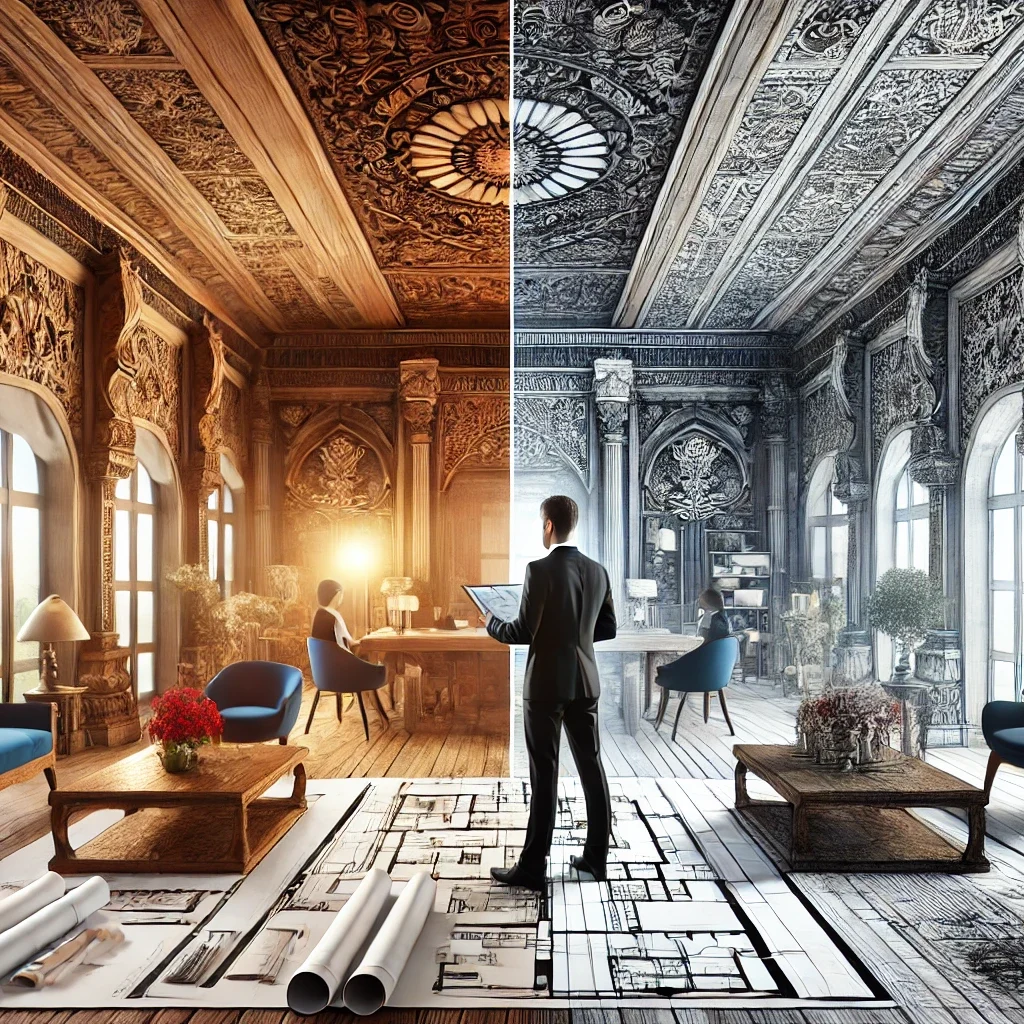
Interior designers frequently encounter the challenge of modernizing spaces while preserving cultural heritage. This issue is particularly significant in heritage buildings, historical homes, and culturally rich environments where renovation must respect the existing aesthetic, craftsmanship, and cultural symbolism. The primary difficulty lies in integrating modern functionality, sustainability, and comfort while maintaining traditional architectural elements, materials, and artistic influences.
Additionally, cultural preservation is more than just maintaining physical structures; it involves sustaining narratives, traditions, and local artistry. Many times, designers struggle to source authentic materials, collaborate with artisans, or incorporate advanced technology without compromising heritage authenticity.
Furthermore, there is often a lack of standardized guidelines on how much modernization is acceptable without losing cultural significance. Clients may have differing opinions, leading to conflicts between functionality and preservation. Budget constraints and regulatory requirements add additional complexity, making it difficult for designers to execute their vision effectively.
Thus, a comprehensive solution is needed—one that provides tools, resources, and methodologies for balancing modernization with heritage preservation, ensuring both aesthetic and functional success.
Key Competitors and Their Offerings
- Houzz – Offers design inspiration, connects clients with professionals, and provides a marketplace for furniture and materials. However, it lacks dedicated heritage restoration tools.
- Autodesk Revit & AutoCAD – Industry-leading software for architectural design and modeling, but lacks specialized tools for cultural heritage preservation.
- Heritage Conservation Professionals (HCPs) & Local Restoration Firms – Small firms specializing in heritage restoration, but their solutions are often localized and not scalable.
- SketchUp – Provides 3D modeling for interior design but does not focus on historical accuracy or sourcing traditional materials.
- Matterport – Creates digital twins of physical spaces, helping designers visualize heritage spaces digitally, but lacks tools for integrating modernization efforts.
Startups Innovating in the Space
- Iconem – Uses AI and 3D scanning to digitally preserve cultural sites.
- Historic England’s Digital Conservation Lab – Develops digital tools for heritage site preservation.
- Heritage BIM – Provides a digital workflow for managing heritage site restorations.
- Tweed – AI-driven tools for historical preservation and urban planning.
- Concr3de – 3D prints stone structures for historical restoration.
- Hispamur – A Spanish startup specializing in cultural restoration using sustainable materials.
- Tradition Meets Tech – Combines smart home tech with heritage aesthetics.
- Preservia – AI-driven material sourcing for heritage conservation.
- Revival Spaces – An online platform connecting designers with artisans for cultural restorations.
- Echoes of the Past – Uses VR to reconstruct historical interiors for design planning.
Recent Investments in the Sector
- UNESCO and World Bank have allocated over $200M (2023-2024) for global cultural heritage preservation projects.
- Autodesk acquired Spacemaker AI (2021) for $240M, integrating AI into architectural design, potentially benefiting heritage conservation.
- Angel investors and VCs have funded startups like Concr3de and Heritage BIM, with funding rounds exceeding $50M combined in the past two years.
Market Maturity and Gaps
- The industry is fragmented, with no single dominant platform offering an end-to-end solution for modernizing heritage interiors.
- Most tools are either focused on general interior design or on historical preservation, but not both.
- There is a lack of affordable, scalable solutions for small-scale heritage projects, making modernization accessible only to high-budget clients.
- Few platforms provide integrated AI-driven tools for heritage-sensitive interior design.
Product Vision
Heritage interior design is a delicate balance between modernization and cultural preservation. Current solutions are fragmented, requiring designers to rely on multiple tools that are either general-purpose or focused solely on historical preservation. Our product, HeritageDesign AI, will serve as a comprehensive digital platform that integrates AI-driven design assistance, heritage material sourcing, regulatory compliance tools, and visualization capabilities to help interior designers seamlessly modernize spaces without compromising their cultural integrity.
Our platform will offer a heritage-aware AI assistant, capable of analyzing historical design elements and suggesting compatible modern materials and layouts. Designers can upload floor plans or 3D scans of heritage spaces, and the AI will recommend modifications that enhance functionality while preserving aesthetics. Additionally, the smart material sourcing module will connect designers with verified suppliers of traditional materials and skilled artisans, solving one of the biggest industry pain points.
To address compliance challenges, an integrated regulation checker will ensure all design modifications adhere to local heritage preservation laws. The platform will also provide collaborative tools where designers, historians, and property owners can work together in a virtual space.
With sustainability in mind, the product will incorporate eco-friendly renovation recommendations that allow historical structures to become more energy-efficient without altering their architectural integrity.
By offering a unified ecosystem for culturally sensitive interior design, HeritageDesign AI will revolutionize the way designers approach historical spaces—ensuring that modern innovations and timeless traditions coexist harmoniously.
Use Cases
- AI-Driven Heritage Design Suggestions – Automatically generates design recommendations that respect cultural aesthetics.
- 3D Scanning & Virtual Preservation – Allows designers to create a digital twin of spaces before making changes.
- Smart Material Sourcing – Matches designers with suppliers of authentic materials and artisans.
- Regulatory Compliance Checker – Scans designs for alignment with local heritage laws.
- Modern Tech Integration Suggestions – Recommends non-invasive ways to incorporate smart home technology.
- Eco-Friendly Upgrades – Suggests sustainable renovation options that preserve authenticity.
- Collaboration Hub – Provides a workspace for designers, clients, and historians.
- Augmented Reality (AR) Previews – Allows clients to see design changes in AR before committing.
- Automated Budget Estimator – Calculates restoration costs with material and labor insights.
- Heritage Style Guide Generator – Produces a visual guideline for maintaining cultural aesthetics in projects.
Summary
Interior designers face a critical challenge: modernizing spaces while preserving cultural heritage. Traditional approaches either prioritize historical accuracy at the cost of functionality or introduce modern elements that dilute cultural authenticity. This gap creates inefficiencies, increased costs, and regulatory hurdles.
HeritageDesign AI is a cutting-edge digital platform designed to seamlessly integrate AI-driven heritage design assistance, smart material sourcing, regulatory compliance tools, and sustainability recommendations. It empowers designers, architects, and property owners to make informed decisions while maintaining historical integrity.
Key features include an AI-powered design assistant that suggests culturally sensitive modifications, 3D scanning and virtual preservation for pre-renovation planning, and a smart material sourcing marketplace connecting designers with artisans. Additionally, an automated compliance checker ensures adherence to local heritage laws, while AR-based previews and collaboration tools enhance stakeholder communication.
Our competitive analysis highlights a fragmented market, where existing solutions either focus solely on restoration or general interior design. The industry lacks an all-in-one, AI-powered tool dedicated to balancing modernization with heritage preservation. With substantial investments in heritage tech and AI-driven conservation, HeritageDesign AI is positioned to revolutionize the field.