Problem Statement
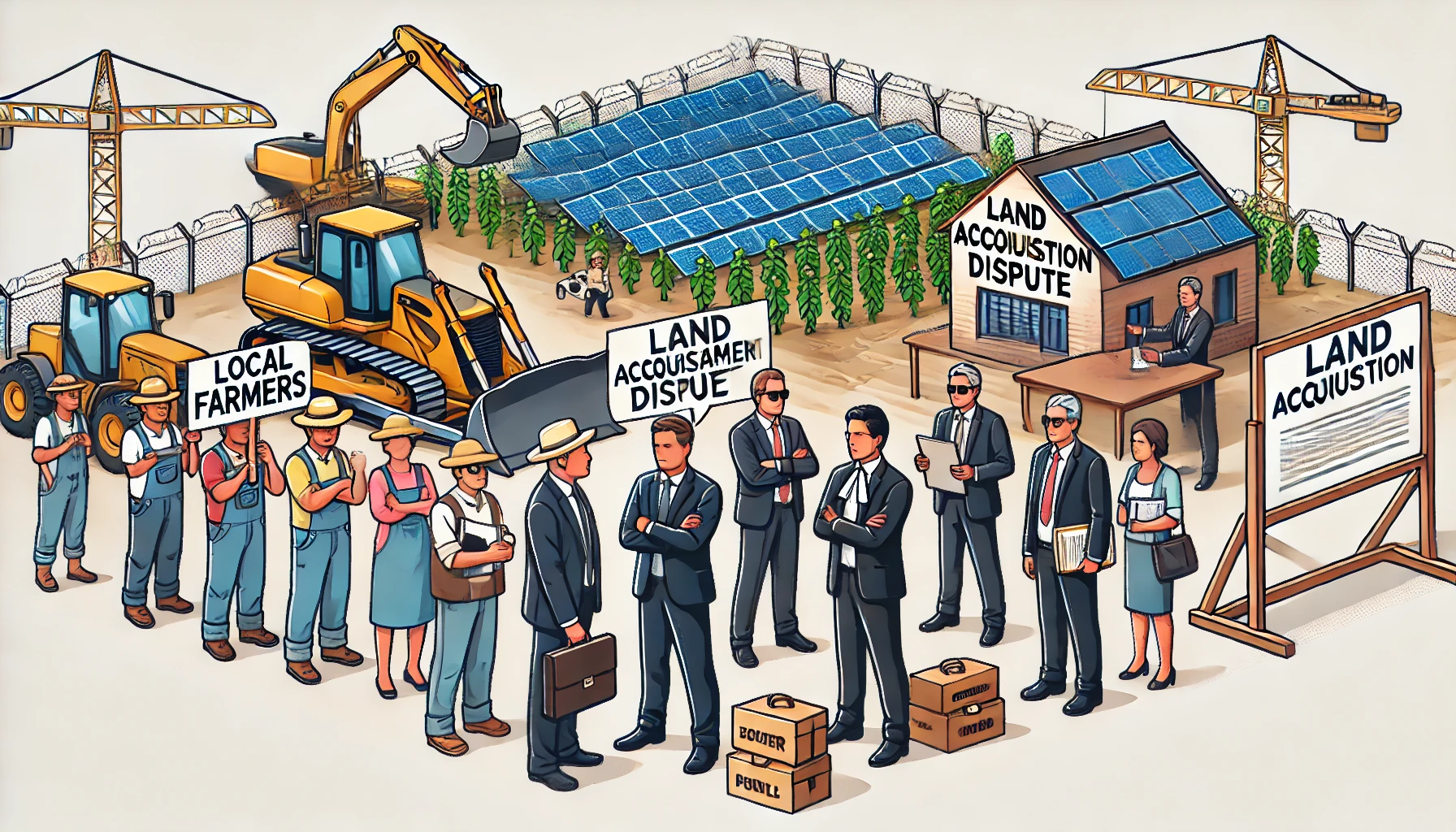
Land acquisition for infrastructure, energy, and commercial development projects often leads to conflicts, especially in rural areas where land serves as the primary source of livelihood. Developers frequently face opposition from local communities, environmental activists, and regulatory bodies, leading to legal battles, protests, and project delays.
One prominent example is Tata Power’s solar project, where local farmers resisted the acquisition of agricultural land, fearing loss of livelihood and cultural displacement. Such disputes arise due to lack of transparent communication, inadequate compensation, unclear land records, and environmental concerns. Moreover, companies often struggle to navigate complex land acquisition laws, further complicating the process.
Governments and private companies need a sustainable, ethical, and legally sound approach to land acquisition that balances development needs with community interests. Digitization of land records, improved stakeholder engagement, and alternative compensation models could be potential solutions to mitigate these conflicts.
Pain Points
- Lack of Transparent Land Records – Many land titles are unclear, leading to disputes over ownership and compensation.
- Inadequate Compensation – Landowners feel underpaid compared to market rates, causing resistance.
- Loss of Livelihood – Farmers and communities lose their primary source of income, leading to economic distress.
- Environmental & Cultural Impact – Forest clearing and displacement of indigenous communities create social unrest.
- Complex Legal & Bureaucratic Processes – Lengthy approval procedures and conflicting laws slow down projects.
- Mistrust Between Stakeholders – Communities often distrust corporations and the government, leading to protests.
- Lack of Community Involvement – Decisions are often made without consulting local populations, increasing opposition.
- Litigation & Project Delays – Legal challenges can delay projects for years, increasing costs.
- Political Interference – Changing government policies can disrupt previously approved projects.
- Lack of Alternative Compensation Models – Cash payments often fail to address long-term community welfare concerns.
Key Competitors and Their Offerings
- Landshare India Pvt Ltd: Specializes in land acquisition, transaction advisory, and asset management services, focusing on prime real estate opportunities. Land Share India
- Magus: Offers land acquisition and consultancy services, with a significant land bank in Thane and Raigad districts. Their services include land surveys, negotiations, legal clearance, and title transfers. Magus India+1The Indian Express+1
- MITCON Consultancy: Provides location assessment and land acquisition services, offering insights into location dynamics, availability of resources, and government benefits. MITCON
- Datta Infra: Emerging as a key player in land acquisition for renewable energy projects, offering organized and sustainable solutions for land consolidation. Reuters+2CXO Today+2The Indian Express+2
- Rucha Group: Provides end-to-end support in land acquisition, emphasizing ethical practices and efficient processes. Rucha Group
Startups Addressing Land Acquisition Challenges
- Clergy Wisemen (C&W): Assisted an agri-tech startup in acquiring agricultural land across multiple states with minimal delays and legal risks, utilizing audio and smart contracts in native languages to improve farmer engagement. CLERGY & WISEMEN
- Technopark: Launched an advanced Land Information System (LIS) to revolutionize land management using GIS-based tools, providing a centralized repository of comprehensive land data. IT Park Technopark
- PropTech Startups: Various startups are leveraging technology to streamline property searches, digital signatures for legal documents, and overall efficiency in the land acquisition process. LinkedIn
Product Vision
Land acquisition in India is fraught with legal complexities, social unrest, and bureaucratic delays. Our solution, LandBridge, aims to digitize, simplify, and democratize land acquisition, ensuring transparency, compliance, and community engagement. LandBridge will be a tech-enabled platform integrating blockchain, AI-powered land analytics, and a stakeholder engagement system to streamline land transactions. It will provide verified land records, real-time market valuation, and smart contract-based agreements to reduce disputes. For landowners, LandBridge will ensure fair compensation by using AI-based land valuation models. A digital negotiation and consensus-building tool will facilitate discussions between landowners, developers, and government agencies, minimizing conflicts.
For developers and corporations, the platform will provide geo-tagged land listings, legal risk assessment reports, and pre-vetted land parcels to reduce acquisition time. Automated compliance checks will simplify regulatory approvals. For government agencies, LandBridge will act as a centralized land record management system, reducing fraud and improving governance. With built-in alternative compensation models like profit-sharing, land pooling, and sustainable relocation programs, LandBridge will foster trust between stakeholders, ensuring responsible development.
Use Cases of the Product
- Blockchain-Based Land Registry – Immutable records to prevent fraud and disputes.
- AI-Powered Land Valuation – Accurate price estimates based on market trends and historical data.
- Smart Contracts for Land Transactions – Automated legal agreements ensuring compliance.
- Digital Negotiation Platform – Virtual forums for landowners and developers to reach fair settlements.
- Legal Risk Assessment Reports – AI-driven analysis of potential disputes and encumbrances.
- Geo-Tagged Land Listings – A marketplace for verified, conflict-free land parcels.
- Automated Compliance Checks – AI-driven validation of regulatory requirements for projects.
- Alternative Compensation Models – Land pooling, annuity payments, and equity-sharing mechanisms.
- Community Engagement & Awareness – Educational modules and grievance redressal systems.
- Government Integration & Land Digitization – Direct sync with government land records for authenticity.
1. Blockchain-Based Land Registry
- Short Info: Secure, tamper-proof digital land records using blockchain.
- Reference: Vision (Transparency & Fraud Prevention), Pain Points (Disputed Land Titles).
- Stakeholders: Government, landowners, legal experts, developers.
- Elaboration:
Traditional land registries are prone to fraud, mismanagement, and disputes due to missing or tampered records. LandBridge will store all land records on a blockchain ledger, ensuring immutable ownership history. Each transaction (sale, lease, mortgage) will be time-stamped and verifiable by all stakeholders. This reduces fake land claims, duplicate registrations, and disputes over ownership. Government bodies can directly integrate with this system, improving governance and land record management. - Requirements:
- Blockchain infrastructure for decentralized land registry.
- Integration with government land records.
- Secure identity verification for landowners.
- Time-stamped and tamper-proof transaction records.
- Access control for different stakeholders.
- API for integration with legal and financial institutions.
- Smart contracts for ownership transfer.
- Multi-language support for rural accessibility.
- Mobile and web-based interfaces for ease of access.
- Backup and recovery mechanisms for data integrity.
2. AI-Powered Land Valuation
- Short Info: Automated, AI-driven land price estimation based on real-time data.
- Reference: Vision (Fair Compensation), Pain Points (Inadequate Compensation).
- Stakeholders: Landowners, real estate developers, financial institutions.
- Elaboration:
Compensation disputes arise when landowners feel undervalued. LandBridge will use AI algorithms to analyze past sales, infrastructure development, and economic factors to estimate fair land prices. This data will be openly available, ensuring transparent negotiations. - Requirements:
- AI-based land pricing algorithm.
- Integration with real estate transaction databases.
- Historical pricing and trend analysis.
- Government-approved valuation compliance.
- User-friendly dashboards for price insights.
3. Smart Contracts for Land Transactions
- Short Info: Automated, self-executing contracts for land deals.
- Reference: Vision (Legal Compliance), Competition (Blockchain Innovations).
- Stakeholders: Developers, legal experts, landowners.
- Elaboration:
Legal delays in land transactions often increase project costs. Smart contracts enable instant verification and automatic fund transfers once predefined conditions are met. This eliminates middlemen, speeds up deals, and ensures compliance with legal frameworks. - Requirements:
- Smart contract integration with blockchain registry.
- Automated dispute resolution triggers.
- Payment gateway for escrow transactions.
4. Digital Negotiation Platform
- Short Info: A virtual negotiation system for landowners and developers.
- Reference: Pain Points (Mistrust, Lack of Communication).
- Stakeholders: Landowners, corporate buyers, community leaders.
- Elaboration:
Developers and communities rarely communicate effectively, leading to mistrust and protests. LandBridge will offer an online negotiation portal, where both parties can discuss compensation, job opportunities, and alternative settlements in a documented and legal format. - Requirements:
- Secure chat and video conferencing.
- AI-driven sentiment analysis for fair negotiation tracking.
- Digital contract signing and legal documentation.
5. Legal Risk Assessment Reports
- Short Info: AI-driven reports highlighting potential legal risks.
- Reference: Vision (Regulatory Compliance), Pain Points (Bureaucratic Delays).
- Stakeholders: Legal experts, developers, government.
- Elaboration:
Companies often invest in land without fully understanding hidden legal complications. LandBridge will generate automated legal risk reports based on encumbrance data, pending litigations, and zoning regulations. - Requirements:
- AI-powered legal document analysis.
- Integration with government land records.
- Alert system for legal red flags.
Summary of Research
Land acquisition for development projects, especially in agricultural or forested areas, is a highly contentious issue. Major challenges include unclear land titles, unfair compensation, bureaucratic delays, and strong community opposition. A notable example is Tata Power’s solar project, which faced significant resistance from farmers, leading to legal battles and delays.
To address these challenges, we propose LandBridge, an AI and blockchain-powered platform for transparent, fair, and legally compliant land transactions. LandBridge will offer immutable blockchain-based land registries, AI-powered land valuation, smart contracts, and an online negotiation portal to ensure stakeholder trust and efficiency.
For landowners, the platform guarantees fair compensation through AI-based valuation models and provides alternative compensation mechanisms like profit-sharing and annuity payments. For corporate developers, LandBridge provides geo-tagged verified land listings, automated legal risk assessments, and regulatory compliance checks, significantly reducing acquisition risks. For government authorities, it serves as a centralized land record management system, minimizing fraud and streamlining approvals.
LandBridge will revolutionize the land acquisition process by integrating technology, legal frameworks, and community engagement tools. By eliminating fraud, ensuring fair compensation, and fostering transparent negotiations, it will facilitate faster, conflict-free development projects.