
Problem Statement
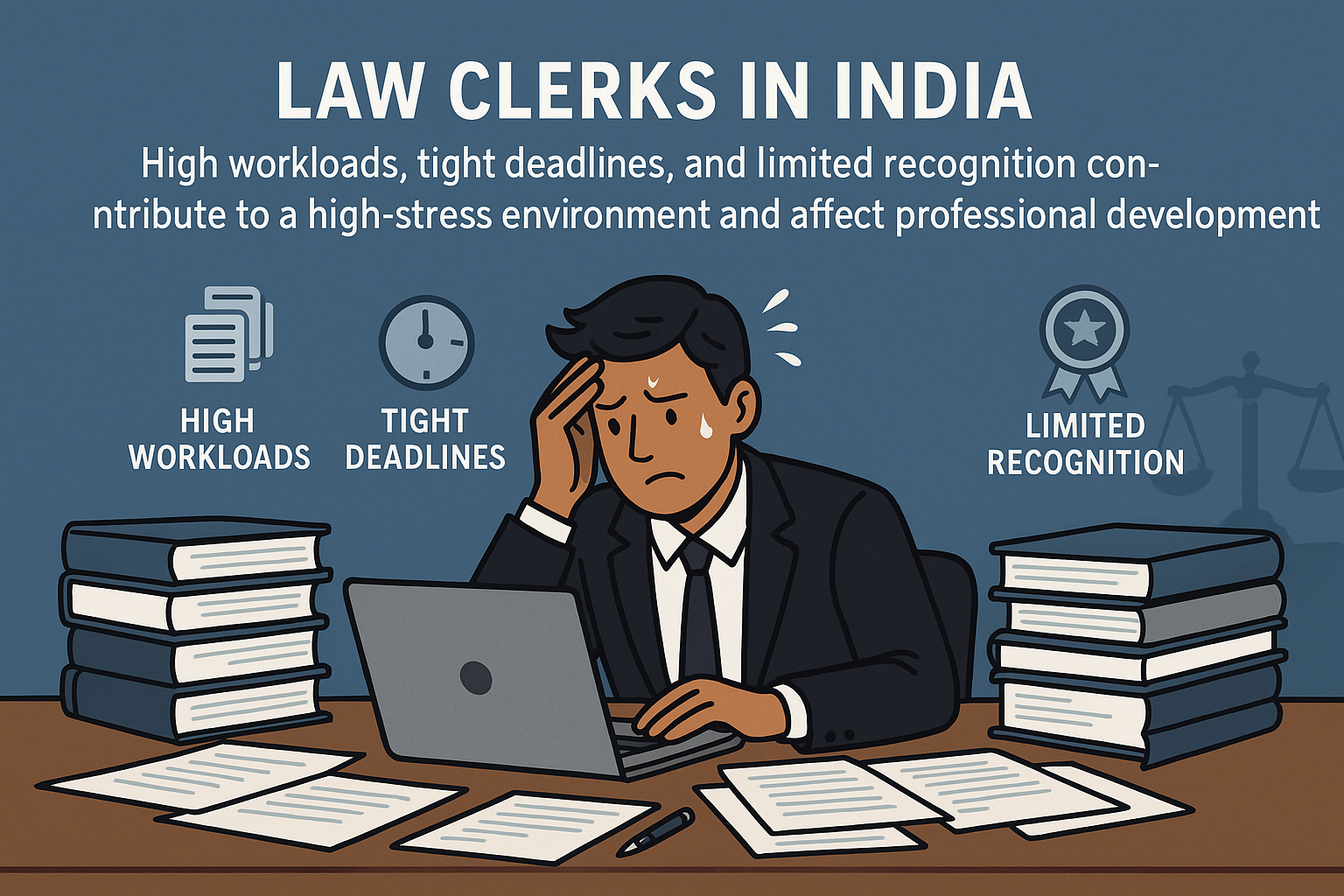
In India, law clerks—who typically assist judges, senior advocates, and legal firms—often face a highly demanding work environment. Their responsibilities include legal research, drafting briefs, managing case files, and coordinating with multiple legal stakeholders under stringent timelines. Despite the critical role they play in the functioning of courts and legal institutions, law clerks often receive limited formal training, career development opportunities, or public recognition. This lack of structural support results in burnout, reduced job satisfaction, and stunted career growth.
Moreover, their contributions are frequently overshadowed by those of senior legal professionals, and their efforts go unacknowledged in official judgments or media. Additionally, the absence of standardized tools for research, time tracking, document collaboration, and performance metrics adds to operational inefficiencies. The legal sector in India is still evolving technologically, and many clerks rely on outdated systems that hinder productivity and add to the cognitive load.
Solving this issue requires a tailored product that boosts productivity, ensures proper workflow management, and enables clerks to build a stronger professional identity. Such a solution should also be scalable and sensitive to the nuances of India’s legal infrastructure.
Pain Points
- Work Overload – Clerks often handle more cases and documentation than feasible within working hours, leading to burnout.
- Lack of Recognition – Their contributions to legal drafts and judgments are rarely credited or publicly acknowledged.
- Limited Career Pathways – Few defined roles or upward mobility beyond temporary clerkships exist.
- Poor Knowledge Sharing – No standard repository or platform exists for sharing templates, insights, or case strategies.
- Manual Workflows – Research and documentation often rely on outdated paper-based or fragmented digital systems.
- Lack of Feedback Mechanism – Infrequent or informal feedback from supervisors hinders professional growth.
- Skill Mismatch – Gap between academic legal education and practical work requirements leads to inefficiencies.
- Time Pressure – Tight deadlines and case volume lead to compromised quality and high stress.
- Lack of Mentorship – Absence of structured mentorship hampers learning and network development.
- Inefficient Collaboration – Multiple communication channels without central tracking causes delays and miscommunication.
Stakeholders and Roles
- Law Clerks – Primary users who face the core issues of workload and recognition.
- Judges – Supervise and rely on clerks for research and documentation.
- Senior Advocates / Lawyers – Assign and evaluate work, indirectly affecting career growth.
- Legal Institutions – Employ clerks and can enforce workflow and technology solutions.
- Law Schools – Serve as a feeder system and potential platforms for training.
- Clients – Indirectly affected by clerk efficiency and case preparation.
- HR/Recruiters – Evaluate clerks’ performance and manage career paths.
- Legal Tech Startups – Potential partners for platform integration.
- Government Bodies – Regulate the legal profession and employment standards.
- Media/Legal Publications – Can influence recognition and awareness of the clerks’ role.
Major Offerings by Competitors
- AI-Powered Legal Research: Tools that expedite case law research and analysis.
- Document Automation: Platforms that automate the drafting and review of legal documents.
- Multilingual Support: Services catering to India’s diverse linguistic landscape.
- Contract Lifecycle Management: Solutions that manage contracts from creation to execution.
- Legal Consultation Platforms: Connecting clients with legal professionals for advice and services.
- Case Law Visualization: Tools that provide graphical representations of legal precedents.
- Workflow Automation: Systems that streamline legal processes and task management.
- Compliance Tracking: Features that monitor and ensure adherence to legal regulations.
- E-Discovery Tools: Platforms that assist in the electronic discovery process during litigation.
- Performance Analytics: Metrics and analytics to assess legal operations and productivity.
Market Maturity & Gaps
India’s legal tech market has moved from early-stage experimentation to a growing and structured phase. With over 800 startups in the space and a market valuation nearing USD 385 million (as of 2020), the sector has matured significantly in terms of:
- Legal awareness and acceptance: Courts and law firms are increasingly open to using tech for case management and legal documentation.
- AI and ML adoption: Platforms like Jhana.ai and CaseMine are using AI for research, signaling deeper technological integration.
- Investment traction: Startups are securing multi-million dollar seed and Series A rounds, indicating investor confidence.
Despite the market’s evolution, several key gaps persist, especially for law clerks
- Clerk-Specific Tools: No end-to-end platform addresses law clerks’ unique workflow, learning needs, and recognition challenges.
- Recognition Ecosystem: No digital system exists to log, endorse, or share law clerk contributions across institutions.
- Mentorship Matching: No structured matching between senior legal professionals and junior clerks exists.
Product Vision
Citeturn envisions a transformative platform tailored to empower law clerks in India, blending legal workflow automation, real-time collaboration, and professional recognition. At its core, the product addresses the unique challenges law clerks face—ranging from overwhelming workloads to the absence of structured mentorship and limited visibility in legal careers.
The product will serve as a digital workspace where clerks can conduct legal research using AI-assisted tools, draft documents collaboratively with senior advocates or judges, and manage their case tasks through integrated dashboards. It will also introduce an innovative “Clerk Portfolio” feature—automatically organizing completed work, feedback, and milestones into a verified, shareable digital resume. Recognition modules will enable tagging by supervisors, case credit logs, and institutional endorsements.
Through integrations with law schools and legal institutions, Citeturn will embed training modules, real-world assignments, and internship-to-job transition pathways. An intuitive interface, enriched with native-language options and mobile-first design, ensures accessibility across user bases.
This platform won’t just reduce stress and increase productivity—it will reposition law clerks as essential, recognized contributors within the judicial ecosystem. With scalable architecture, Citeturn aims to become India’s leading digital platform for junior legal professionals, laying the foundation for a more efficient and inclusive legal sector.
USE CASES
1. AI-Assisted Legal Research
Law clerks often spend significant time sifting through vast legal databases to find relevant case laws and statutes. An AI-powered tool can expedite this process by providing accurate and contextually relevant information, thereby reducing research time and increasing efficiency.
2. Collaborative Document Drafting
Drafting legal documents often requires input from multiple stakeholders. A collaborative platform allows simultaneous editing, commenting, and version control, ensuring that all parties are aligned and reducing the chances of miscommunication.
3. Task Management Dashboard
Managing multiple tasks across various cases can be overwhelming. A task management dashboard provides a clear overview of pending, ongoing, and completed tasks, helping clerks prioritize and manage their workload effectively.
4. Performance Analytics
Understanding performance trends helps in identifying areas of improvement and recognizing top performers. Analytics can provide insights into task completion rates, accuracy, and efficiency, facilitating informed feedback and career development discussions.
5. Mentorship Matching
Mentorship can significantly impact a clerk’s professional growth. A matching system that considers areas of interest, career goals, and expertise can foster meaningful mentor-mentee relationships, promoting knowledge sharing and guidance.
6. Recognition and Badging System
Recognizing accomplishments boosts morale and motivation. A digital badging system can highlight specific achievements, such as completing a significant case or mastering a new skill, and can be showcased in professional profiles.
7. Integrated Learning Modules
Continuous learning is vital in the legal field. Integrating educational modules, such as courses, webinars, and articles, can help clerks stay updated and bridge the gap between academic knowledge and practical application.
Summary
Law clerks in India, though crucial to the legal ecosystem, often face systemic neglect in terms of workload management, recognition, and professional development. They serve as the research and drafting backbone for judges and senior advocates but are burdened with unrealistic deadlines, inefficient workflows, and a lack of structured feedback. The legal profession’s slow adoption of technology has only amplified their challenges.
To address this, Citeturn proposes a comprehensive platform specifically tailored to the Indian legal environment. Through an AI-powered research assistant, real-time collaboration tools, task dashboards, and a recognition framework, the platform aims to streamline work, reduce stress, and enhance visibility for law clerks. With integrations to law schools and court systems, the platform will also provide mentorship matching, professional analytics, and continuous learning modules.
Our competition research indicates a maturing legal tech market in India with startups like Jhana.ai and LegalKart already making waves. However, none offer a focused solution for clerks. Citeturn’s strength in legal workflows and institutional relationships gives it a unique advantage. With an estimated revenue potential of ₹8 crore by year 5, and a targeted beta launch in November 2025, the product vision is both feasible and scalable. This initiative not only empowers law clerks but also strengthens the judicial process as a whole.