
Problem Statement
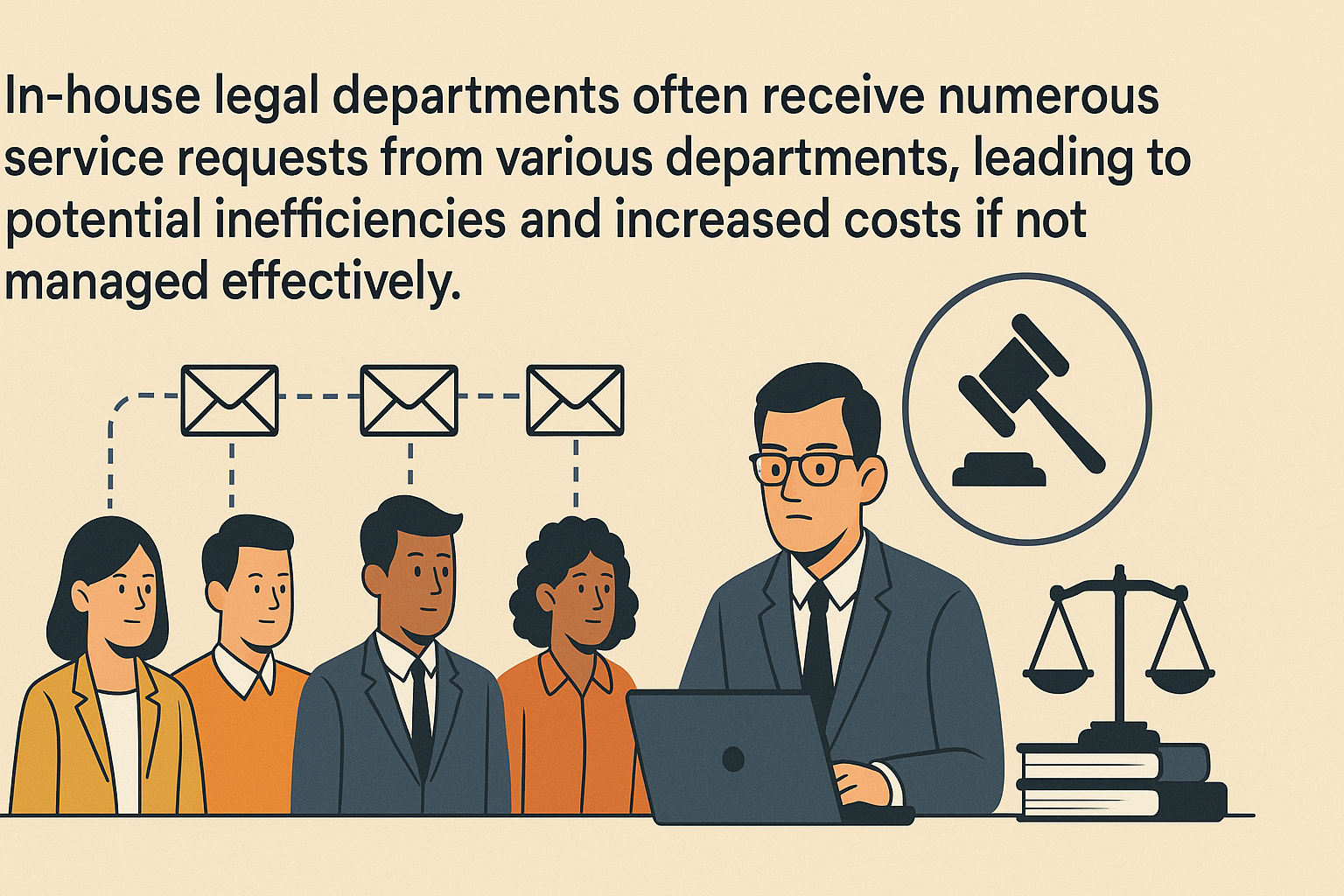
In-house legal departments within organizations frequently serve as the central point for managing legal compliance, contracts, regulatory issues, and risk assessments. However, these departments often face a barrage of service requests from multiple internal teams such as sales, HR, procurement, finance, and operations. These requests are often unstructured, lack prioritization, and come via various channels like email, messaging apps, or informal conversations. This fragmented request intake process creates inefficiencies in tracking, processing, and resolving legal tasks. It becomes difficult to measure team productivity, allocate resources, and ensure timely compliance with legal and regulatory obligations.
The lack of a centralized system leads to missed deadlines, inconsistent legal advice, increased reliance on external counsel (raising legal costs), and reduced satisfaction for internal clients. Legal teams struggle to demonstrate their value through analytics or KPIs due to the absence of structured data. This scenario calls for a structured, automated legal service request platform tailored for in-house teams that can intake, triage, track, and report on requests efficiently—enhancing visibility, transparency, and accountability across departments.
Pain Points
- Unstructured Requests: Legal teams receive service requests via scattered channels like email and chat, leading to tracking and prioritization issues.
- Lack of Prioritization: No system to distinguish between urgent and low-priority tasks causes delays and frustration.
- Manual Tracking: Legal teams often use spreadsheets or emails, resulting in oversight and duplication.
- No Workflow Automation: Approvals and updates are manual, consuming time and increasing the risk of human error.
- Inability to Measure Performance: No analytics or dashboards to demonstrate the legal team’s efficiency or workload.
- High External Counsel Dependency: Inefficiencies internally often lead to costly outsourcing of legal work.
- Compliance Risks: Incomplete tracking or delayed responses may result in regulatory non-compliance.
- User Frustration: Departments requesting legal help experience delays and poor communication.
- Lack of Visibility: Leadership can’t easily assess legal task statuses or team capacity.
- Onboarding New Legal Staff: Difficult knowledge transfer due to absence of centralized, historical data on requests.
Key Competitors
- Clio: A Canadian legal tech company offering cloud-based software for legal professionals. Clio has experienced significant growth, securing a $900 million Series F funding round in July 2023, bringing its total funding to approximately $1.3 billion.
- Agiloft: Specializes in contract lifecycle management and business process management software. Agiloft secured a $45 million growth equity investment from FTV Capital in June 2019.
- Litera: Provides integrated tools designed to manage legal workflows, secure collaboration, and organize firm knowledge. Litera’s software is used by over 2.3 million legal professionals.
- Lexzur: Offers a comprehensive solution for in-house legal teams, including matter management, document management, task management, and contract lifecycle management.
- Smartsheet Legal Service Request Manager: A solution that streamlines legal service requests, enabling self-service across the organization and providing automated notifications, dashboards, and reporting.
Market Maturity
The legal tech market is experiencing rapid growth, with significant investments indicating a mature and competitive landscape. Companies are increasingly adopting technology to streamline legal operations, manage contracts, and improve efficiency.
Major Offerings by Competitors
- Clio: Cloud-based legal practice management, client intake, billing, and payments.
- Agiloft: Contract lifecycle management, workflow automation, and business process management.
- Litera: Document drafting, proofreading, transaction management, and legal analytics.Wikipedia
- Lexzur: Matter management, document management, task management, contract lifecycle management, and collaboration tools.
- Smartsheet Legal Service Request Manager: Legal service request management, automated workflows, dashboards, and reporting.Smartsheet
Gaps
Despite available tools, many legal teams still grapple with:
- Fragmented communication across departments.
- Lack of request triaging based on urgency and impact.
- Inadequate integration with tools like email, Slack, or Teams.
- Limited customization for internal legal workflows.
- Poor user experience for non-legal stakeholders submitting requests.
Product Vision
Our product aims to revolutionize how in-house legal departments handle internal service requests. We envision a centralized, AI-enabled platform designed specifically for legal teams to receive, triage, manage, and resolve service requests from across the organization. This system will act as the “legal front door”—a structured intake portal that captures all necessary information upfront and routes requests through smart workflows based on priority, department, and risk level.
The platform will offer customizable forms for different types of legal work—contract reviews, policy consultations, compliance checks, etc.—ensuring all necessary data is captured from the start. Integrated collaboration tools will allow stakeholders and legal staff to communicate within each request, eliminating long email threads. Legal teams can assign, track, and escalate tasks through an intuitive dashboard, with built-in SLA tracking and deadline reminders.
Advanced analytics will provide leaders with actionable insights into workload, turnaround times, and common request types, aiding in resource planning and performance reporting. Importantly, the platform will be designed to integrate easily with enterprise communication tools and document repositories like Slack, Microsoft Teams, SharePoint, and Docusign.
Ultimately, this product will reduce inefficiencies, cut external legal costs, improve compliance, and elevate the perceived value of the legal team within the organization.
Top 10 Use Cases:
- Contract Review Request Management
- Compliance Question Routing
- NDA Generation Automation
- Employment Legal Query Handling
- IP Protection Requests
- Procurement Contract Review
- Document Repository Integration
- Legal Performance Dashboard
- Self-Serve Legal FAQ
- Task Prioritization via AI
1. Use Case: Contract Review Request Management
- Short Info: Centralized intake and triaging of contract review requests from internal departments.
- Reference: Pain Point #1, Vision, Clio/Lexzur features.
- Stakeholders: Legal team, Sales, Procurement, Compliance Officer.
- Elaboration:
Internal teams often send contracts via email without standard format or necessary context. This use case will streamline the intake of contracts through a dynamic form that captures details such as contract value, counterparty, deadlines, and risk level. Requests are triaged based on predefined rules and routed to appropriate legal personnel. Real-time dashboards and notifications track progress. Integrated document comparison and commenting tools enhance review efficiency. - Requirements:
- Custom contract intake form
- Risk-based triaging engine
- Task assignment engine
- SLA tracking
- Commenting/collaboration tools
- Version control
- Document upload
- Approval workflow
- Real-time dashboard
- Audit trail
2. Use Case: Compliance Query Routing
- Short Info: Structured intake and escalation of compliance-related questions.
- Reference: Pain Point #7, Vision, Agiloft features.
- Stakeholders: Legal, Compliance, HR, Operations.
- Elaboration:
Compliance queries such as regulatory clarification or internal audit responses are often untracked. This feature enables employees to submit queries through a categorized portal. AI tagging and routing ensure the query reaches the correct SME. Escalation paths ensure unresolved issues are surfaced before compliance deadlines. - Requirements:
- Compliance query intake form
- Categorization engine
- Query routing logic
- Notification system
- Resolution timer
- User feedback loop
- Escalation matrix
- Dashboard for compliance team
- FAQ auto-suggestions
- Archival of resolved queries
3. Use Case: NDA Generation Automation
- Short Info: Auto-generation of Non-Disclosure Agreements through a self-service portal.
- Reference: Vision, Smartsheet, Lexzur features.
- Stakeholders: Legal, Sales, HR, Procurement.
- Elaboration:
A self-serve tool allows employees to generate NDAs by answering a few guided questions. The system auto-fills templates, inserts clauses based on deal context, and sends for internal and external signatures via integrated e-signature tools like Docusign. - Requirements:
- Template library
- Smart questionnaire
- Clause insertion rules
- PDF generation
- E-signature integration
- Approval triggers
- Version tracking
- Usage logs
- Auto-archival
- Searchable NDA repository
4. Use Case: Employment Legal Query Handling
- Short Info: Handles queries related to employment law, policy, or terminations.
- Reference: Pain Point #8, Vision.
- Stakeholders: HR, Legal.
- Elaboration:
HR submits issues like employee disputes, policy interpretation, or documentation requests via a structured intake portal. Based on the topic, it is assigned to relevant counsel. Includes checklists for terminations or disciplinary actions and ensures timely documentation and compliance. - Requirements:
- Employment query intake form
- Topic-based routing
- HR-Legal chat window
- Preloaded response templates
- Checklist builder
- Attachments support
- SLA tracking
- HR data integration
- Resolution status indicator
- Escalation and feedback
5. Use Case: Legal Task Prioritization via AI
- Short Info: Intelligent prioritization of legal tasks based on impact and urgency.
- Reference: Pain Point #2, Vision.
- Stakeholders: Legal team, Requesting departments.
- Elaboration:
An AI engine analyzes metadata (e.g., deadline, department, risk) to suggest priority levels. Legal staff can manually adjust priorities. This helps ensure urgent tasks don’t get buried under low-impact items. - Requirements:
- Metadata extraction
- AI-based scoring
- Manual override
- Visual priority tags
- User-defined rules
- Historical task learning
- SLA visualization
- Real-time alerts
- Dashboard prioritization view
- Performance analytics
Summary
In-house legal departments today face a surge of service requests from various internal teams—ranging from contract reviews and compliance checks to employment queries and procurement validations. These requests typically arrive through fragmented channels like emails, chats, and verbal communication, leading to inefficiencies, delays, and lack of accountability. Legal teams struggle to prioritize tasks, track workloads, and provide measurable insights to executive leadership. Moreover, the absence of structured workflows increases reliance on external counsel, inflating costs and complicating compliance efforts.
To solve this, we envision a centralized legal request management platform designed specifically for in-house legal teams. The product will enable structured request intake through customizable forms, automated triaging based on urgency and legal risk, and seamless tracking of task status. By integrating with enterprise tools like Slack, Teams, and Docusign, the platform will fit naturally into existing work ecosystems. Additionally, real-time dashboards and AI-driven insights will help legal leaders optimize resource allocation, measure performance, and elevate the department’s strategic value.
Extensive competitive analysis reveals solutions like Clio, Agiloft, and Lexzur offer partial answers but often lack deep customization or integration. Our product aims to bridge that gap by offering a truly configurable, user-friendly experience tailored for legal operations.