
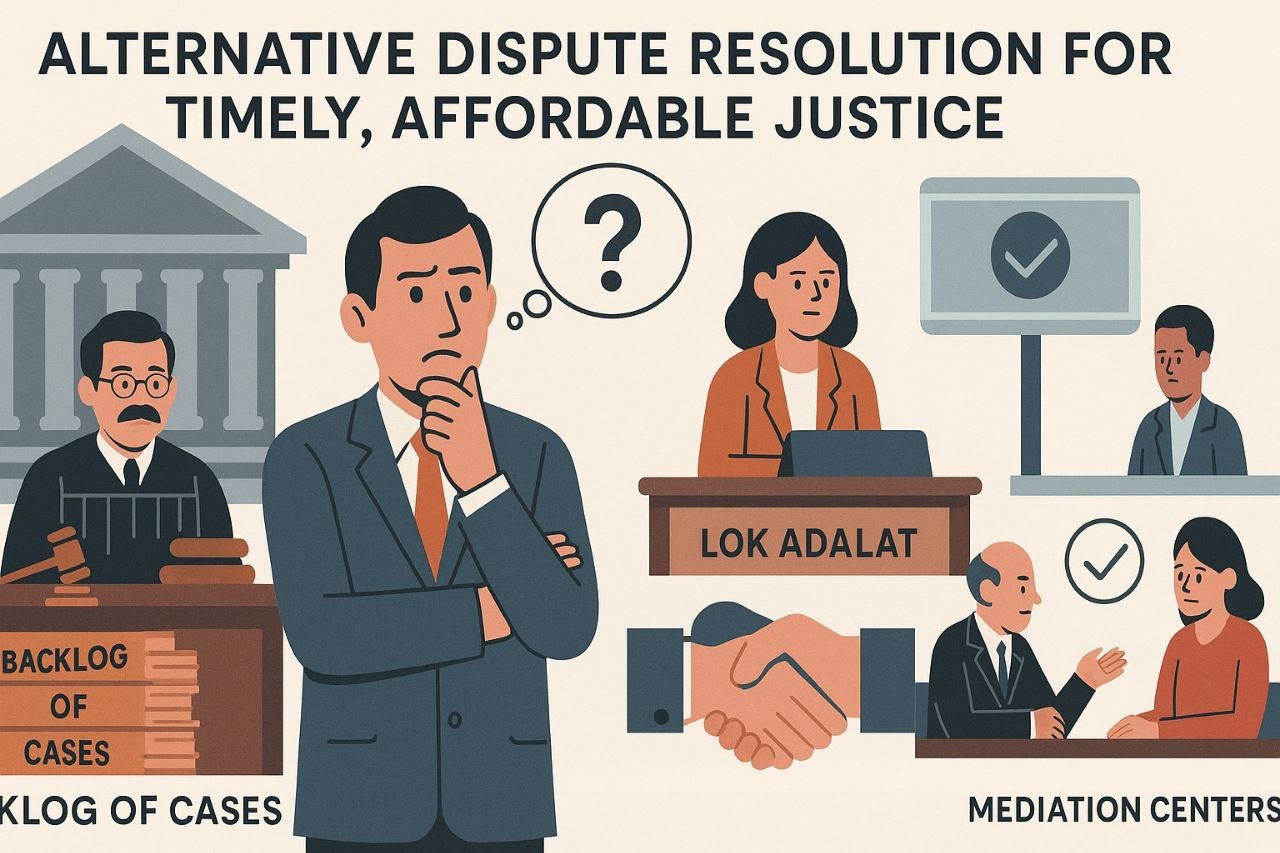
While traditional courts in India continue to grapple with a massive backlog of cases, alternative dispute resolution (ADR) mechanisms like Lok Adalats and mediation centers present a significant opportunity to offer timely, affordable justice. Lok Adalats provide binding decisions in a single day, while mediation centers encourage voluntary settlements that avoid adversarial trials. Despite these advantages, a majority of citizens and even many legal practitioners remain unaware or skeptical about their effectiveness. Concerns about neutrality, authority of outcomes, and a lack of formal education about these processes hinder trust. Consequently, people default to formal litigation, further exacerbating delays in an already burdened judicial system. The current ADR systems, though established, lack sufficient outreach, technology-driven platforms, and user-friendly engagement tools that can build public confidence and facilitate greater usage. Addressing these issues can potentially revolutionize access to justice, reduce pressure on courts, and provide citizens with quicker, more satisfying resolutions to their disputes.
Stakeholders with their Roles
- General Public: Users who could potentially resolve disputes faster.
- Lawyers: Advisors who could recommend ADR but often push formal litigation.
- Mediators and Arbitrators: Professionals who run mediation processes.
- Judiciary (Courts & Judges): Indirect beneficiaries from reduced case loads.
- Government Agencies: Entities promoting faster dispute redressal.
- Legal Aid Organizations: NGOs promoting legal literacy.
- ADR Centers: Institutions conducting Lok Adalats, mediation sessions.
- Technology Providers: Companies (like us) building platforms for ADR.
- Academia/Researchers: Studying the impact of ADR.
- Media: Helping spread awareness.
Pain Points
- Lack of Awareness: Majority of the public unaware that Lok Adalats or mediation centers exist.
- Low Trust: Citizens perceive ADR mechanisms as unofficial or “less serious.”
- Limited Accessibility: Physical ADR centers mostly in urban areas; rural population left out.
- Inconsistent Quality: Varied experiences depending on mediator competence.
- Poor Digital Presence: Most ADR institutions lack user-friendly, informative websites or apps.
- Lawyers’ Bias: Many lawyers prefer lengthy court cases for higher fees.
- Confusion Over Binding Nature: People fear that ADR decisions won’t be legally enforceable.
- Limited Government Promotion: ADR mechanisms not actively endorsed in public campaigns.
- Social Stigma: Settling disputes outside court perceived as “admitting guilt” in some communities.
- Complex Enrollment Process: Current ADR process to register a dispute is manual and tedious.
Key Competitors
Several companies are actively addressing the pain points in India’s Alternative Dispute Resolution (ADR) landscape:
- Sama: A Bengaluru-based legal tech startup, Sama has resolved over 3.5 million disputes online, offering cost-effective and efficient solutions for civil disputes .
- CADRE ODR: An AI-driven platform that recently secured $200,000 in pre-Series A funding to enhance its dispute resolution services, aiming to resolve cases within 45-60 days .
- Presolv360: Offers hybrid models of negotiation, mediation, and arbitration, utilizing technology to streamline dispute resolution processes .
- WeVaad: Provides online dispute resolution services, focusing on making ADR accessible and efficient for users across India.
- Jupitice: Aims to promote private digital courts specifically for ADR cases, enhancing the ODR mechanism through digitalization .
Gaps in Current Solutions
Despite the advancements, certain gaps persist:
- Awareness and Trust: Many citizens remain unaware or skeptical of ADR mechanisms, leading to underutilization.
- Accessibility: Rural and remote areas often lack access to ADR services, highlighting the need for broader outreach.
- Standardization: There is a lack of standardized procedures and quality assurance across different ADR platforms.
Product Vision
At NyayaSetu Technologies Pvt Ltd, we envision a future where justice is not only accessible but also trusted by every citizen, irrespective of geography, education, or economic status. Our mission is to democratize dispute resolution through a digital platform that simplifies, educates, and accelerates the use of Lok Adalats, mediation, and arbitration mechanisms.
Our platform will act as an intuitive one-stop portal offering online case filing, mediator matchmaking, real-time dispute tracking, and digital agreements. Through strong public campaigns, vernacular language support, mobile accessibility, and partnerships with legal aid organizations, we aim to bridge the trust and awareness gaps that currently plague the ADR ecosystem.
Artificial Intelligence (AI) will ensure dispute categorization and mediator allocation are unbiased and efficient, while blockchain-backed digital signatures will reinforce the binding nature of settlements. For rural users, we will introduce “NyayaSathi Centers” — physical kiosks operated by trained facilitators to bridge digital literacy challenges.
By 2027, NyayaSetu targets to facilitate at least 2 million dispute resolutions annually, resulting in saving billions in court costs and reducing case backlogs substantially.
Through innovation, empathy, and empowerment, NyayaSetu will not just complement the judiciary — it will redefine access to justice in India.
Use Cases
- Online Case Filing: Users can submit cases via mobile app/web, choosing mediation or Lok Adalat.
- Mediator Matchmaking: AI-driven system matches best mediator based on dispute type and history.
- Virtual Mediation Rooms: Secure video rooms for mediation sessions.
- Smart Settlement Drafting: Auto-drafted settlement agreements with legal enforceability.
- Dispute Status Tracker: Real-time tracking of the case progress.
- Awareness Campaigns: Digital marketing and community events to promote ADR awareness.
- Multi-Language Support: Full platform available in at least 10 Indian languages.
- Local Kiosks: “NyayaSathi Centers” for semi-urban/rural onboarding.
- Blockchain Contracts: Settlement agreements stored securely on blockchain.
- Integrated Feedback Mechanism: Ratings for mediators and overall process.
Summary of Overall Research
India’s legal system is facing a crisis of delays, with millions of cases pending across formal courts. While Alternative Dispute Resolution (ADR) mechanisms like Lok Adalats and mediation centers offer cost-effective and timely solutions, their usage remains minimal due to public unawareness, trust issues, and accessibility gaps. Our company, NyayaSetu Technologies Pvt Ltd, envisions a robust, scalable digital platform to bridge these gaps by empowering users, enabling mediators, and supporting judiciary decongestion.
Through extensive research, we identified 10 core pain points affecting stakeholders such as the general public, mediators, lawyers, judiciary, and government bodies. Our product vision addresses these gaps through innovative use cases including AI-based mediator matchmaking, real-time dispute tracking, blockchain-secured agreements, virtual mediation rooms, and physical kiosks for rural users.
Competition research revealed key players like Sama and Presolv360, but also underscored unmet needs in rural coverage, trust-building, and legal literacy. Innovations like AI, blockchain, and DPI integration are helping shift momentum in ADR tech. With the government’s push via the Mediation Act, 2023, and growing investments in legal-tech, NyayaSetu is uniquely poised to lead the ADR transformation.
By 2026, our platform aims to resolve over two million disputes annually. We will restore citizen faith in quick and fair justice, redefining how India accesses its right to resolution.