
Problem Statement
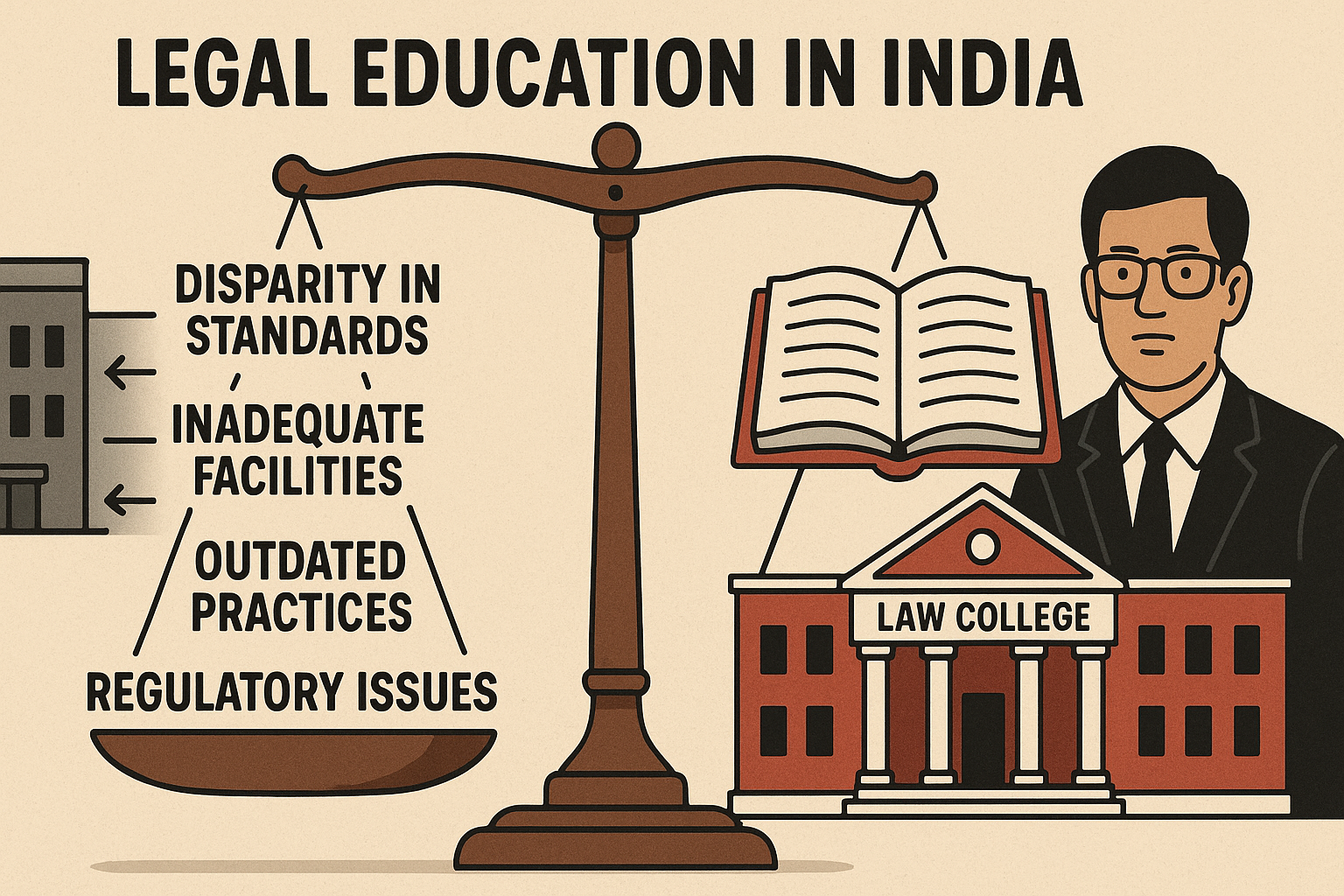
Legal education in India is facing a serious and persistent challenge of maintaining uniformity and high-quality standards across a diverse range of law colleges. Despite being under the regulatory purview of the Bar Council of India (BCI), a wide disparity exists in terms of infrastructure, faculty competence, teaching methodologies, and curriculum frameworks among different law schools. This discrepancy not only affects the competence of future legal practitioners but also undermines the credibility of the Indian legal education system on a global scale.
Many colleges lack proper facilities such as libraries, moot court halls, and digital access, which are essential for holistic legal training. Moreover, faculty qualifications and student-to-teacher ratios differ greatly, leading to varied learning experiences. The syllabus and teaching practices are outdated in many institutions and not aligned with modern legal developments or global standards. The involvement of multiple regulatory bodies and lack of stakeholder collaboration further deepen these challenges, causing confusion and inefficiencies in standard enforcement. The ultimate outcome is an unequal playing field for students graduating from different colleges, resulting in varying professional capabilities and employability.
Pain Points
- Inconsistent Infrastructure: Law colleges have unequal physical and digital learning resources, impacting student exposure and practical skills.
- Faculty Quality Disparity: Lack of standardized qualifications and uneven training quality among law educators.
- Outdated Curriculum: Many colleges still teach outdated legal principles, failing to align with global and modern developments.
- Regulatory Overlap: Multiple agencies involved in oversight create confusion and compliance gaps.
- Poor Industry Integration: Limited internship and placement support disconnect students from real-world legal practice.
- Limited Research Opportunities: Inadequate facilities and mentoring for legal research dampen academic growth.
- Geographical Inequity: Rural and tier-2 law colleges lag far behind urban counterparts in quality and exposure.
- Lack of Student-Centric Evaluation: Traditional rote-based exams overlook critical thinking and advocacy skills.
- Faculty Shortages: Many institutions operate without sufficient, qualified teaching staff.
- Global Irrelevance: Graduates often struggle to meet international legal standards due to lack of comparative and cross-border legal studies.
Innovations in the Industry
- AI-powered case search tools.
- Digital moot court simulators.
- Blockchain for certification verification.
- Virtual internships and remote learning platforms.
- Adaptive testing for law exams.
- Legal document automation.
- Natural Language Processing for legal research.
- Smart contract platforms.
- E-learning platforms offering bar exam training.
- Legal education gamification.
Key Competition
Several established institutions and startups are working to modernize legal education, but their focus is often fragmented — either on premium-level education or niche online training. The key competitors are:
- National Law Universities (NLUs) — Elite law schools offering rigorous legal training with high infrastructure and academic standards, yet limited in number and accessibility.
- Jindal Global Law School (JGLS) — A private university setting global benchmarks in legal education through modern faculty, international collaborations, and research.
- Symbiosis Law School (SLS) — Offers structured law programs with a blend of practical and theoretical education, but limited reach across India.
- LawSikho — An ed-tech startup providing online legal skills training and certifications aimed at both students and professionals.
- iPleaders — Focuses on online practical legal courses and mentorship, especially for industry-relevant skills beyond traditional law curricula.
While these competitors partially address quality, research, and employability, none offer an end-to-end regulation, monitoring, and curriculum standardization platform for law colleges nationwide, leaving BCI in a unique leadership position.
Market Maturity
India’s legal education market is at a moderate stage of maturity — especially in metropolitan regions and among top-tier institutions. Premier law schools like National Law Universities (NLUs), JGLS, and Symbiosis have introduced structured, high-quality legal education that includes modern infrastructure, globally aligned curriculums, research, and industry partnerships.
However, the broader market — especially in Tier 2 and Tier 3 cities — remains underdeveloped. Hundreds of regional law colleges operate with inconsistent infrastructure, outdated syllabi, underqualified faculty, and minimal exposure to practical legal experience.
This uneven landscape shows that while legal education has seen growth in prestige institutions, the mass-market ecosystem is still largely fragmented, under-regulated, and lacks technological adoption. There’s significant room for scalable platforms like LEQAP that can elevate the baseline quality across India’s law colleges, especially in rural and semi-urban pockets.
Gaps
- Standardization Void:
No existing platform ensures real-time curriculum uniformity or monitors whether institutions implement updated legal frameworks. - Regulatory Fragmentation:
Multiple agencies like UGC, State Councils, and Universities have overlapping, often inconsistent regulations, confusing stakeholders. - Faculty Development Deficit:
No national-level continuous education or skill validation system ensures faculty stay updated on evolving legal principles. - Digital Audit Shortfall:
Current auditing of law colleges is manual, irregular, and lacks real-time transparency. - Lack of Unified Student Portfolios:
Students have no standardized, verifiable portfolio of skills, internships, and achievements. - Industry Integration Weakness:
No platform bridges the gap between academia and legal practice (law firms, courts, corporate legal teams). - Research Underutilization:
Legal research remains siloed, with little support for modern methodologies or digital collaboration. - Global Competency Gap:
Most students are trained for national scenarios, with little emphasis on international law systems or global market readiness. - Data-driven Policy Formation Missing:
Regulatory decisions are rarely based on comprehensive, real-time data about law colleges’ operational realities. - Scalability of Education Reform:
Solutions like LawSikho and iPleaders address individuals, not systemic reform across the entire educational ecosystem.
Product Vision
The Bar Council of India envisions the creation of a comprehensive Legal Education Quality Assurance Platform (LEQAP) — a centralized digital ecosystem designed to standardize and elevate the quality of legal education across India. This platform will not only regulate infrastructure benchmarks but also offer a continuously evolving national curriculum, faculty assessment tools, accreditation monitoring, and virtual learning enhancements for students.
Through LEQAP, the BCI will implement real-time audits of law schools, enable automated reporting of compliance status, and maintain a national faculty registry linked to performance metrics and ongoing legal education credits. Colleges will gain access to a centralized knowledge hub containing modern syllabi, updated legal case repositories, teaching guides, and AI-powered tools for curriculum planning.
Students will directly benefit through verified internships, cross-institutional collaboration, and exposure to standardized academic content, ensuring uniform professional readiness across regions. The platform will bridge the gap between regulatory oversight and classroom realities, creating an ecosystem where regulatory decisions are backed by transparent data and real-time feedback.
LEQAP will help the BCI reshape the future of legal education by making India’s law graduates globally competitive, socially aware, and ethically grounded. It will address the uneven distribution of quality across urban and rural legal institutions, ensure faculty development, modernize curricula in sync with global legal practices, and offer a path toward meaningful industry collaboration and research excellence.
Use Case
I’ve analyzed the Vision, Pain Points, and Competition — here are the top 15 detailed use cases for the Legal Education Quality Assurance Platform (LEQAP):
1.Use Case: Infrastructure Compliance Automation
- Short Info: Auto-verification and audit of college infrastructure against BCI guidelines using digital checklists and AI.
- Reference: Pain Point #1, Vision, Competition with regulatory gaps.
- Stakeholders: BCI Inspectors, Law College Admins.
- Elaboration: This feature will allow law colleges to submit real-time data and visual proof of their physical and digital infrastructure, which the BCI can audit remotely. Using AI and geo-tagged data, the system flags non-compliance issues, suggests remedial actions, and streamlines the manual inspection process. This ensures rural and urban colleges meet the same infrastructure standards.
- Top 10 Functional Requirements:
- Geo-tagged photo uploads.
- Automated checklist matching.
- AI-generated compliance reports.
- Notification system for non-compliance.
- Annual audit scheduling.
- Document repository.
- Real-time dashboard for BCI.
- Integration with college portals.
- PDF/Excel export of reports.
- Red flag alert system.
2.Use Case: National Curriculum Repository
- Short Info: Centralized distribution of standardized legal syllabi.
- Reference: Pain Point #3, Vision.
- Stakeholders: BCI Academic Committees, College Academic Deans.
- Elaboration: A cloud-based library will offer colleges the latest curriculum updates, ensuring all institutions follow a uniform syllabus designed by experts. Curriculum versions will have semantic version control, and automated alerts will be sent for any changes. It guarantees students across the country are exposed to the same foundational legal education.
- Top 10 Functional Requirements:
- Central syllabus upload system.
- Version control mechanism.
- Role-based access.
- Audit trails.
- Automated change notifications.
- PDF export capability.
- Curriculum download logs.
- API for LMS integration.
- Suggestion and feedback tool.
- Multi-language support.
3.Use Case: Faculty Qualification & Performance Tracker
- Short Info: National-level database for faculty qualification and teaching outcomes.
- Reference: Pain Point #2, Vision.
- Stakeholders: BCI, Law Colleges, Faculty.
- Elaboration: A centralized system will track qualifications, publications, and teaching assessments of faculty across all law colleges. This system encourages faculty to meet minimum qualification standards and engage in continuous professional development to maintain their teaching licenses, thus improving overall education quality.
- Top 10 Functional Requirements:
- Faculty registration portal.
- Qualification document upload.
- Peer review system.
- Teaching assessment records.
- Automated expiry reminders.
- Continuous Legal Education credit tracker.
- Publications repository.
- Cross-institution faculty transfer log.
- Misconduct flagging system.
- Annual certification renewal.
4.Use Case: AI-powered Legal Research Library
- Short Info: Central AI-assisted research platform for students and faculty.
- Reference: Pain Point #6, Vision, Competition.
- Stakeholders: Law Students, Faculty.
- Elaboration: An AI-backed library that pulls from legal databases like SCC, Manupatra, and court archives to offer keyword and semantic-based research. Students can access case summaries, statutes, and international law references, making legal research more efficient and consistent across institutions.
- Top 10 Functional Requirements:
- Semantic keyword search.
- Citation export tools.
- Court judgment database.
- Law journal access.
- User search history.
- Topic-based recommendations.
- Case summary generator.
- Bookmarking system.
- Legal document annotation.
- Integration with college LMS.
5.Use Case: Virtual Internship and Placement Portal
- Short Info: Centralized hub for verified internships and placements.
- Reference: Pain Point #5, Vision.
- Stakeholders: Law Students, Law Firms, Corporate Legal Departments.
- Elaboration: A secure, centralized platform for law students to apply for internships and jobs, linked to verified law firms, companies, and courts. BCI validates listings to ensure quality exposure, while companies gain access to standardized candidate profiles.
- Top 10 Functional Requirements:
- Internship listing system.
- Verified employer registry.
- Digital resume builder.
- Application tracking.
- Recommendation engine.
- Interview scheduling.
- Automated feedback collection.
- Employer rating system.
- Offer letter repository.
- Alumni tracking system.
Perfect! Here’s the continuation with the remaining 10 detailed use cases for the Legal Education Quality Assurance Platform (LEQAP):
6.Use Case: National Law College Ranking System
- Short Info: Data-driven ranking framework for law schools based on standardized metrics.
- Reference: Pain Point #1, Vision.
- Stakeholders: Law Students, Parents, Colleges, BCI.
- Elaboration: LEQAP will automatically rank law colleges based on parameters like infrastructure, faculty quality, student satisfaction, bar exam success rates, and placement records. Rankings will be dynamic, data-backed, and publicly available, pushing colleges to maintain high standards to remain competitive.
- Top 10 Functional Requirements:
- Dynamic ranking engine.
- Weighted metric configuration.
- Automated data feeds from colleges.
- User-friendly ranking dashboards.
- Historical ranking comparisons.
- Regional, national, global views.
- Stakeholder feedback integration.
- Fraud detection and correction mechanisms.
- Ranking badges for marketing.
- Annual reports and publications.
7.Use Case: Regulatory Collaboration Suite
- Short Info: A communication and documentation tool for multi-agency regulatory coordination.
- Reference: Pain Point #4, Vision.
- Stakeholders: BCI, UGC, State Governments.
- Elaboration: An integrated workspace where regulatory bodies like BCI, UGC, and state councils can collaborate, share audit reports, and co-develop policy guidelines. The suite will reduce administrative lag and eliminate redundant inspections and policy overlaps.
- Top 10 Functional Requirements:
- Document collaboration tools.
- Cross-agency permission control.
- Policy version control.
- Meeting scheduling.
- Digital signature integration.
- Real-time notification system.
- Role-based dashboards.
- Action tracker.
- Secure file storage.
- Analytics for agency performance.
8.Use Case: Student Grievance Redressal System
- Short Info: Central platform for students to report and resolve academic and administrative grievances.
- Reference: Pain Point #8, Vision.
- Stakeholders: Students, BCI, Colleges.
- Elaboration: A structured, transparent grievance portal where students can report issues like faculty misconduct, resource shortages, or unfair grading. The system assigns cases, tracks resolution timeframes, and provides data to improve compliance across institutions.
- Top 10 Functional Requirements:
- Ticket creation with category tagging.
- Confidentiality protection.
- Auto-routing to relevant authority.
- Case status tracking.
- Feedback and resolution survey.
- Escalation matrix.
- Response time analytics.
- Student notification system.
- Whistleblower protection.
- Case archive with search.
9.Use Case: Faculty Continuous Learning Credits System
- Short Info: Tracks and mandates faculty participation in legal education workshops and courses.
- Reference: Pain Point #2, Vision.
- Stakeholders: Faculty, BCI, Law Colleges.
- Elaboration: Faculty must accumulate learning credits by attending workshops, publishing papers, or completing new certifications. This ensures that teachers stay updated with new laws, international trends, and evolving teaching methodologies.
- Top 10 Functional Requirements:
- Workshop enrollment portal.
- Credit scoring algorithm.
- Digital certificate issuance.
- Calendar sync for upcoming events.
- Leaderboards.
- Attendance verification via QR or GPS.
- API integration for external courses.
- Historical transcript generation.
- Expiry alerts for recertification.
- Compliance report generation.
10.Use Case: AI-Powered Curriculum Gap Analysis Tool
- Short Info: Detects gaps in law college curricula compared to global benchmarks.
- Reference: Pain Point #3, Vision.
- Stakeholders: BCI, Academic Boards, Colleges.
- Elaboration: This tool uses machine learning to analyze existing syllabi, comparing them to global best practices, legal tech developments, and case law trends. Recommendations are generated for institutions to update outdated or missing content, ensuring students learn the most relevant material.
- Top 10 Functional Requirements:
- Curriculum upload interface.
- AI gap detection engine.
- Global benchmark library.
- Auto-generated reports.
- Recommendation workflows.
- Export to curriculum templates.
- Faculty review feedback loop.
- Peer comparison module.
- Trend prediction engine.
- Annual audit summaries.
11.Use Case: Student Portfolio & Certification Hub
- Short Info: Consolidated academic and extracurricular record management.
- Reference: Pain Point #5, Vision.
- Stakeholders: Students, Faculty, Employers.
- Elaboration: This hub acts as a legal student’s verified digital resume, storing transcripts, moot court participations, internships, published research, and extracurricular achievements. It simplifies job applications, post-graduate admissions, and cross-border validation.
- Top 10 Functional Requirements:
- Transcript upload and verification.
- Achievement badge system.
- Employer access portals.
- Certification validity tracking.
- Export to PDF/LinkedIn.
- Cross-institution record transfer.
- QR code credential validation.
- Privacy settings.
- Portfolio analytics.
- Digital signature support.
12.Use Case: Virtual Moot Court Simulation
- Short Info: Online, gamified moot court environment for legal practice.
- Reference: Pain Point #6, Vision, Competition.
- Stakeholders: Students, Faculty.
- Elaboration: Students practice argumentation in virtual reality or simulated courtrooms. Judges can review performances, and AI provides immediate feedback on legal reasoning, posture, and speaking clarity. Competitions can also be held online.
- Top 10 Functional Requirements:
- Virtual courtroom interface.
- Judge and student role assignments.
- AI speech analysis.
- Argument timer.
- Automated performance scoring.
- Courtroom scenario templates.
- Real-time feedback.
- Peer review system.
- Historical video archives.
- Live streaming for audience.
13.Use Case: Annual Compliance Certification Engine
- Short Info: Auto-generate legal education compliance certificates.
- Reference: Pain Point #1, Vision.
- Stakeholders: Law Colleges, BCI.
- Elaboration: Colleges upload relevant data to the platform annually, and the system auto-generates compliance certificates based on preset BCI rules. Non-compliant colleges are flagged for audit or remedial action.
- Top 10 Functional Requirements:
- Auto-data extraction.
- Compliance checklist automation.
- Digital certificate issuance.
- Non-compliance notification.
- Audit scheduling.
- Certificate expiration reminders.
- Public certificate repository.
- Role-based access.
- Signature validation.
- Historical audit logs.
14.Use Case: Legal Education Policy Recommendation Engine
- Short Info: AI-powered insights for evolving national education policies.
- Reference: Pain Point #4, Vision.
- Stakeholders: BCI, Policy Makers.
- Elaboration: The platform uses historical data, global trends, and stakeholder feedback to recommend policy changes for legal education reform. This data-backed approach modernizes how regulatory changes are proposed.
- Top 10 Functional Requirements:
- Policy version history.
- Global legal education trend tracking.
- Stakeholder feedback integration.
- AI-based trend prediction.
- Data visualization tools.
- Proposal draft generator.
- Impact simulation reports.
- User voting mechanism.
- Approval workflows.
- Annual policy whitepapers.
15.Use Case: Regional Disparity Heatmap
- Short Info: Visual map highlighting regional gaps in legal education quality.
- Reference: Pain Point #7, Vision.
- Stakeholders: BCI, Colleges, State Governments.
- Elaboration: This feature visualizes data on infrastructure, faculty, placements, and student satisfaction across geographic locations to highlight underserved areas. Policymakers and BCI can prioritize resources and interventions based on these insights.
- Top 10 Functional Requirements:
- Interactive map interface.
- Layer-based data visualization.
- Real-time data sync.
- Geographic filters.
- Exportable reports.
- Trend heatmaps.
- Historical comparison timelines.
- Alert notifications for red zones.
- Resource allocation suggestions.
- Integration with government portals.
Summary
India’s legal education landscape is currently facing an acute crisis of quality and uniformity. Despite the Bar Council of India’s mandate to regulate law colleges, vast disparities in faculty competence, infrastructure, curriculum content, and student readiness continue to exist. These inconsistencies lead to an uneven professional landscape where graduates from different institutions possess wildly differing skills and knowledge.
Our research reveals that the lack of real-time compliance systems, outdated syllabus frameworks, minimal research exposure, poor industry integration, and regional inequities create long-term damage not only to students but also to the legal system itself. Private law colleges and high-profile universities may offer pockets of excellence, but the bulk of India’s legal institutions lag behind, failing to produce globally competitive legal talent.
A well-defined digital ecosystem — the Legal Education Quality Assurance Platform (LEQAP) — emerges as a critical solution. This platform aims to unify regulatory efforts, automate compliance reporting, enable AI-powered curriculum standardization, and facilitate student and faculty development across all Indian law colleges.
LEQAP’s vision is to transform legal education by creating transparency, accountability, and continuous quality enhancement through smart, scalable tools. By doing so, it will not only serve future law professionals but also strengthen India’s legal institutions and improve access to justice for all.